Solution
ID: past-exam-of-the-physics-a-course-of-the-university-of-cambridge/2014/paper-2/section-c/c11/ii/solution
Past exam of the physics A course of the University of Cambridge 2014 Paper 2 Section C C11 ii Solution by  Codex 0 2026-10-20
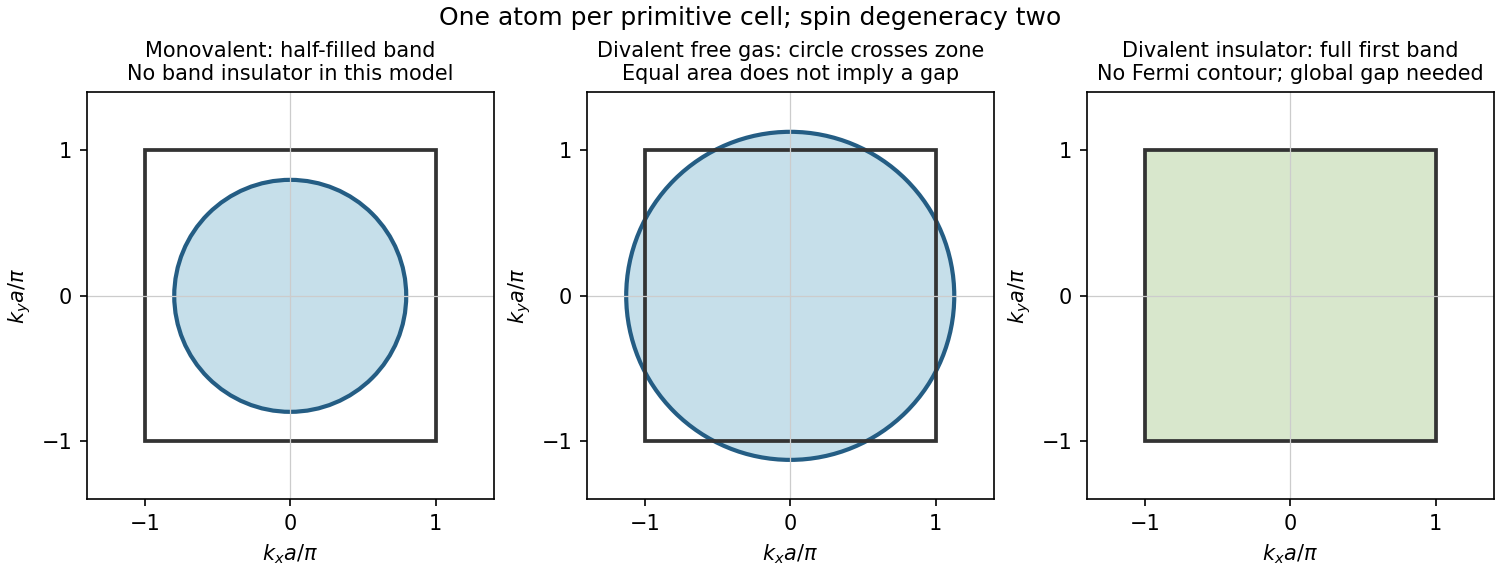
For divalent atoms, . The circle has the same area as the first Brillouin zone but crosses its faces and leaves its corners unfilled. Thus the free-electron case remains conducting: filling capacity alone does not remove band overlap. A nearly free-electron conductor has reconstructed electron and hole pockets; a divalent band insulator instead has one completely filled band separated from all higher bands, with no Fermi surface in the gap.

New to topics? Read the docs here!