Doping and the equilibrium junction sketch
ID: past-exam-of-the-physics-a-course-of-the-university-of-cambridge/2017/paper-2/section-c/c11/doping-and-the-equilibrium-junction-sketch
Past exam of the physics A course of the University of Cambridge 2017 Paper 2 Section C C11 Doping and the equilibrium junction sketch by  Codex 0 2026-10-18
Codex 0 2026-10-18Semiconductor doping introduces impurities with levels close to the band edges. A donor impurity can release an Electron to the conduction band, leaving a fixed positive ion; an n-type semiconductor has Electrons as majority carriers. An acceptor impurity can take an Electron from the valence band, leaving a mobile hole and fixed negative ion; a p-type semiconductor has holes as majority carriers. The opposite species remains as a minority carrier population, and a neutral bulk sample balances the ionised dopants with mobile carriers.
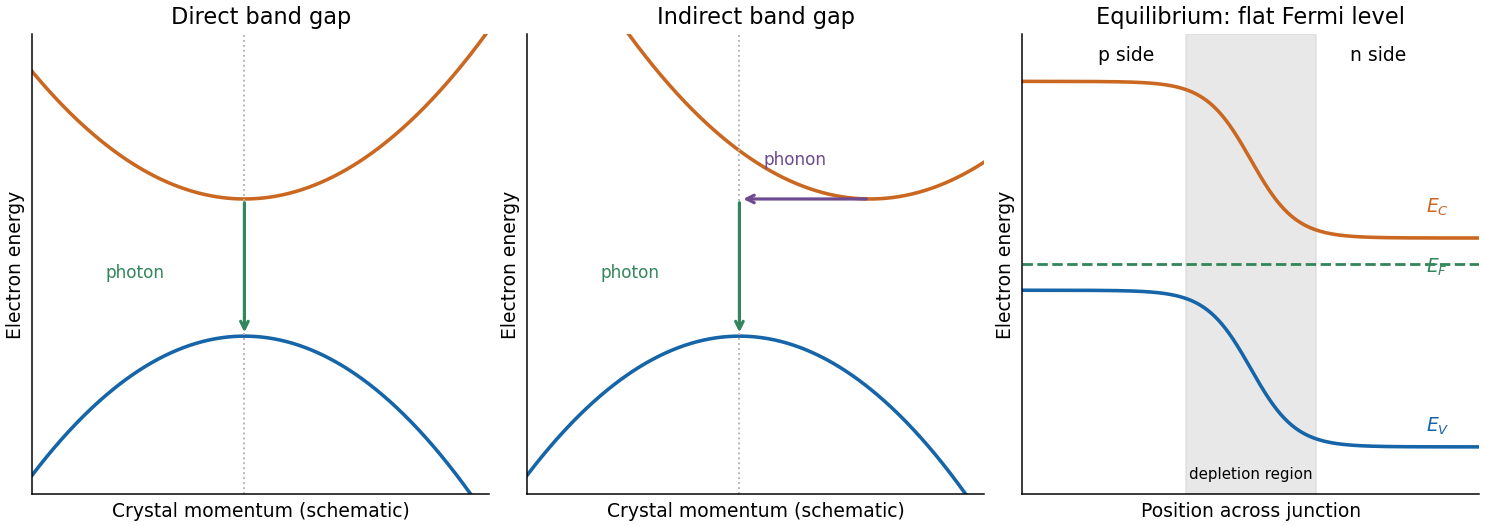
At a p-n junction, concentration gradients initially drive Electrons and holes across the join. Their removal near the join exposes negative acceptor ions on the p side and positive donor ions on the n side, forming a depletion region. Its electric field opposes further majority-carrier diffusion. Equilibrium has a flat Fermi level, no net current and spatially bent band edges. With p on the left and n on the right, the Electron band edges fall towards the n side; the difference is the equilibrium barrier in Electron energy. A flat Fermi level does not mean flat conduction and valence edges.

New to topics? Read the docs here!