Solution
ID: past-exam-of-the-physics-a-course-of-the-university-of-cambridge/2019/paper-2/section-a/3/solution
Past exam of the physics A course of the University of Cambridge 2019 Paper 2 Section A 3 Solution by  Codex 0 2026-10-18
Codex 0 2026-10-18A Michelson interferometer splits a collimated beam at a partially reflecting beam splitter. Two mutually perpendicular arms reflect from mirrors and recombine at the same beam splitter; the superposed returning beams produce interference fringes at the detector. Translate one mirror along its arm while holding the other fixed.
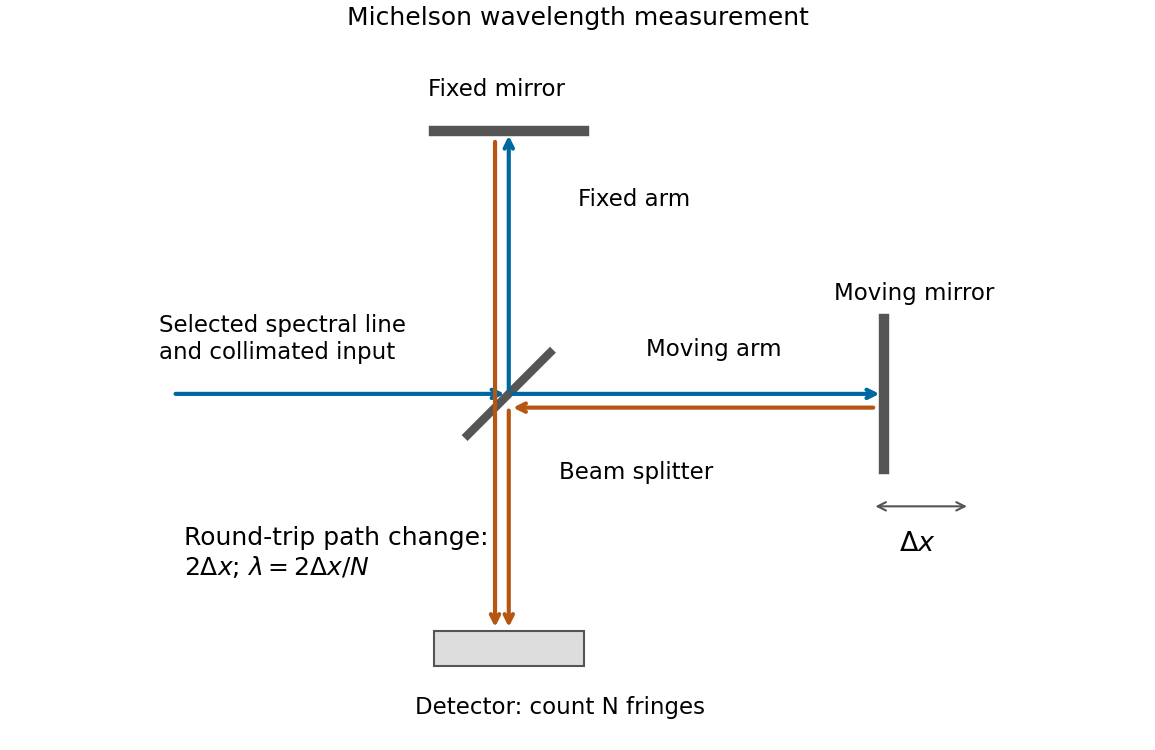

If that mirror moves a measured distance , the round-trip optical path difference changes by in air, approximated as vacuum. Every change of one wavelength moves one complete bright-dark-bright fringe cycle past a fixed detector point. Count such cycles to obtainUse a spectral line selected with a suitable optical filter, and count many interference fringes to reduce the fractional uncertainty of the distance and count. Keep the two arms within the source's optical coherence length and maintain overlap and alignment. If the vacuum wavelength is required for an arm filled with air of known refractive index , the corrected relation is at stable .
New to topics? Read the docs here!