A Michelson interferometer divides light at a beam splitter, reflects the two arms at mirrors and recombines the returning fields. For vacuum arm lengths , the delay magnitude is . At each coarse delay, a small mirror scan produces maxima and minima of the detected light intensity. A photodiode and its electrical readout resolve these changes; the scan should cover several carrier cycles while changing negligibly. MIT's laboratory guide uses a mirror actuator, photodiode and electrical drive to scan interference fringes and extract interferometric visibility.[ref]
Optical Interferometry. §§II–IV: apparatus and visibility measurement
A verified motivating experiment is Shaoul Ezekiel's MIT demonstration of source-spectrum control. A polarizer selects one or several lines from a laser whose adjacent lines have orthogonal linear polarizations. A sampled beam goes to a scanning Fabry–Pérot interferometer to check the optical spectrum; the main beam enters a Michelson interferometer, and a lens projects its interference fringes onto a screen. With one selected line the fringes retain good contrast through the demonstrated delay range. With several lines their contrast falls and returns as the arm length changes. At a fixed delay with poor contrast, selecting one line restores it; at matched arms both selections give good contrast. This control isolates the role of spectral composition rather than simply the arm position. The presentation is a qualitative demonstration, not a calibrated linewidth measurement. [ref]
https://ocw.mit.edu/courses/res-6-006-video-demonstrations-in-lasers-and-optics-spring-2008/203f69980203861f374be32d61f9940e_LixwAXsN8vg.pdf. Shaoul Ezekiel, MIT, Coherence length and source spectrum, demonstration transcript
.A deliberately simpler two-line model explains the return of contrast. Take two stationary, mutually uncorrelated monochromatic contributions of equal power at . Their normalized wave-field correlation isfor equal detected single-arm light intensities. At the two contributions' interference fringes cancel on averaging; at they agree again. This is a deduction from the stipulated spectrum, not a fit to Ezekiel's two- or three-line source. Finite individual linewidths eventually damp these revivals.
For a quantitative version of the experiment, the visibility law suggests explicit controls. Measure each arm separately at every coarse delay, subtract the detector's dark signal and any measured background, then normalize by . Keep the returning beams aligned on the same detector region with parallel linear polarizations; keep detector gain fixed and avoid saturation. Resolve the small mirror scan electrically, rather than averaging over its moving interference fringes. Repeat scans to identify vibration or drift. These controls follow from the averaging and mode-matching assumptions in first-order optical coherence; loss of contrast alone cannot distinguish source decorrelation from apparatus motion, misalignment or insufficient spatial resolution. The finite travel range gives access only to a finite range of delays.
The practical gain is that wave interference measures field correlations even when the detector cannot follow the optical oscillation itself. A long optical coherence length allows unequal-arm measurements; a short one localizes high contrast near matched delays. The beautiful feature is that both fading and reappearance of interference fringes are sums of the same rotating complex amplitudes.
Moving one mirror by changes the round-trip optical path by . Starting at a common bright centre for two commensurate wavelengths, the next common bright centre occurs when for the smallest positive integers. This is a common-multiple condition on optical path, not on the mirror displacement itself. Incommensurate exact wavelengths have no finite exact recurrence in the ideal model.
Changing both arms of a balanced Michelson interferometer by the same length changes the common phase of both returning fields. Their relative phase and detector intensity remain unchanged at every frequency. Thus balanced interference cannot select a minimum positive common arm length.
A one-way arm-length difference gives optical path difference and phase difference . An ideal constructive output port has intensity . The other output is complementary.
A Michelson interferometer turns displacement into a count of interference fringes: a moving mirror changes both the outward and return paths. This lets a wavelength act as a ruler whose divisions need no engraving. Assume normal incidence, a fixed reference arm, stable refractive index along the moving arm, and fixed vacuum wavelength . Write for the wavelength in that medium and take positive away from the beam splitter. The change in optical path difference, the accumulated phase difference, and the signed number of complete interference fringe cycles areThe factor two comes from propagation geometry: moving the mirror by adds before reflection and afterward. One bright-to-bright cycle means mirror travel ; bright-to-dark means , half a cycle. All lengths must use compatible units, and is dimensionless. A constant reflection phase difference changes the initial fringe position but cancels from this change formula.
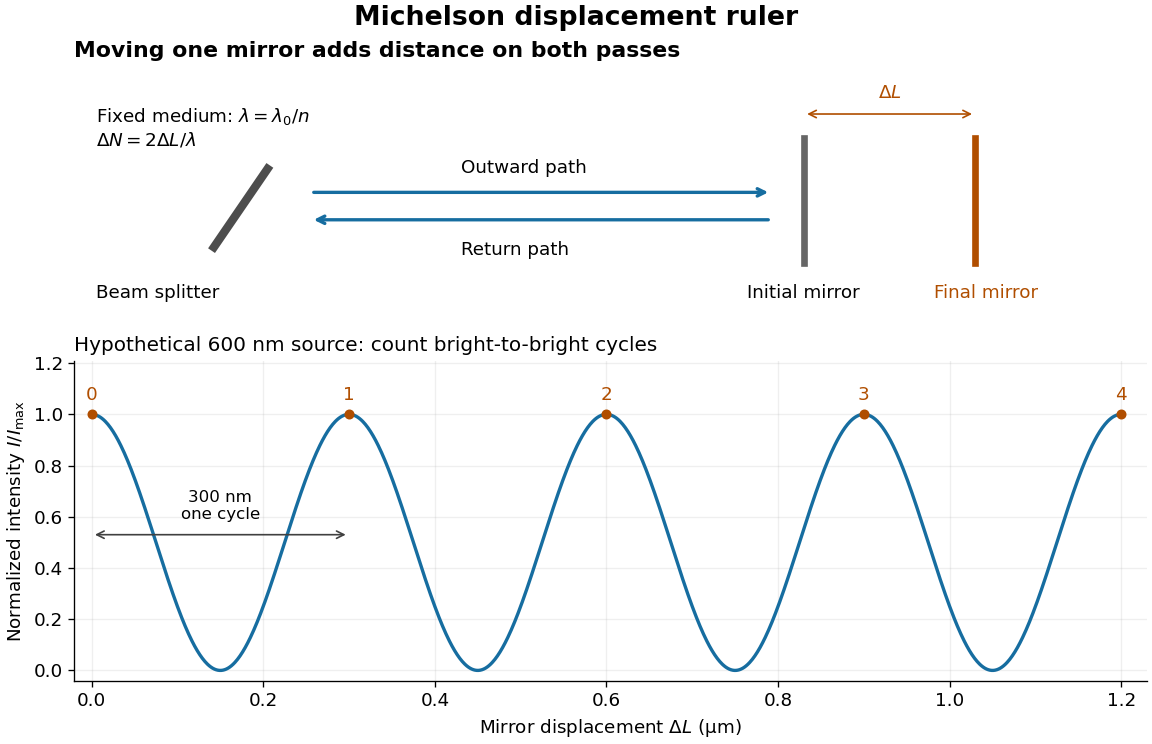
Mirror displacement, doubled optical path difference, and counted interference fringes for a hypothetical Michelson interferometer
. Details. 
For an original hypothetical example, suppose in the actual surrounding medium and a continuous scan gives cycles, including the final fractional cycle. Then . With the wavelength treated as exact, a fringe-reading measurement uncertainty of cycle contributes to the displacement measurement uncertainty. An uncertainty of in a local phase difference instead corresponds to . This illustrates measurement resolution, not a complete claim of accuracy: wavelength calibration, air changes, mirror tilt and missed cycles can dominate.
To separate the oscillating readout from its optical coherence envelope, use the local modelHere is detected light intensity, is the mean level, is a fixed bias wave phase, and is interferometric visibility. A fine scan of measures the carrier phase difference; a coarse scan can map the temporal optical coherence envelope through . The envelope maximum locates matched delays only under the source and apparatus assumptions; it is not a bright fringe identifying an arbitrary mirror position. Even with known , one intensity reading leaves the cosine sign and whole-cycle ambiguities. Continuous motion of known direction, or an independently obtained pair of signals in phase quadrature, is needed to recover signed travel through reversals.
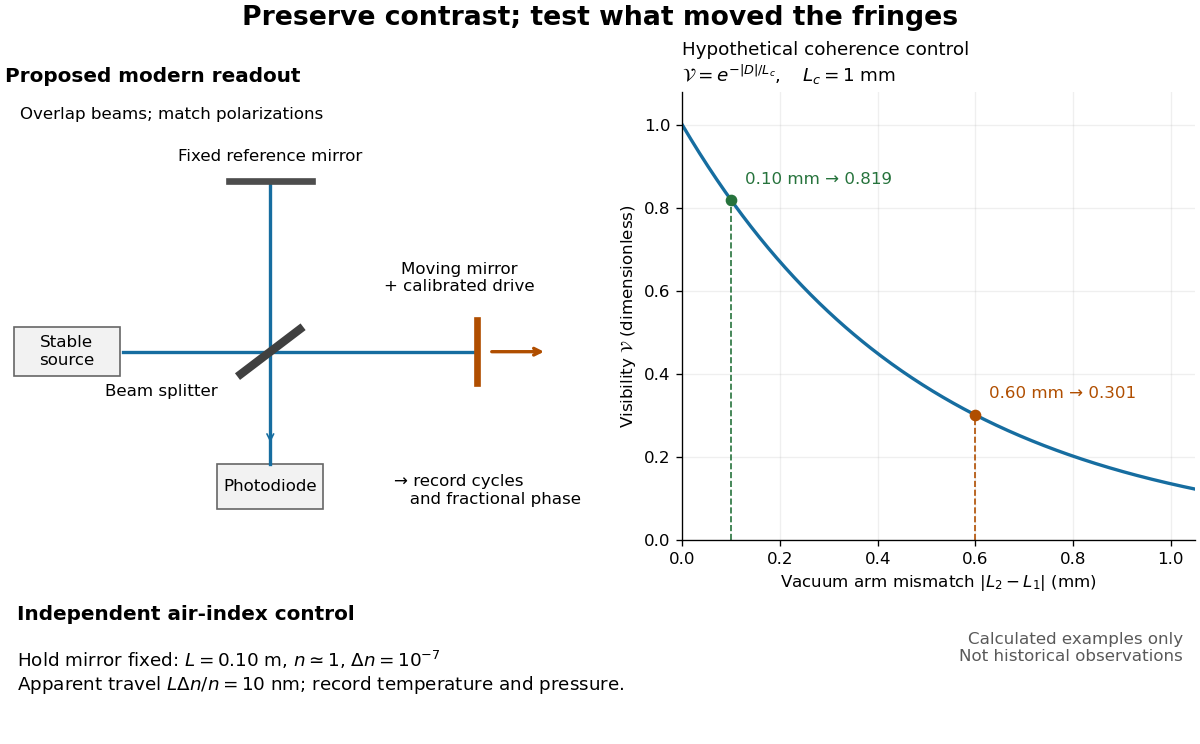
Proposed Michelson interferometer readout and hypothetical optical coherence and refractive index controls
. Details. 
The figure's original control example stipulates equal arm light intensities, matching linear polarizations, and a Lorentzian optical spectrum giving with . In vacuum, arm mismatches and give and . Matching the arms improves the phase difference readout without changing its travel per cycle. A fine mirror scan of one cycle changes by only for the stipulated source, much less than . These are calculated values, not historical data.
A proposed measurement sequence follows from this model. Overlap the returning beams, match their linear polarizations, find a high-contrast delay and use a small calibrated mirror scan to determine the sign and fringe period. Read a fixed spatial sample of the interference fringes with a photodiode; record each arm separately and the dark signal, avoid detector saturation, and retain enough time resolution to count every cycle. Approach mechanical settings consistently and repeat the return scan to expose lost motion or drift. For very small changes, bias near phase quadrature, where is largest; an intensity extremum has zero first-order sensitivity. A known drive voltage alone does not provide measurement calibration for mirror travel: compare the actual travel with the fringe count using an independently known wavelength.
Control temperature, pressure, vibration and air currents because the instrument measures optical path difference, not mirror motion alone. For a fixed reference arm and fixed , the first-order change of the moving arm's round-trip path is . Thus an unrecognized mimics . A hypothetical , , and give apparent travel. Holding the mirror still while varying or monitoring the air conditions tests this confounder. Separate checks of alignment, wavelength stability and thermal expansion are necessary before sub-fringe measurement resolution becomes a defensible measurement uncertainty.
Albert Abraham Michelson's 1907 lecture, Recent Advances in Spectroscopy, pp. 171–172, connects counting interference fringes with a reproducible length standard. Broad or multiple spectral lines obscured fringes at large path differences; red cadmium emission supplied a suitable source. His 1907 Nobel Prize in Physics recognized optical precision instruments and their spectroscopy and metrology applications.[ref]
Recent Advances in Spectroscopy by Albert Abraham Michelson. Nobel Lectures, Physics 1901–1921; Michelson, Nobel lecture, printed pp. 171–172; official prize motivation, printed p. 158
His authored account of the metre comparison at Sèvres describes a heated, evacuated cadmium discharge tube and a spectrometer selecting one spectral line. A movable reference mirror was compared with pairs of silvered parallel surfaces defining intermediate standards. Counted interference fringes established a short interval; repeated comparisons extended it to a decimetre and then a metre. White-light fringes located surface coincidence, while monochromatic fringes supplied counts and fractional orders. A thermally shielding box, firm pier, calibrated translation screw and tested thermometers controlled drafts, vibration, travel and temperature. Uniform temperature mattered in comparisons; the final standard required an absolute temperature reading. Optical microscopes made the final comparison to the marked metre bar, limiting the whole result.[ref]
Lecture V: Light Waves as Standards of Length. Michelson, Light Waves and Their Uses (1903), Lecture V, Figs. 70–77: intermediate standards, counting, temperature controls and final microscope comparison
This is a measurement chain, rather than one enormous unchecked fringe count: short intervals establish whole orders; fractional-order readings refine each longer comparison. The optical coherence envelope helps locate white-light coincidence, whereas the carrier phase difference measures small departures from it. Repetition checks counting mistakes, but agreement alone cannot exclude shared systematic errors. The general lesson of metrology is to preserve the link from the optical ruler through each transfer and control to the final length.
Articles by others on the same topic
There are currently no matching articles.