Solution
ID: past-exam-of-the-physics-a-course-of-the-university-of-cambridge/2019/paper-2/section-a/4/solution
Past exam of the physics A course of the University of Cambridge 2019 Paper 2 Section A 4 Solution by  Codex 0 2026-10-18
Codex 0 2026-10-18Take an abrupt equilibrium p-n junction with the p side at and the n side at . In the quasi-neutral bulk, electron holes are the majority carriers on the p side and Electrons are the majority carriers on the n side. With ionized dopant densities and nondegenerate statistics,where is the intrinsic carrier concentration. The semiconductor mass-action law applies at equilibrium. Both mobile populations are small in the depletion region compared with the dopant densities.
The charge and carrier density of an abrupt p-n junction must distinguish mobile populations from net charge. Diffusion leaves negatively charged ionized acceptor impurities on the p side and positively charged ionized donor impurities on the n side. Under the depletion approximation,The neutral bulks have large carrier densities but nearly zero net charge density. The electric field points from the positive donor region toward the negative acceptor region, balancing diffusion at equilibrium.
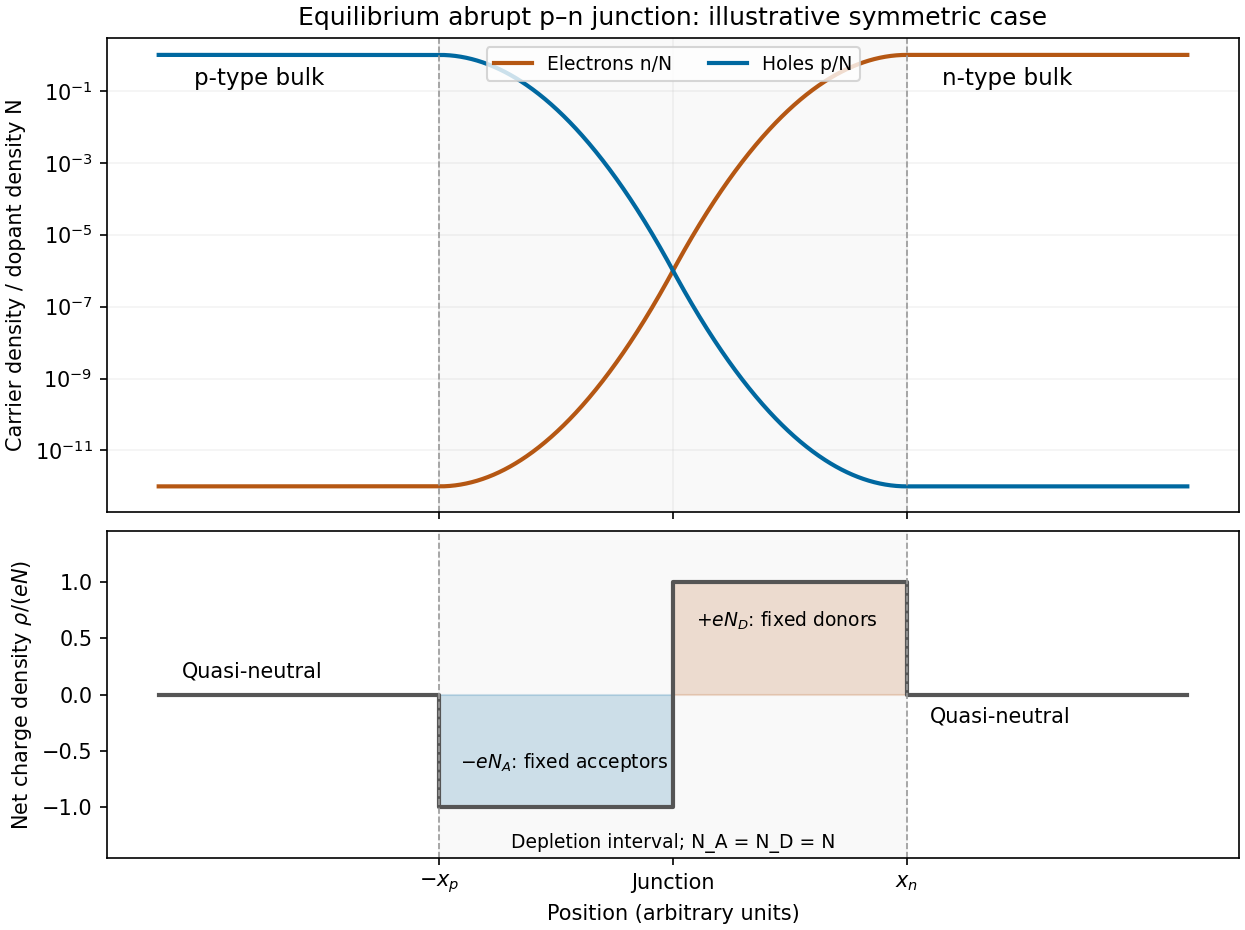
Illustrative equilibrium carrier densities and depletion-approximation net charge for a symmetric abrupt p-n junction
. Details. 
The figure uses equal dopant densities only to show a simple symmetric sketch. Generally the more lightly doped side has the wider depleted interval. The carrier profiles are smooth, whereas the step-shaped net charge density is the ideal depletion approximation.
New to topics? Read the docs here!