Solution
ID: past-exam-of-the-physics-b-course-of-the-university-of-cambridge/2010/paper-2a/section-b/b7/solution
Past exam of the physics B course of the University of Cambridge 2010 Paper 2A Section B B7 Solution by  Codex 0 2026-10-20
Faraday's law for a moving circuit is . The magnetic flux is through a surface bounded by the instantaneous loop, with consistent orientation. For the stationary external field here, the motion supplies the motional electromotive force.
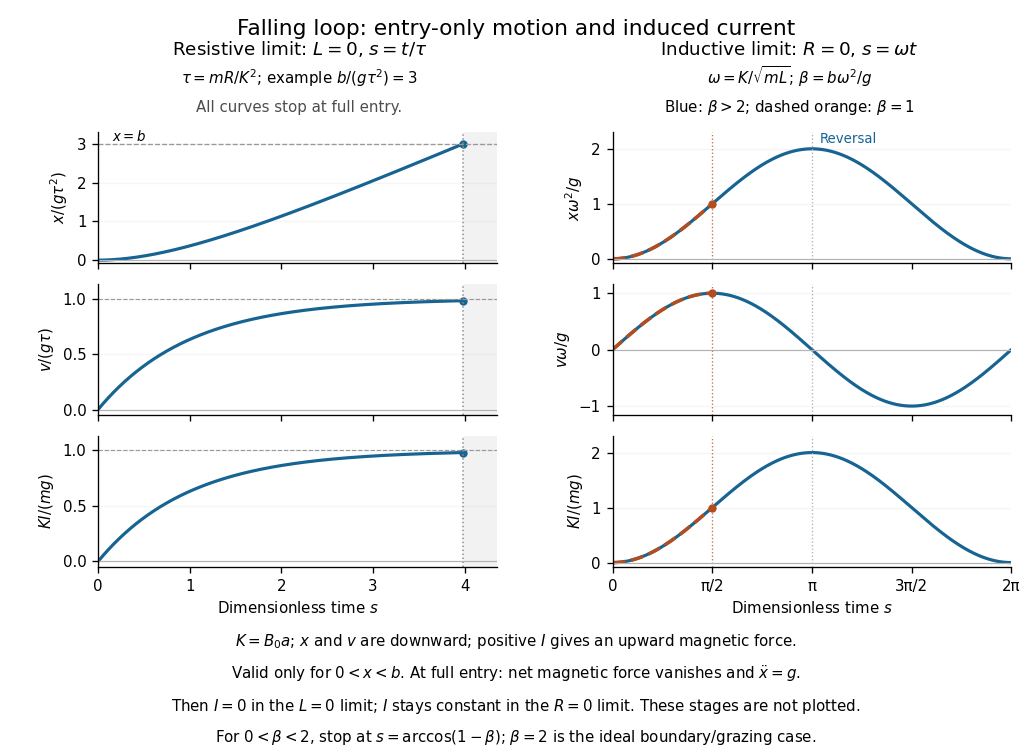
Let be downward penetration of the bottom segment, , and . While , flux grows at rate . Define positive current as the direction whose magnetic force is upward. With negligible self-inductance, andThe resistive magnetic entry of a falling loop givesThe initial acceleration is and the speed approaches if the loop remains partly immersed long enough. Joule heating removes gravitational energy. At the first , both horizontal segments are inside the uniform field: the net flux becomes constant, the net magnetic force vanishes, and this zero-inductance model has thereafter. The subsequent speed increases with acceleration .
For negligible electrical resistance, conservation of total linked flux instead gives in the braking-current convention. Thereforeand the lossless limit of magnetic loop braking yieldsHere energy is stored reversibly in , not dissipated. If , the loop reverses before complete entry and executes the ideal oscillatory motion while straddling the boundary. If , it reaches complete entry on its first descent; thereafter the current is constant, the forces on its two horizontal segments cancel, and it falls with acceleration . The exact grazing case needs care at the ideal discontinuous field boundary. An entry-only sinusoid must not be extrapolated through full immersion.

New to topics? Read the docs here!