Motional electromotive force is the contribution from an electrical conductor moving with local velocity through a magnetic field. The cross product comes from the magnetic part of the Lorentz force. For a straight rod of length , perpendicular to both its velocity and a uniform magnetic field, its magnitude is . The sign depends on the direction of integration along the rod. [ref].
For a computed example, take , velocity to the right, and magnetic field out of the page. The rod lies along . ThenPositive electric charge is driven downward. For an isolated rod after charge separation has equilibrated, inside it, and the electric potential difference is ; the bottom is positive. This open-circuit statement does not imply a sustained electric current.
Close the rod's path with stationary U-shaped rails and an electrical resistance at the left. With out-of-page unit normal, the positive loop direction is counterclockwise, hence upward along the rod. If the rod's horizontal position is , the enclosed area is and the external magnetic flux is . ThusHere the resistive approximation neglects self-inductance. The negative electric current is clockwise, downward along the rod, consistent with the charge-separation calculation and Lenz's law.
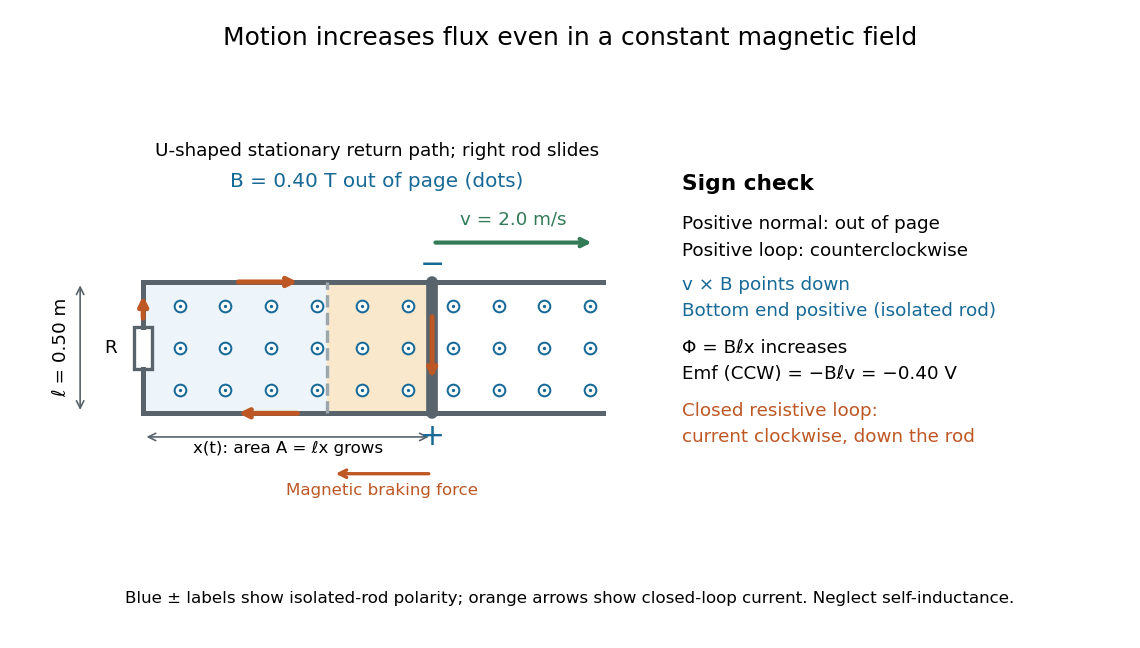

The closed-loop result illustrates why the moving-circuit form of Faraday's law of induction includes motional electromotive force: the magnetic field is constant in time, so the electric field circulation alone would miss this drive. Its mechanical consequence is electromagnetic braking of a sliding rod.
A vertical field linking a conducting loop on an incline contributes flux . For zero resistance and zero initial current, flux conservation gives . The uphill magnetic force component then makes the downhill coordinate oscillate about . Release from first stops at , not at the force-free point . The energy is stored in the inductor, not dissipated.
For positive loop resistance, coupled mechanical and circuit equations relax toward constant sliding speed on sufficiently long rails. The steady current balances the downhill gravitational force, and motional electromotive force balances the resistive voltage. The undamped zero-resistance limit has no relaxation, so its late-time limit is singular.
For laboratory velocity and field , and . Their powers are opposite. The field-dependent guide-reaction power is ; the total ideal radial reaction for bead mass and constant expansion speed additionally contributes the ordinary centripetal term .
A conducting rod sliding on rails separated by in a transverse magnetic field has induced current magnitude when self-inductance is neglected and resistance is . The Lorentz force opposes motion with magnitude , so free motion decays exponentially on the displayed time constant. Joule heating integrates to the rod's lost kinetic energy. Current direction follows the Lenz's law.
For a smoothly moving circuit and a divergence-free magnetic field, the magnetic flux derivative is . The minus sign follows by orienting the swept side surface compatibly with the two spanning surfaces. Combining this transport identity with Faraday's law yields the moving-loop electromotive-force law.
Articles by others on the same topic
There are currently no matching articles.