Solution
ID: past-exam-of-the-physics-b-course-of-the-university-of-cambridge/2012/paper-1/section-b/b6/solution
Past exam of the physics B course of the University of Cambridge 2012 Paper 1 Section B B6 Solution by  Codex 0 2026-10-20
In a charge-free region of homogeneous permittivity, Gauss's law and give Laplace's equation, . Prescribed surface electric potentials specify a Dirichlet problem. Its Uniqueness of the Dirichlet problem permits replacing conductors by fictitious charges outside the physical solution region: a harmonic candidate with the same boundary conditions is the physical solution. For an exterior problem its behaviour at infinity must also be prescribed. For a proof, subtract two candidate potentials to obtain with zero boundary values. Green's first identity gives , so is constant and its boundary value fixes it to zero. Conditions on a normal electric field instead determine a potential only up to an additive constant when the usual compatibility condition holds.
A cylindrical Gaussian surface around an infinite line charge gives . The electric potential difference is thereforeAn isolated infinite line charge has no finite potential zero at infinity. For the opposite pair, however, the logarithmic growth terms cancel and one can choose there. Define and . superposition givesOn ,Thus the circle, and its cylindrical extension, is an equipotential. This is an Apollonius circle: a constant ratio of distances gives a circle rather than a constant distance from either charge.
For the cylinder above the plane, call its centre height and set . The cylinder-plane image charges are at height and at height . Their distances are equal on the grounded plane, while their distance ratio is on the circular surface. The positive fictitious line lies inside the metal, so the exterior is charge-free and Uniqueness of the Dirichlet problem applies. A Gaussian surface enclosing the physical cylinder confirms that its charge per unit length is indeed . Its voltage isThe physical field energy per unit length at fixed cylinder charge is . Differentiate with respect to height, keeping and fixed:The electrostatic attraction per unit length of a cylinder above a plane is downward for either sign of charge. Placing the fictitious line at the cylinder centre would give the wrong answer at this separation. The long-cylinder approximation neglects the ends.
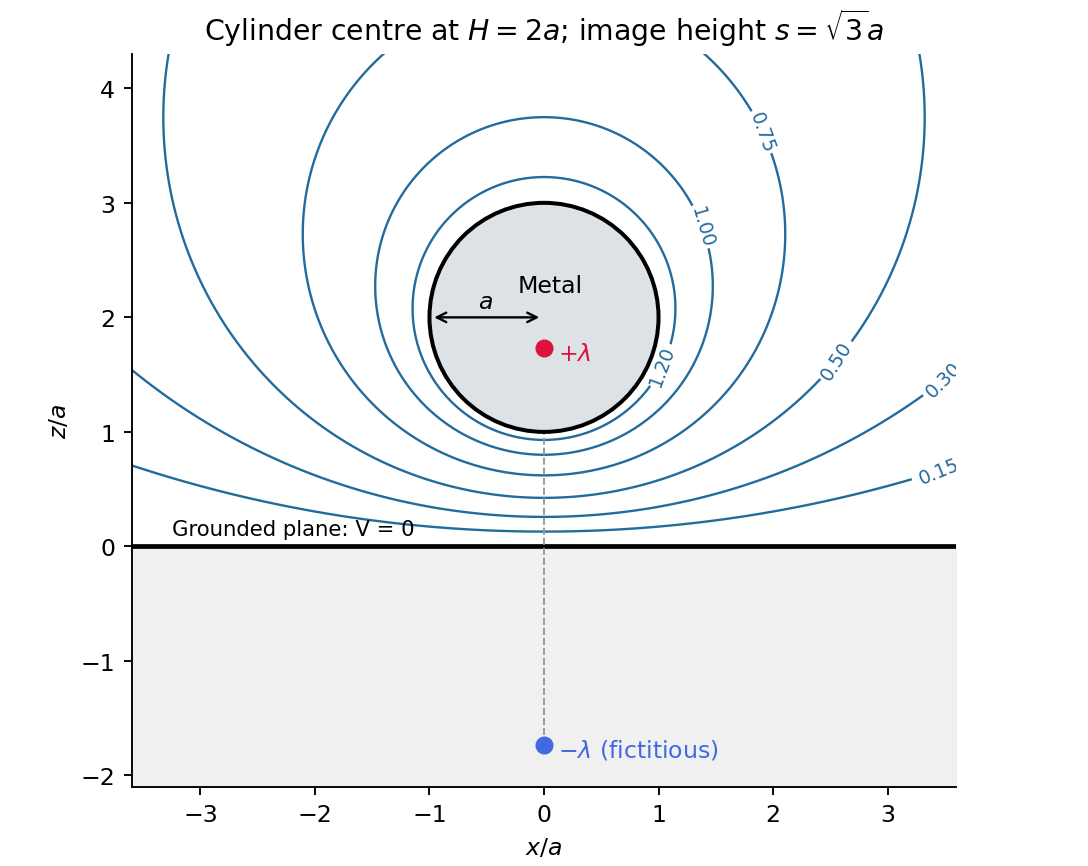
Original cylinder-plane image charges construction and exterior equipotentials
. Details. 
New to topics? Read the docs here!