Solution
ID: past-exam-of-the-physics-b-course-of-the-university-of-cambridge/2018/paper-2/section-a/a5/solution
Past exam of the physics B course of the University of Cambridge 2018 Paper 2 Section A A5 Solution by  Codex 0 2026-10-18
Codex 0 2026-10-18The appropriate quantity to minimize is the energy including exchange of particles with the Electron reservoir, . The occupation of an interacting localized electron level follows fromFor repulsion , the first Electron costs and the second costs . Comparing all three grand energies givesFor attraction , the singly occupied state never minimizes the grand energy. At the crossing of the empty and doubly occupied states, , its grand energy is , while both competing states have zero grand energy. HenceFor the two thresholds coincide at , giving a direct step. At a threshold, distinct occupations are degenerate; zero-temperature minimization alone does not select a unique occupation. A grand canonical ensemble at small positive temperature smooths the steps, withIn particular, the equal-weight empty/pair limit for gives mean occupation one exactly at its crossing; this is not a finite-width singly occupied plateau.
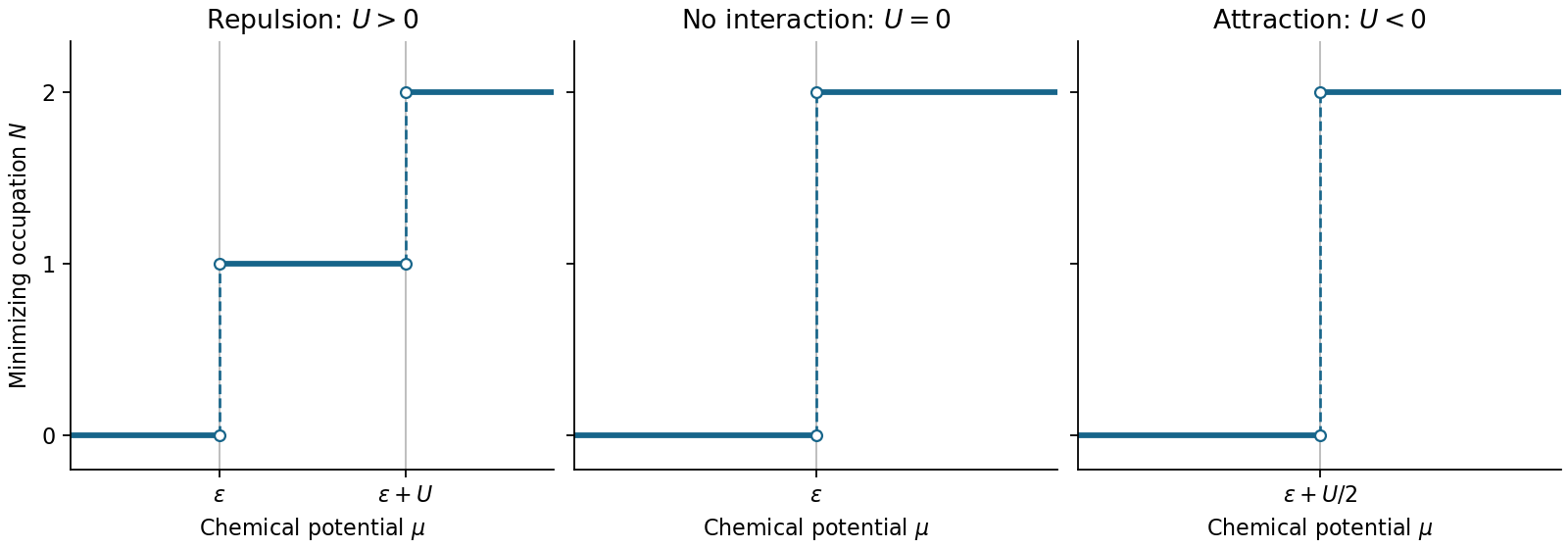
Zero-temperature occupation of a localized impurity level in a crystal with repulsive, zero and attractive interaction
. Original plots of the minimizing occupation away from degeneracy points. Dashed vertical lines mark the chemical potentials at which different occupations have equal grand energy. Their vertical segments indicate jumps, not intermediate stable states. Details.
New to topics? Read the docs here!