Solution
ID: past-exam-of-the-physics-course-of-the-year-1-of-the-natural-sciences-course-of-the-university-of-cambridge/2010/paper-1/section-e/e15/solution
Past exam of the physics course of the year 1 of the natural sciences course of the University of Cambridge 2010 Paper 1 Section E E15 Solution by  Codex 0 2026-10-20
For point masses, Newton's force is attractive along their separation with magnitude . Treat the narrow rod as uniform, with linear mass density ; a mass profile would otherwise be needed beyond total mass and length.
For axial and transverse gravity of a uniform rod, on the axis at , integrating the element force givesdirected toward the rod. On the perpendicular bisector, axial components cancel and transverse components add:At ,Both approach the point-mass force, but , so the axial attraction is slightly larger.
For a circular orbit perpendicular to a uniform rod, rotational symmetry about the rod makes a centred circular orbit possible in its perpendicular-bisector plane. With , centrifugal balance givesFor , it is Keplerian, . For rod thickness , the force approximates that of an infinite line and , a flat speed limit rather than a divergence.
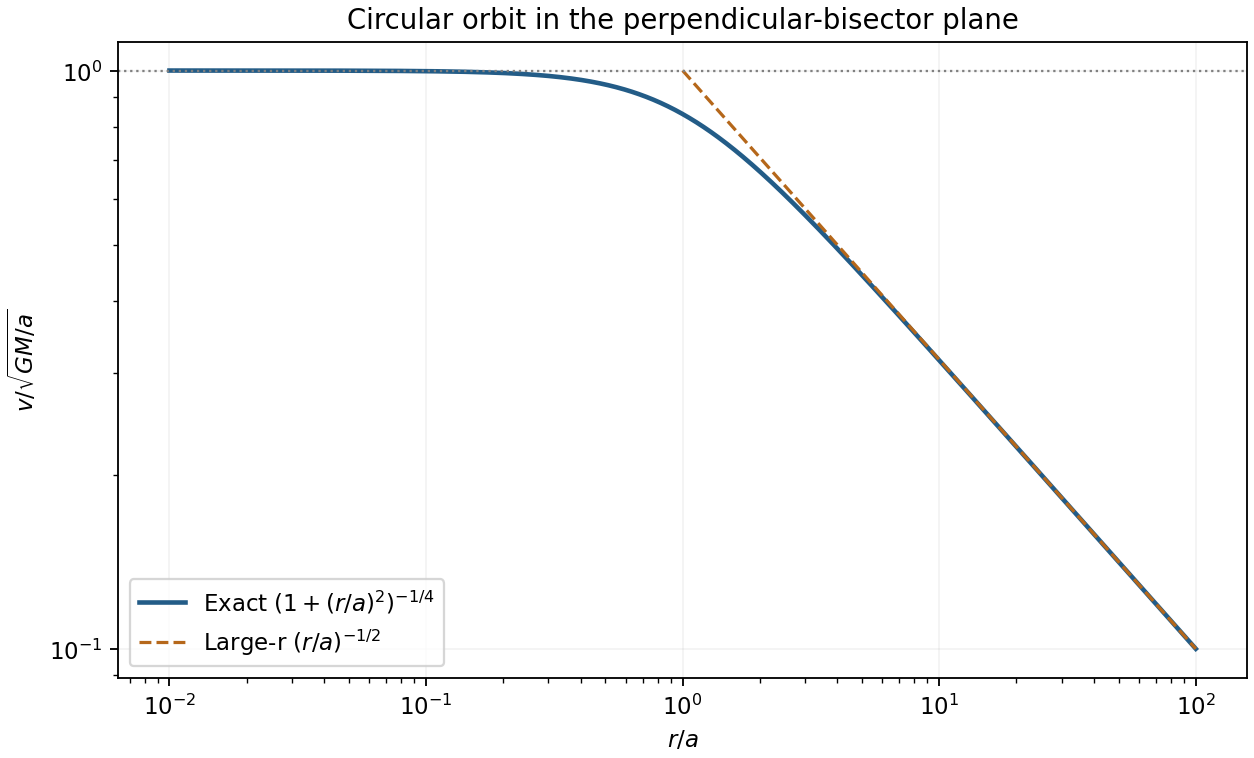
Circular speed around a uniform rod
. Original orbital speed normalized by sqrt(GM/a), against perpendicular orbit radius divided by the rod half-length. The small-radius plateau and large-radius Kepler asymptote are marked; the zero-thickness rod approximation requires orbit radius larger than the physical rod thickness. Details.
New to topics? Read the docs here!