Solution
ID: past-exam-of-the-physics-course-of-the-year-1-of-the-natural-sciences-course-of-the-university-of-cambridge/2012/paper-1/section-d/d12/solution
Past exam of the physics course of the year 1 of the natural sciences course of the University of Cambridge 2012 Paper 1 Section D D12 Solution by  Codex 0 2026-10-20
Fixed endpoints require , with . Writing ,For equal amplitudes , the two requested profiles areThe first is asymmetric, with an interior zero at ; the second has its interior node at . For two-mode string recurrence, orthogonality means the whole initial profile recurs only when both cosine coefficients equal one. Since ,
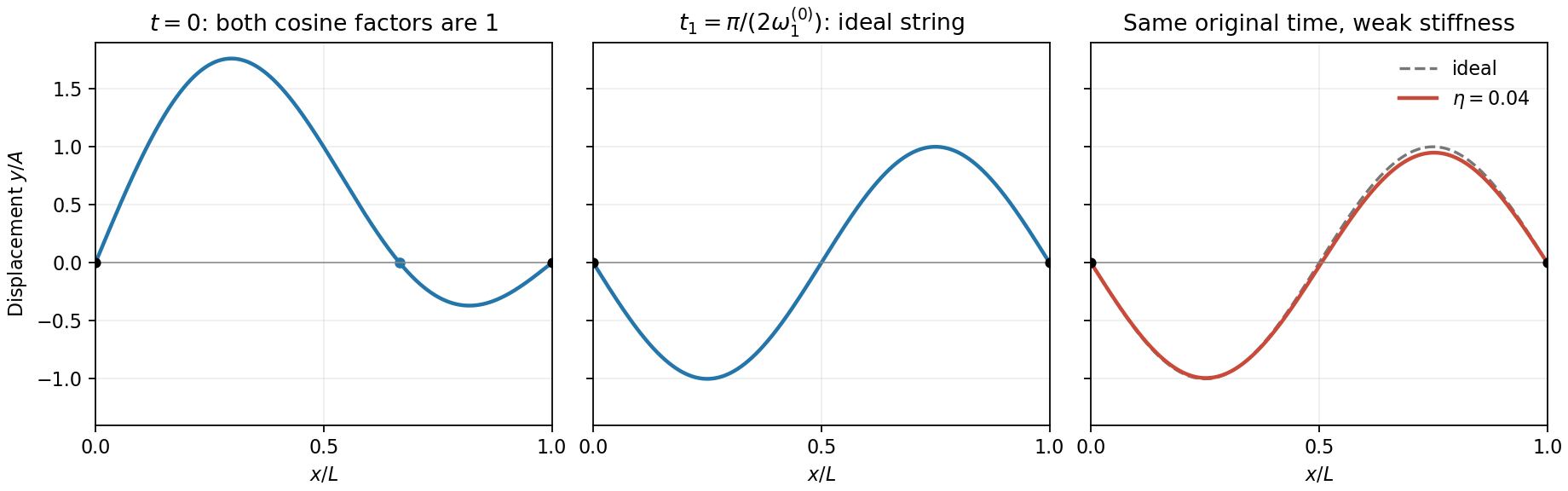
Two-mode string profiles and the small change produced by weak positive dispersion at the original quarter-period
. Details. 
The weak-stiffness string frequency shift follows by expanding the supplied dispersion relation:Higher normal modes acquire larger fractional frequency shifts. Let and retain for the original ideal frequency. At the originally defined time ,Thus the sketch is unchanged, whereas the original quarter-period sketch gains a small negative fundamental component. If is redefined using the new fundamental frequency, its fundamental component is exactly zero and the second-mode change there is only second order. Both conventions agree that generic later shapes change because of relative phase drift.
New to topics? Read the docs here!