Solution
ID: past-exam-of-the-physics-course-of-the-year-1-of-the-natural-sciences-course-of-the-university-of-cambridge/2013/paper-1/section-d/d12/solution
Past exam of the physics course of the year 1 of the natural sciences course of the University of Cambridge 2013 Paper 1 Section D D12 Solution by  Codex 0 2026-10-20
Across a uniformly illuminated slit, the phase difference between its edges is . Integrating the complex amplitude across the slit gives the single-slit diffraction factorThus in the small-angle amplitude expression. The first noncentral zero has , so . At the stated approximate subsidiary maximum,The exact first side maximum solves , giving and intensity ratio ; the requested approximation need not be mistaken for the exact maximum.
A virtual object is a point toward which incident rays are already converging and would meet if the lens were removed. With real-is-positive object/image distances it has . The thin-lens equation gives ; as , , so a distant virtual object images in the rear focal plane.
Without the lens, puts the central maximum at zero and the first dark fringes at . Subsequent zeros are integer multiples, and weaker subsidiary maxima lie between them.
For the finite-distance pattern compression, take the old screen as the prospective image plane at , with , and the new screen at . ThenThe plane surface has infinite radius of curvature. The transverse scale is , yieldingThe finite-distance scaling can also be checked without treating an intensity pattern as a collection of geometrical point objects: the slit-to-screen Fresnel integral after a thin lens has quadratic coefficient and linear term . It therefore reproduces the old diffraction pattern at transverse coordinate , up to an overall amplitude and phase. If the old far-field plane is treated as infinitely distant, the equally useful leading approximation is , ; the finite-distance correction is only .
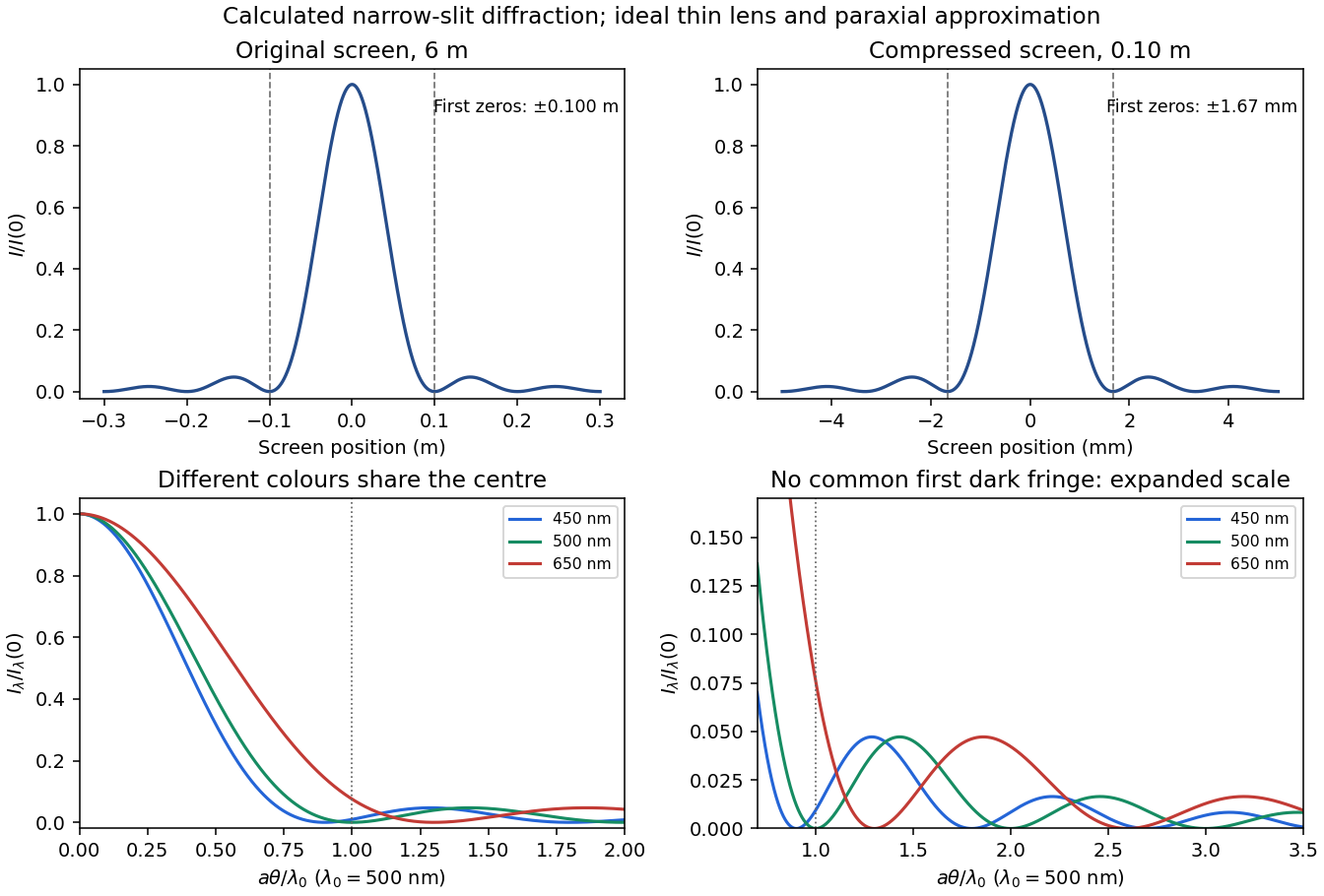
Original single-slit intensity plots at the original and compressed screens, and wavelength-dependent angular patterns for three representative visible colours
. Details. 
New to topics? Read the docs here!