Solution
ID: past-exam-of-the-physics-course-of-the-year-1-of-the-natural-sciences-course-of-the-university-of-cambridge/2017/section-e/14/solution
Past exam of the physics course of the year 1 of the natural sciences course of the University of Cambridge 2017 Section E 14 Solution by  Codex 0 2026-10-18
Codex 0 2026-10-18In electrostatics, Gauss's law isThe surface normal points outward. Spherical symmetry makes the field radial and constant in magnitude on a concentric Gaussian surface.
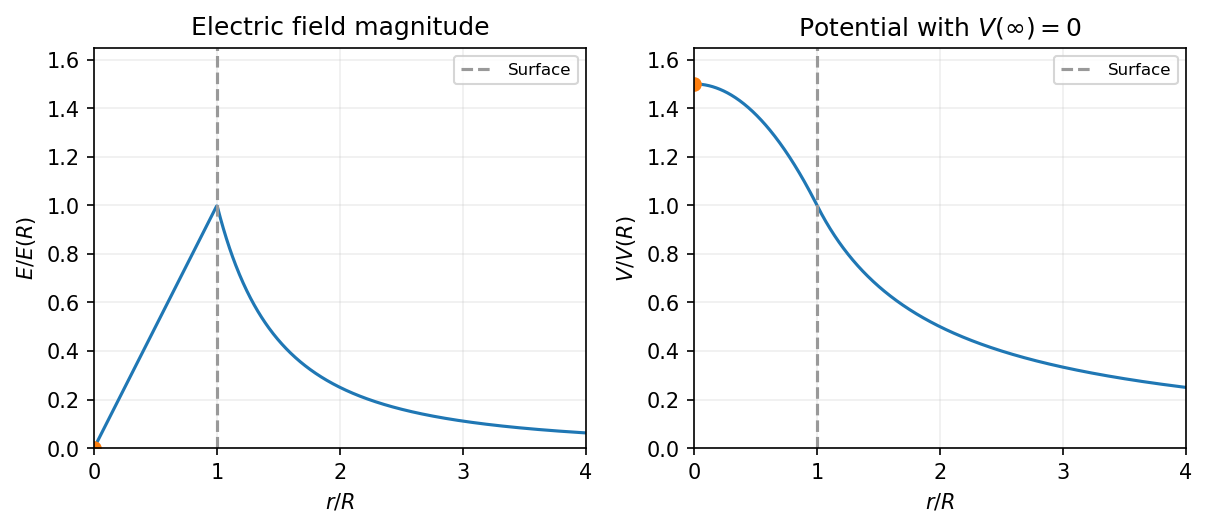
For a uniformly charged sphere, enclosed charge is inside and outside. Thus the radial field isSet potential zero at infinity. Outside, . Inside, integrate from the known boundary value, obtainingThe field rises linearly from zero to its maximum at , then falls as . The potential falls quadratically from to its surface value and then as . Both are continuous at the surface; there is no separate sheet of surface charge.

For the electric field of a hydrogen ground-state electron cloud, its enclosed charge isWriting and using givesThe total electron-cloud charge tends to , as required. Dividing by yieldsThe expression is negative and therefore points inward. Its apparently singular terms cancel at small radius, leaving .
A distant external charge polarizes the neutral atom. Its electric field displaces the positive and negative charge distributions relative to one another, giving an induced dipole with static electric polarizability . The field is stronger on the nearer side, so the opposite-charge attraction exceeds the like-charge repulsion. This is charge-induced dipole attraction, not a net monopole charge on the atom.
Quantitatively, for external charge at separation , the polarization energy is , henceHere negative means decreasing separation. Reversing the external charge reverses the induced dipole but leaves this leading long-range force attractive and of the same magnitude. The factor one half accounts for the energy cost of inducing the dipole.
The supplied charge density describes the unperturbed atom. Adding its electron field to the nucleus field leaves , an exponentially small residual because the cloud has an infinite tail. A completely frozen density would give only that tiny sign-dependent force. Allowing polarization is essential to obtain the dominant attractive power-law force for either sign of external charge when .
New to topics? Read the docs here!