Solution
ID: past-exam-of-the-physics-course-of-the-year-1-of-the-natural-sciences-course-of-the-university-of-cambridge/2019/section-b/8/d/solution
Past exam of the physics course of the year 1 of the natural sciences course of the University of Cambridge 2019 Section B 8 d Solution by  Codex 0 2026-10-18
Codex 0 2026-10-18Take the threshold from the above-step side used in the preceding parts, . Then while remains finite. The reflected probability amplitude approaches , and the transmitted amplitude approaches . At each fixed position, the potential-step threshold wavefunction is thereforeIts probability density is
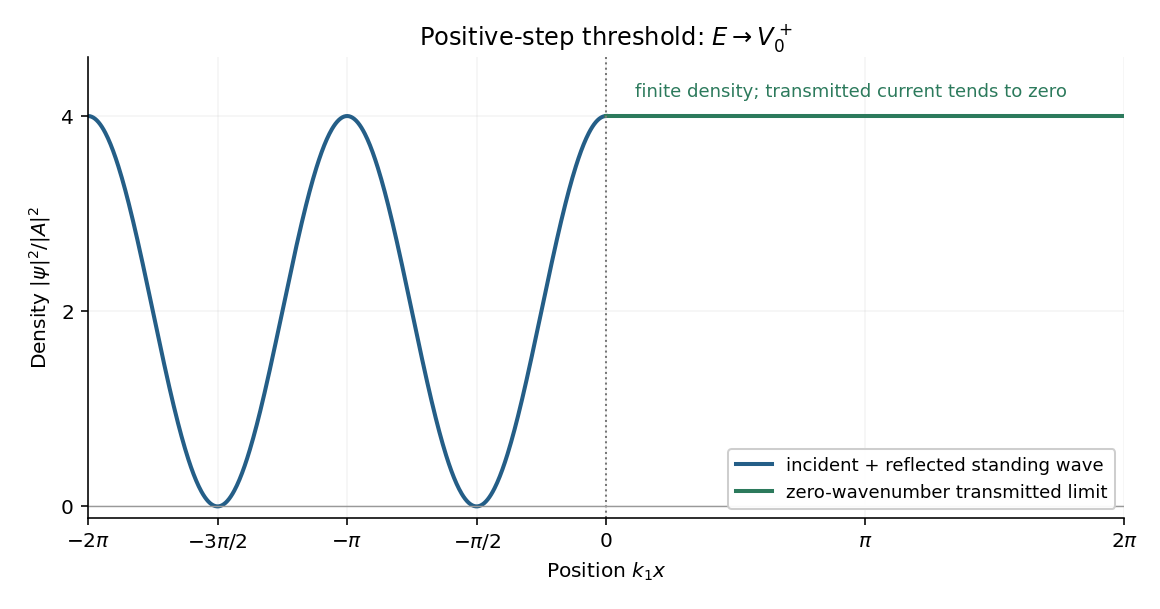
Probability density at the positive-step threshold, normalized to the incident amplitude squared
. Details. 
The left-hand standing wave has zero-density nodes at and maxima of height . Its density period is , half the incident de Broglie wavelength. At the origin the density is a maximum, continuous with the constant value on the right; its first derivative is also zero on either side there.
The nonzero right-hand density does not imply transmitted flux: , so and . The exact threshold solution with no incoming component from the right is the limiting constant solution of in the raised region. These stationary scattering states are not normalized over the whole real line; finite-interval density ratios are nevertheless well defined.
New to topics? Read the docs here!