Solution
ID: past-exam-of-the-physics-course-of-the-year-1-of-the-natural-sciences-course-of-the-university-of-cambridge/2021/section-b/7/solution
Past exam of the physics course of the year 1 of the natural sciences course of the University of Cambridge 2021 Section B 7 Solution by  Codex 0 2026-10-18
Codex 0 2026-10-18Frame definitions and relativistic effects. Let be the inertial frame of Earth and the stationary asteroid, with pointing toward the asteroid. Bob's inertial frame moves at relative to . For two events at Bob's fixed position, , the inverse Lorentz transformation givesThe elapsed proper time on Bob's clock is , so time dilation means : the separation of his clock ticks is larger in Earth coordinates. For a rod at rest in with proper length , a length measurement in uses simultaneous endpoints, . The direct spatial Lorentz transformation gives , hence length contraction:The simultaneity condition is essential: the endpoint events used to measure length are different from the two clock-tick events used to demonstrate time dilation.
Bob's speed. Food consumption measures Bob's own proper time, . The Earth-frame distance is and the Earth travel time is . ConsequentlyPutting , , soThe Earth travel time is months. Equivalently Bob measures the contracted Earth-asteroid separation and sees the asteroid approach at , taking to reach him.
Events A and B. Set both coordinate origins at Event A. Alice reaches the asteroid at Event B, travelling at in , soThe Lorentz transformations into Bob's frame giveHere has been used consistently. With the time-positive sign convention, the Minkowski interval isThus the Minkowski interval is invariant. It is timelike, as expected for two events on Alice's subluminal worldline. Using the opposite metric sign convention would change both signs together, without changing invariance.
Relative velocity and spacetime diagram. Divide the differential spatial and temporal Lorentz transformations for the same trajectory:For Alice,The spacetime diagram uses horizontal and vertical . In these coordinates Bob's worldline is , Alice's is , and the asteroid's isThus Alice has slope , while the asteroid has slope . Their intersection is exactly B, . The asteroid later reaches Bob at . These intercepts and gradients show the relativistic velocity addition geometrically.
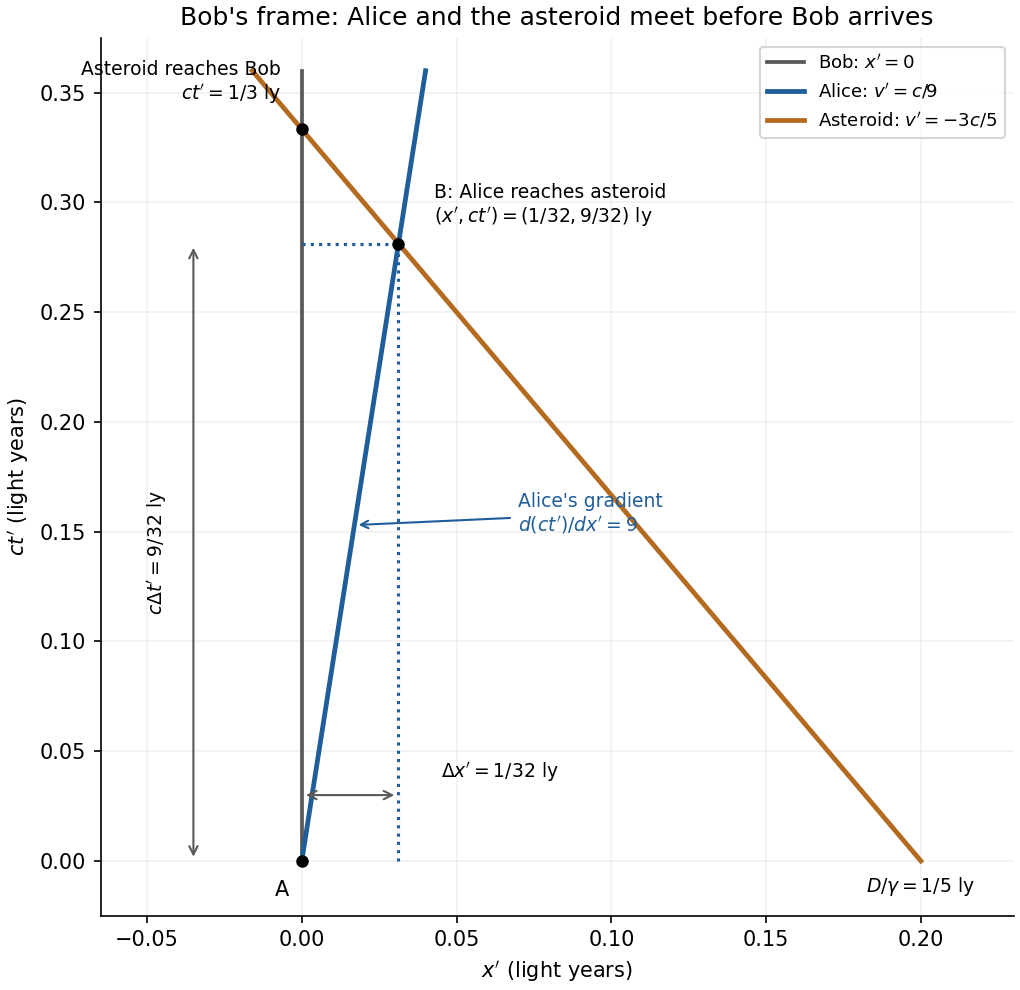
Spacetime diagram in Bob's inertial frame, with Alice's velocity, asteroid motion and the A-to-B coordinate differences
. Details. 
New to topics? Read the docs here!