Solution
ID: past-exam-of-the-physics-of-atmospheres-and-oceans-course-of-the-university-of-oxford/2017/1/b/solution
Past exam of the physics of atmospheres and oceans course of the University of Oxford 2017 1 b Solution by  Codex 0 2026-10-25
Let be the absorber mass path along a ray. If the spectral line profile is independent of position, Beer-Lambert law gives . A finite-band mean and the line's equivalent width are respectivelyWhen the band contains all significant absorption, . An unqualified integral of transmission over the entire infinite line domain diverges because transmission tends to one far from line centre; is the finite and physically useful line deficit.
This is nonexponential band transmission: each monochromatic transmission is exponential, but their average generally is not. Differentiating with respect to mass path givesMore decisively, define the absorption coefficient averaged over the transmitted spectrum byThen . The core saturates first and the surviving radiation increasingly samples weakly absorbing wings. The effective attenuation per additional mass therefore decreases. Jensen's inequality also gives , with equality for a spectrally constant coefficient. Thus the band transmission decays more slowly than the exponential with its initial mean attenuation.
The corresponding curve of growth has for an optically weak line, and sublinear growth after saturation. For the Gaussian profile, with , absorption extends to , so . For a strongly saturated pure Lorentz profile the wings instead give . These asymptotes apply while the line remains isolated and its important wings remain within the range where the assumed profile and nearly constant Planck function are appropriate. The integrated absorption is not an exponential either: and .
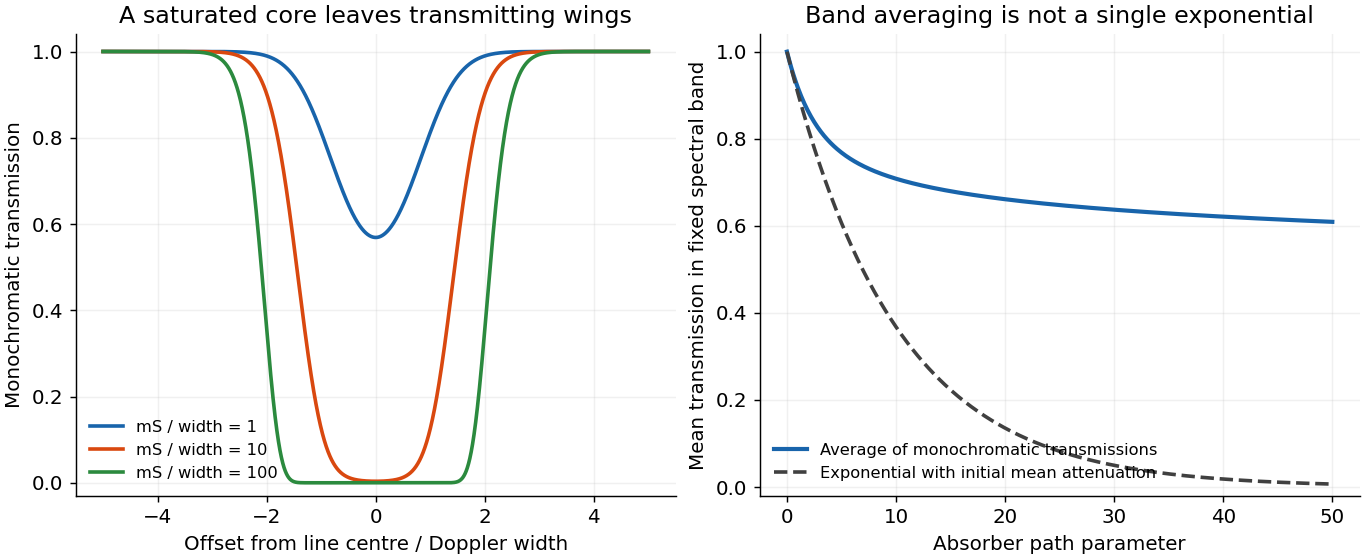
Line saturation produces nonexponential band transmission
. An original fixed Gaussian line example shows its opaque core expanding with absorber path. The mean transmission across a fixed band remains above the single exponential determined by its initial mean attenuation. Details.
New to topics? Read the docs here!