The Planck function is the equilibrium spectral specific intensity of a blackbody, given by Planck's law. Per unit wavelength it isIt can also be written per unit frequency, with under the corresponding change of variable.
The radiation constant relates equilibrium radiation energy density to temperature by . It satisfies in terms of the Stefan-Boltzmann constant.
The ultraviolet catastrophe is the divergent total thermal radiation energy predicted by classical equipartition theorem applied to the electromagnetic mode density in a box. Each mode has mean energy , while the number of modes per volume per frequency is . The Rayleigh-Jeans law therefore gives , whose integral over all positive frequencies diverges at every .
Planck's law replaces the classical mode energy by . It agrees with equipartition when but suppresses high-frequency excitations exponentially. The resulting spectral energy density is integrable and yields the finite Stefan–Boltzmann law. The failure concerns the classical equilibrium distribution of energy among modes, not the existence of electromagnetic wave propagation itself.
Wien's displacement law says that the wavelength maximizing the Planck function per unit wavelength, , moves inversely with absolute temperature:Here is the Wien displacement constant. Heating an ideal blackbody therefore shifts this peak toward shorter wavelengths, while also increasing its emission at every fixed wavelength. The peak identifies where equal narrow wavelength intervals carry the most power; it is not a single emitted wavelength. Planck's law supplies the full curve, and the Stefan–Boltzmann law supplies its integral.
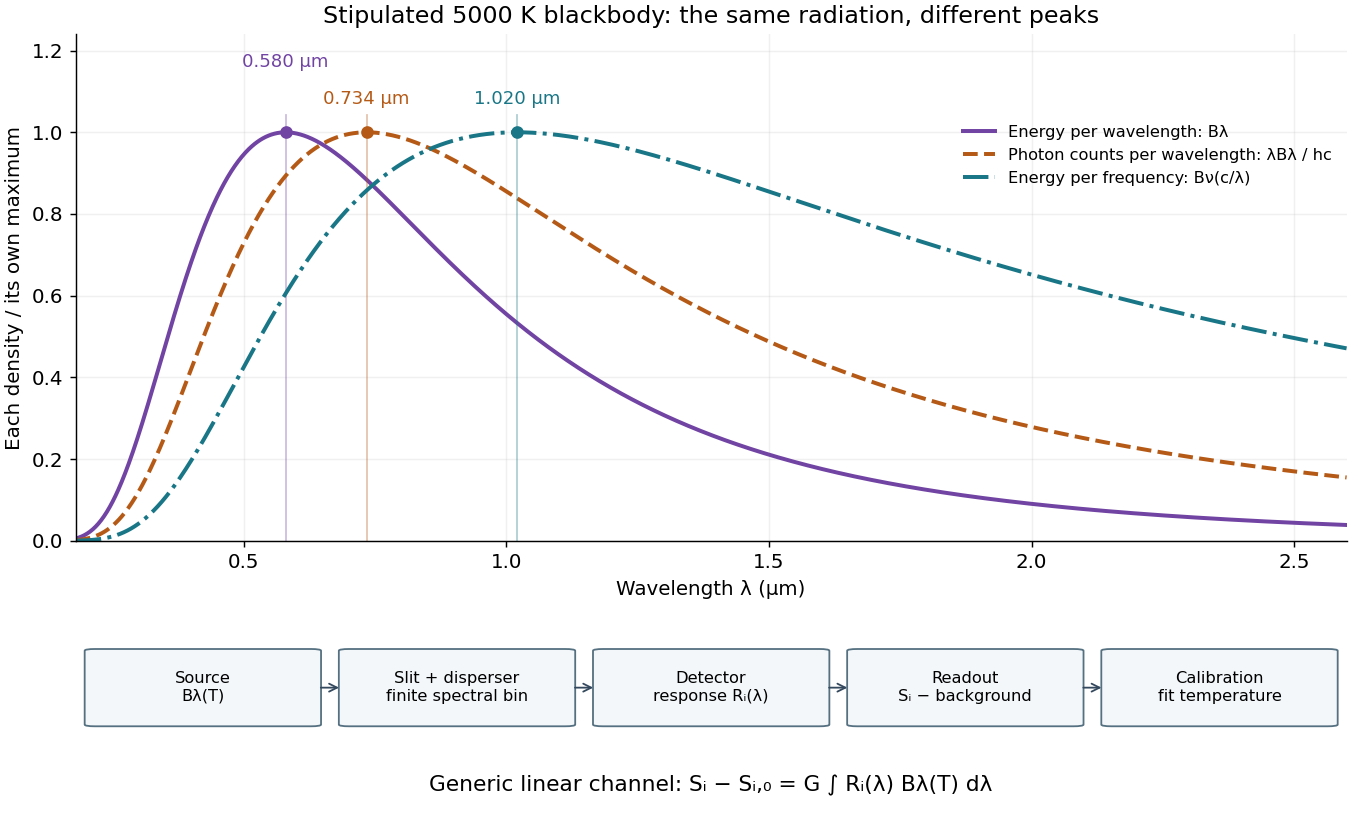
Specify the spectral coordinate before finding a peak. The frequency form of Wien's displacement law maximizes , which is spectral radiance per unit frequency. Its maximum is not . The frequency and wavelength spectral radiance conversion changes the density as well as the horizontal coordinate; the existing frequency and wavelength peaks of Planck's law give a complementary numerical comparison.
In his 11 December 1911 Nobel lecture, Wilhelm Wien explained the displacement principle through a thought experiment: compress black-body radiation between reflecting moving walls. Work against radiation pressure raises the energy density, while reflection changes each frequency by the Doppler effect. The Second law of thermodynamics connects the resulting spectrum to one at a higher temperature. This determines how the spectrum scales between temperatures, without determining its complete shape. The Wien approximation is a separate, restricted spectral formula.[ref]
On the Laws of Thermal Radiation by Wilhelm Wien. Nobel Lectures, Physics 1901–1921; Wilhelm Wien, On the laws of thermal radiation, Nobel Lecture, 11 December 1911, printed pp.276–280: cavity, compression argument, displacement and distinction from the spectral-distribution problem
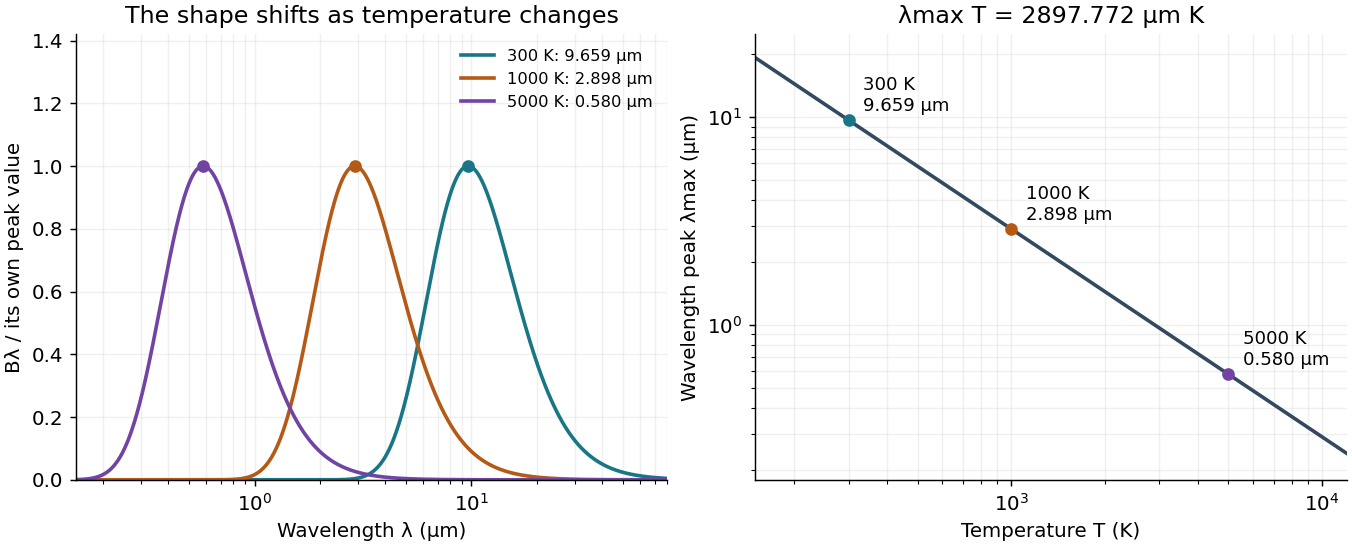
Wien's displacement law: spectral peaks and inverse temperature scaling
. Left: Planck function curves divided by their own maxima, for three stipulated temperatures. This normalization hides the increase in absolute spectral radiance. Right: the peak wavelength follows ; a tenfold rise in temperature divides the peak wavelength by ten. The curves are computed ideal blackbody predictions. Details.
At fixed , substitute into the Planck function:Here is the Planck constant, the Boltzmann constant, and the speed of light. Since , an interior maximum in wavelength is also a stationary point in . A logarithmic derivative givesThe required positive root is . The rearranged equation also has , but that endpoint is not a peak. For , changes sign once, at . Thus first increases and then decreases to negative values, crossing zero exactly once for . Since tends to zero at both endpoints, this stationary point is the unique global maximum. Solving the definition of for wavelength givesThe inverse-temperature dependence follows before any numerical root-finding. More generally for one fixed function , so spectra at all temperatures have the same rescaled shape. This is stronger than a relation between two peak positions. Replacing the denominator by in the Wien approximation would instead give and a peak wavelength about too short.
For Planck's law per unit frequency, setting leaves a positive constant times . Its logarithmic derivative givesThe same uniqueness argument as in the Derivation of Wien's displacement law, with replaced by , selects the positive root. The maxima differ because corresponding positive spectral intervals obeyThe nonconstant Jacobian determinant changes density heights. Consequently . A peak is a property of a specified density, rather than an invariant point of the spectrum. For equal logarithmic intervals, the corresponding densities satisfy and have matching converted peak positions; this is a third convention, distinct from either linear-interval density.
The Wien displacement constant is the constant of proportionality in . From the exact International System of Units values of the Planck constant, speed of light and Boltzmann constant,The units follow from : . The defining constants are exact; the displayed decimal is rounded. [ref]
Consider a hypothetical star whose emitted specific intensity is exactly that of a uniform blackbody. Assume transparent propagation with negligible Doppler shift and interstellar extinction, so geometric dilution multiplies every spectral interval by the same factor. The stipulated temperature givesUsing the converted frequency peak as though it maximized would return , a substantial error caused solely by mixing spectral conventions.
Now stipulate a photodetector with constant quantum efficiency over the relevant wavelengths, collecting equal narrow wavelength bins. For fixed accepted projected area times solid angle , with dilution included in , its expected photon count rate density isThis follows by dividing the received power by the photon energy . It peaks where , at , giving for the same model star. Constant quantum efficiency is not constant energy spectral responsivity: the latter includes the wavelength-dependent photon energy conversion. For example, , and a bin centered at give approximately detected photons per second in the narrow-bin approximation. These are calculated model values, not observations of a named star.
A more general linear detector channel has outputwhere is the background reading and includes spectral selection, optical transmission and detector spectral responsivity. A raw channel maximum need not locate either Planck function maximum. Recovering a temperature requires an appropriate calibrated response and an emission model. For a real stellar atmosphere, opacity and radiative transfer can reshape the spectrum; interstellar extinction can reshape it again. A single peak does not establish a unique physical temperature without those assumptions.

William Weber Coblentz's primary report describes an electrically heated porcelain cavity wound with platinum ribbon. Mirrors imaged its central radiating diaphragm onto a optical slit; a fluorite optical prism dispersed the beam onto a vacuum bolometer. Galvanometer deflections read the detector response. A resistance standard checked electrical sensitivity, while repeated readings checked stability. Sodium lines fixed the angular zero; a refractive index curve supplied wavelengths and slit-bandwidth corrections. Thermocouples were standardized at freezing points of zinc, antimony and copper. Drying the optical path reduced atmospheric absorption; prism scattering and temperature calibration remained limitations. These were Coblentz's measurements. His extraction of radiation constants assumed the Planck law, so it was not a model-independent proof of the spectral formula.[ref]
Constants of Spectral Radiation of a Uniformly Heated Inclosure or So-Called Black Body, I by William Weber Coblentz. W. W. Coblentz, Constants of spectral radiation of a uniformly heated inclosure or so-called black body, I: printed pp.15–27, 35, 42–47 and 73–77; apparatus, sensitivity checks, temperature scale, wavelength calibration and model-dependent constants
The inference to test is whether corrected spectra taken at independently determined temperatures have their maxima at a constant product . Comparing raw galvanometer deflections at different optical prism settings would also compare different wavelength widths and optical losses. The response integral in blackbody peak and detector response explains why those corrections belong to the physical inference rather than merely to presentation.
Articles by others on the same topic
There are currently no matching articles.