Solution
ID: past-exam-of-the-physics-of-atmospheres-and-oceans-course-of-the-university-of-oxford/2018/6/c/solution
Past exam of the physics of atmospheres and oceans course of the University of Oxford 2018 6 c Solution by  Codex 0 2026-10-25
A mountain width is not an exactly specified sinusoidal wavelength. Taking its characteristic horizontal inverse length as with gives . Since , the stationary vertical wavenumber isThis is close to the long-horizontal-scale/hydrostatic estimate . If instead the quoted width is identified with a sinusoidal wavelength , then and . Thus several kilometres, roughly – under these two common width conventions, is the justified estimate; the terrain profile would fix its actual forcing spectrum.
For the inverse-width choice, both and are negative for upward energy radiation. The stationary phase lines tilt upstream with increasing height, while energy propagates upward and slightly downstream. Numerically , with ray inclination about . Intrinsic phase propagation points upstream and downwards; the ground pattern itself remains fixed. The original sketch below uses this explicit convention.
A ground observer may see stationary lenticular or wave clouds where ascent cools sufficiently moist air, with continuing air flow through a cloud whose position remains almost fixed. Descending regions can clear or warm. An aircraft crossing the pattern encounters alternating updraughts and downdraughts; gliders can exploit the lift. Strong amplitudes, shear or rotors may cause turbulence, but a linear gravity wave can also be smooth, and clear-air waves need not produce any visible cloud. Mountain height, humidity and nonlinear stability are not supplied, so neither a vertical-wind amplitude nor a definite atmospheric precipitation forecast follows.
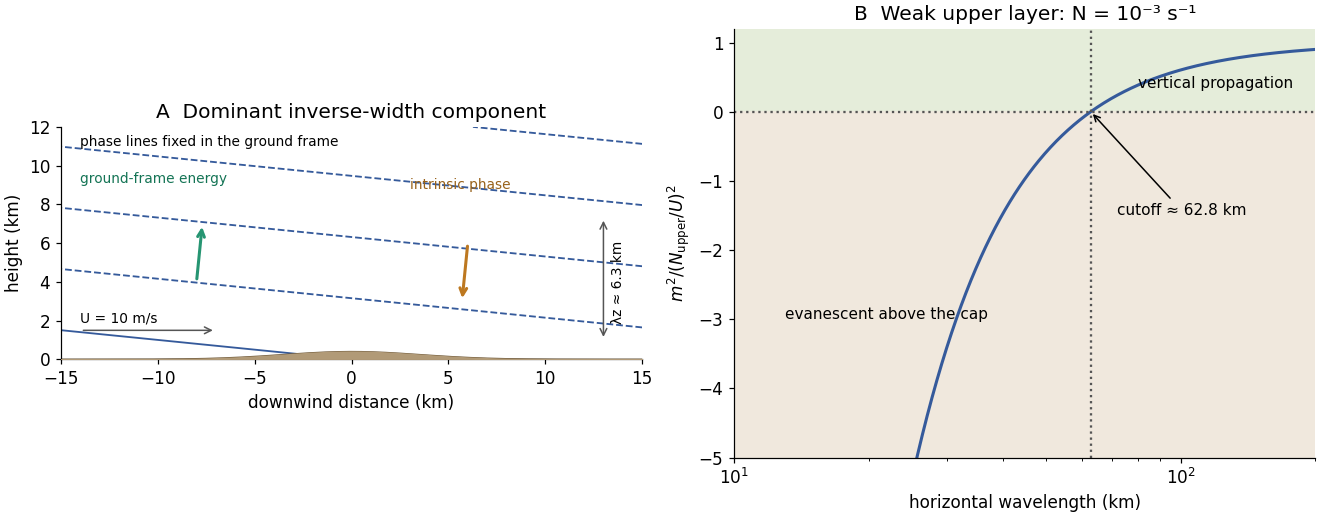
Stationary mountain-wave phase lines, intrinsic phase direction, energy rays and an upper-layer propagation cutoff
. Original schematic and dispersion calculation. The ridge height is illustrative; the phase sketch uses , while the upper-layer panel shows the cutoff for the reduced Brunt–Väisälä frequency. No cloud or turbulence amplitude is inferred. Details.
New to topics? Read the docs here!