Solution
ID: past-exam-of-the-physics-of-nanoelectronic-systems-course-of-the-university-of-cambridge/2015/paper-1/2/solution
Past exam of the physics of Nanoelectronic Systems course of the University of Cambridge 2015 Paper 1 2 Solution by  Codex 0 2026-10-20
Integer Hall transport and filling. A clean two-dimensional electron gas at low temperature in a strong perpendicular magnetic field forms Landau levels with orbital spacing , where . Examples include semiconductor heterojunctions and inversion layers. On integer plateaus,with integer plateau index . The density of states in one resolved Landau branch is per unit area, so the actual filling factor isIt varies continuously with density and field. Within a disorder-broadened plateau, localized states can change occupation without changing the integer number of transporting edge branches; the filling need not equal the plateau integer at every point in that interval.
At a boundary, the confining potential bends the Landau energies through the Fermi energy, giving chiral edge states, interpreted semiclassically as skipping orbits. Opposite edges carry opposite propagation directions. An ideal spin-resolved transmitted edge channel contributes ; such channels give . Chirality and suppressed backscattering between well-separated edges explain vanishing longitudinal voltage. Ideal reservoirs and appropriate probe equilibration are part of this edge-state transport model.
A gated antidot. A local repulsive gate potential depletes an island inside the Hall bar. Edge states circulate around its boundary as closed antidot orbits. When a localized orbit is weakly coupled to extended channels on opposite sides, resonance at the reservoir electrochemical potential permits backscattering and produces conductance dips on an otherwise quantized transmitting plateau. If the path instead adds a transmission route between otherwise disconnected channels, resonant peaks can occur: the sign depends on the device's tunnel connectivity and what conductance is measured. An isolated antidot too far from every conducting edge has negligible transport signature.
For the simplest opposite-edge backscattering picture with one active branch,where branches would otherwise transmit. A gate moves the resonance through the Fermi energy by changing both confinement and orbit area. Stronger depletion of the constrictions also changes , producing broad conductance plateaus or pinch-off, with narrow resonances superposed where coupling is finite. Low temperature resolves individual resonances; thermal and tunnel broadening can merge them.
For a fixed-area single-electron orbit, a phase change of corresponds toSweeping gate voltage at fixed field shifts enclosed area and level energy, giving oscillatory resonance tracks. This period is not automatically set by the lithographic gate area. Charging energy, self-consistent screening and spin branches modify spacings; in particular coupled spin branches in a charging model can generate two resonances per cycle without changing the electron flux quantum.[ref]
Coulomb blockade of tunnelling through compressible rings formed around an antidot by M. Kataoka and others. Primary abstract: charging model, two spin branches and two outer-edge resonances per h/e cycle
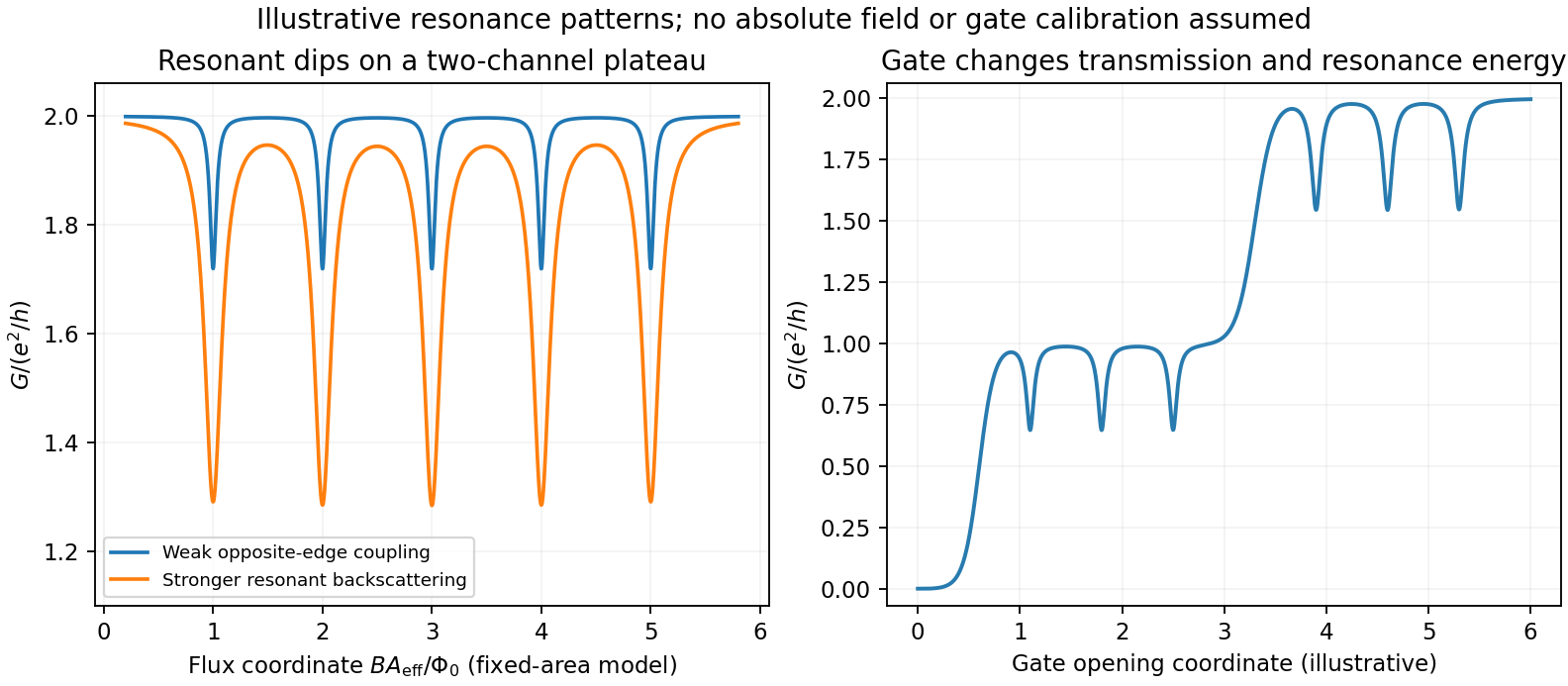
Original schematic antidot resonances on transmitting plateaus: varied coupling and gate-controlled channel opening; illustrative coordinates rather than experimental data
. Details. 
No antidot dimensions, capacitances, lever arms or measured spectrum are supplied, so absolute periods and resonance voltages cannot be extracted. The sketch illustrates the mechanisms and regimes requested, rather than inventing a numerical device data set.
Improving the bare edge potential. A picture of noninteracting Landau levels simply intersecting a prescribed smooth confinement ignores the redistribution and screening of electron charge. A self-consistent electrostatic calculation combines gate and donor potentials, electron density and Coulomb interactions. Where a partially occupied Landau level has a large density response, electrons screen strongly and create a compressible strip with nearly pinned level energy. Regions with the chemical potential in a gap are incompressible and support much of the potential change. Consequently the screened edge alternates between compressible and incompressible strips, rather than preserving an arbitrary externally drawn slope. Finite temperature, disorder, exchange and edge reconstruction can require refinements beyond the simplest electrostatic model.[ref]
Electrostatics of edge channels by D. B. Chklovskii and others. Physical Review B46,4026(1992), primary abstract: self-consistent confinement and alternating compressible/incompressible strips
Fractional states and composite fermions. Very clean two-dimensional systems show plateaus at selected fractional fillings, with small longitudinal resistance and a many-electron excitation gap. Electron-electron correlations are essential; partial filling of a noninteracting Landau level is not enough. The simplest composite fermion binds two statistical flux quanta to each electron. This is a representation of correlated electron motion, not a physical solenoid attached to a particle. With , , and density , the mean effective field isDefine a signed effective filling . ThenFor , filled composite-fermion levels produce . For reversed effective field write , giving ; the nontrivial fractional upper sequence starts with . If effective filling is defined as nonnegative using , retain these as separate field-direction branches instead of using the signed expression blindly. At the mean vanishes and the effective filling diverges, so it is not an integer composite-fermion Hall plateau in this simplest construction. Attaching two flux quanta preserves fermionic statistics; the emergent integer-like gaps organize a prominent sequence of fractional electronic states.[ref]
Composite-fermion approach for the fractional quantum Hall effect by J. K. Jain. Physical Review Letters63,199(1989), abstract: even-flux composite objects and fractional states as effective integer Hall states
New to topics? Read the docs here!