The Fermi energy is the highest occupied one-particle energy in the ground state of a noninteracting Fermi gas at zero temperature, measured here relative to the lowest one-particle energy. The Pauli exclusion principle allows only one fermion in each complete one-particle quantum state, including its spin, so adding more particles fills progressively higher energy eigenstates. A cold gas can therefore have substantial kinetic energy even when its temperature is zero. In the thermodynamic limit, with the same energy reference, where is the chemical potential.[ref]
3 Quantum Gases. Statistical Physics by David Tong; §3.6.2, equation (3.130), zero-temperature filling
For a uniform, three-dimensional gas of noninteracting electrons, with spin one-half, equal populations of the two spin states, no applied magnetic field, and nonrelativistic particles of mass ,Here is the total number density, the volume, the Fermi momentum, the reduced Planck constant, and the Boltzmann constant. The electron Fermi temperature expresses the same energy scale in kelvin; it is not the actual gas temperature. Strong degeneracy of a degenerate electron gas means . The momentum formula counts states and survives changing the energy–momentum relation, whereas requires .[ref]
Degenerate Electron Gases by Richard Fitzpatrick. Richard Fitzpatrick, Degenerate Electron Gases, equations (506)–(509), two spin states and density dependence
The reference matters: the displayed excludes rest energy and sets the zero at . Including rest energy shifts both the one-particle energy and the zero-temperature chemical potential by , leaving occupations unchanged. More generally, adding a constant to every one-particle energy also adds to ; the Fermi-Dirac distribution depends only on their difference. In a finite quantum system the chemical potential at zero temperature can lie between the last occupied and first empty energy eigenstates; its equality with the filling edge is a continuum statement.
At positive temperature, remains the zero-temperature scale associated with the specified number density. The Fermi level must instead satisfy the particle-number conditionwhere is the extensive density of states, including both spin states. Smearing the Fermi-Dirac distribution while arbitrarily holding generally changes . This distinction matters when interpreting electron heat capacity and any experiment that infers temperature from an occupation profile.[ref]
3 Quantum Gases. Statistical Physics by David Tong; §§3.6.1–3.6.4, equation (3.127) fixes particle number, and finite-temperature chemical potential is determined separately
The Fermi temperature expresses a Fermi energy as a temperature scale, , where is the Boltzmann constant. In the convention measured from the relevant band minimum, is the regime of a strongly degenerate Fermi gas. For an interacting Fermi liquid, an effective Fermi scale can be introduced through its quasiparticle dispersion; its convention should be specified.
Choose for a uniform noninteracting electron model with two equally populated spin states. This is an original worked example, not a measured number density assigned to an actual material. Using , , and givesThe conversion uses : an electronvolt is an energy unit, while a joule is its SI counterpart. The dimensions provide a quick check: is inverse length, has units of momentum, has units of energy, and has units of temperature. The ratio verifies the nonrelativistic limit for this model, where is the speed of light.
Increasing this chosen number density eightfold doubles the Fermi momentum and quadruples the Fermi energy, giving approximately . The exponent has a geometric origin: the number of occupied states grows as the cube of a momentum radius, but kinetic energy of nonrelativistic particles grows as its square. This makes Fermi energy a useful bridge between a count of particles and a mechanical energy scale.
The kinetic electron Fermi temperature is , where the Fermi momentum counts the net electrons. Strong degeneracy requires . With mean molecular weight per electron and , . Its nonrelativistic and ultrarelativistic limits scale as and , respectively.
Fermi momentum is the magnitude of the momentum at the boundary of filled one-particle states in an isotropic zero-temperature Fermi gas. For the uniform three-dimensional two-component electron model, a short state count givesTo see the factors, impose periodic boundary conditions on a cubic box of side , so and each momentum component is for an integer . Each allowed momentum point occupies a cell of volume in momentum space. Divide the sphere volume by this cell volume and multiply by two for the two spin states. Replacing the discrete count with a volume is the large-box approximation; surface and shell effects are neglected.[ref]
3 Quantum Gases. Statistical Physics by David Tong; §3.1, periodic wavevectors and momentum-space integration measure; §3.6.1, spin degeneracy
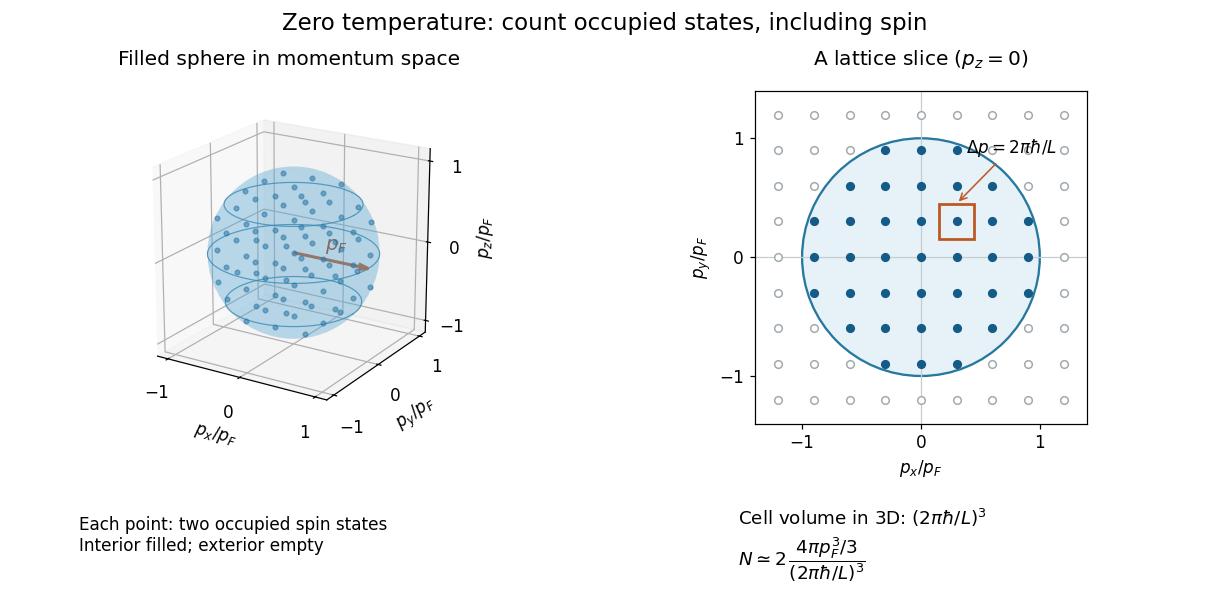
The occupied momentum sphere counts two spin states per momentum point; a slice shows the state lattice
. Details. The factor two is not automatic for every Fermi gas. If only one internal state is populated, its number density instead satisfies . For two equally populated states, recovers the displayed result. A Fermi surface in a crystal can have a more complicated shape, so a single spherical Fermi momentum is a property of this isotropic model.
The group velocity of an excitation evaluated on the Fermi surface. For an isotropic dispersion relation , , where is the Fermi momentum.
The Fermi wavevector is the radius of the occupied sphere in wavevector coordinates for an isotropic Fermi gas. In the uniform two-component electron model, and for nonrelativistic particles. Its units are inverse length, whereas the Fermi momentum has units of momentum.
The wavelength associated with a specified Fermi wavevector. A local-density response normally requires variation on a scale large compared with ; numerical factors such as must be kept explicit when comparing a variation scale with the full wavelength.
The Fermi sea is the zero-temperature many-fermion quantum state with every one-particle state below the Fermi energy occupied and every state above it empty. For a uniform isotropic Fermi gas, the occupied region in momentum space is a solid sphere; its boundary is the Fermi surface. These are momenta, not positions: filling the sphere does not put the particles in a ball in ordinary space. Opposite momentum contributions cancel, so the gas at rest has zero total momentum even though its total kinetic energy is positive.
The filled states are forced upward in energy by the Pauli exclusion principle. This is different from the zero-point energy of one particle confined by a boundary. At fixed number density, the Fermi energy remains positive as the box grows to the thermodynamic limit, while the lowest box confinement energy tends to zero. Low-energy excitations move particles from occupied states near the Fermi surface into nearby empty states; deep states have no nearby available destination. This explains why only a small fraction of electrons contribute to the low-temperature electron heat capacity.[ref]
3 Quantum Gases. Statistical Physics by David Tong; §§3.6.2–3.6.3, filled sea and thermally active surface shell
For the uniform noninteracting electron model with two spin states and kinetic energy of nonrelativistic particles , count all available one-particle states up to an energy :This extensive density of states has units of inverse energy; is the density of states per unit volume. Availability and occupation are different: is positive above , but at zero temperature those states are empty. The occupied energy distribution is , with the Fermi-Dirac distribution reduced to below and above it. The convention at the exact boundary does not affect a continuum integral.
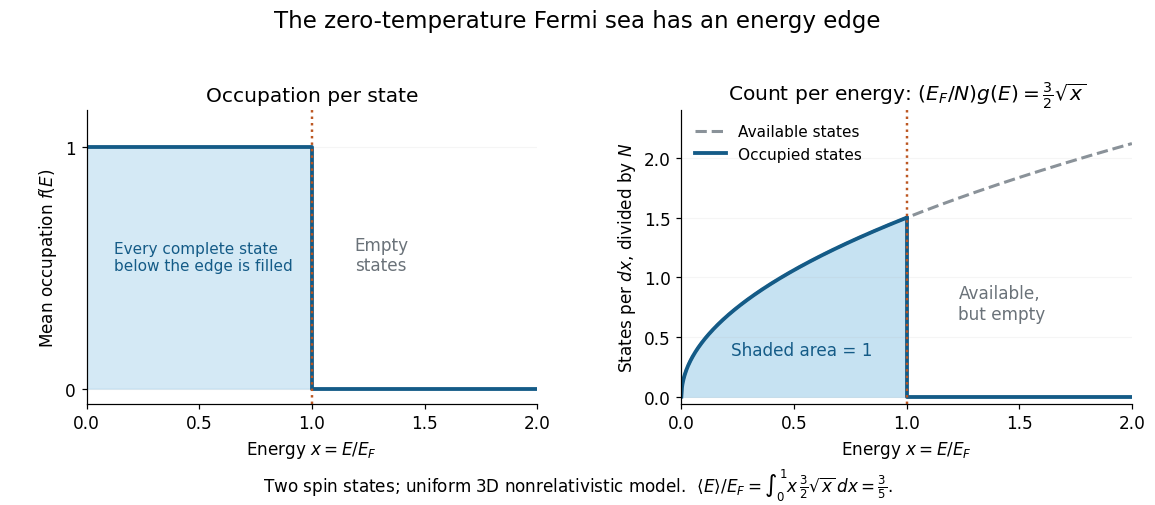
At zero temperature occupation cuts off at the Fermi energy although the density of available states keeps growing
. Details. With the dimensionless quantity , the occupied count per , divided by the total particle number, is for . Its area is one. Weighting this by gives the internal energy and its mean per particle:Thus the highest occupied energy and the mean energy differ. For the Fermi energy of a model electron gas, . At fixed , , so the derivative gives the electron degeneracy pressure . The same state-counting geometry therefore predicts a nonzero pressure at zero temperature.
In 2001, Andrew G. Truscott, Randall G. Hulet, and collaborators observed degeneracy pressure in trapped lithium. A Zeeman slower fed a dual magneto-optical trap; optical pumping prepared atoms for a cloverleaf apparatus for magnetic trapping of neutral atoms. Microwave evaporation removed energetic lithium-7 bosons; elastic collisions cooled lithium-6 fermions by sympathetic cooling.[ref]
Observation of Fermi Pressure in a Gas of Trapped Atoms by Andrew G. Truscott and others. Truscott et al., Observation of Fermi Pressure in a Gas of Trapped Atoms (2001), p. 2570, preparation and cooling
Sequential absorption imaging recorded both trapped clouds on a camera. Fits to axial profiles used the boson cloud as a thermometer. At common temperature, the nearly equal magnetic trapping potentials provided a comparison: the clouds had similar sizes near , but the fermion cloud remained broader as cooling reached . Figure 3 compared its radius with ideal Fermi gas and classical predictions.[ref]
Observation of Fermi Pressure in a Gas of Trapped Atoms by Andrew G. Truscott and others. pp. 2570–2572, Figs. 1–3, imaging, thermometry, and radius comparison
Varying the wait before imaging tested thermal equilibrium. Finite imaging resolution restricted the analysis to the axial direction; fits neglected interaction-induced density shifts. Cooling eventually suffered from the dwindling boson heat capacity. The result supports quantum occupation effects, without directly resolving individual occupied states or reaching zero temperature.[ref]
Observation of Fermi Pressure in a Gas of Trapped Atoms by Andrew G. Truscott and others. p. 2571, axial resolution and negligible-interaction approximation; p. 2572, equilibration test and cooling limit
These were neutral alkali atoms in a spatially varying trap. The Fermi energy of a model electron gas instead uses uniform electrons, two equally populated spin states, and the electron mass. The measured trapped-atom radii are not measurements of that electron model's or ; comparing their numerical Fermi energies requires the appropriate particle mass, internal-state populations, and confining potential.


