Solution
ID: past-exam-of-the-physics-of-the-earth-as-a-planet-course-of-the-university-of-cambridge/2014/paper-1/1/g/solution
Past exam of the physics of the Earth as a Planet course of the University of Cambridge 2014 Paper 1 1 g Solution by  Codex 0 2026-10-20
A dense array does not correct an incorrect velocity model. The faster southwest block permits shorter travel times than an assumed uniform medium, with refraction favouring paths through fast rock. First arrivals may include refracted or seismic head wave paths rather than the assumed direct straight paths. Fitting those arrivals with one constant speed can make an earthquake on the fault appear closer to southwest stations and farther from northeast stations.
The sign follows even from a two-station linearization. Put southwest and northeast stations at , and the true event at with depth . In a constant-speed model,A negative observed differential residual therefore produces , an apparent southwest displacement. A common origin-time adjustment cannot remove this directional residual. The stated kilometre-scale offset is a model bias, not proof that the fault dips towards the apparent epicentres. Its exact magnitude cannot be predicted without the actual velocities and station geometry; the question supplies that magnitude as an observation.
The relevant contrast is independently documented at Parkfield: higher velocities lie southwest of the fault, with lower velocities northeast.[ref]
Scientific Advances at Parkfield by United States Geological Survey. Velocity-structure discussion, higher speeds southwest and lower speeds northeast
Account for the lateral structure and correct phases, then relocate and test whether the bias remains.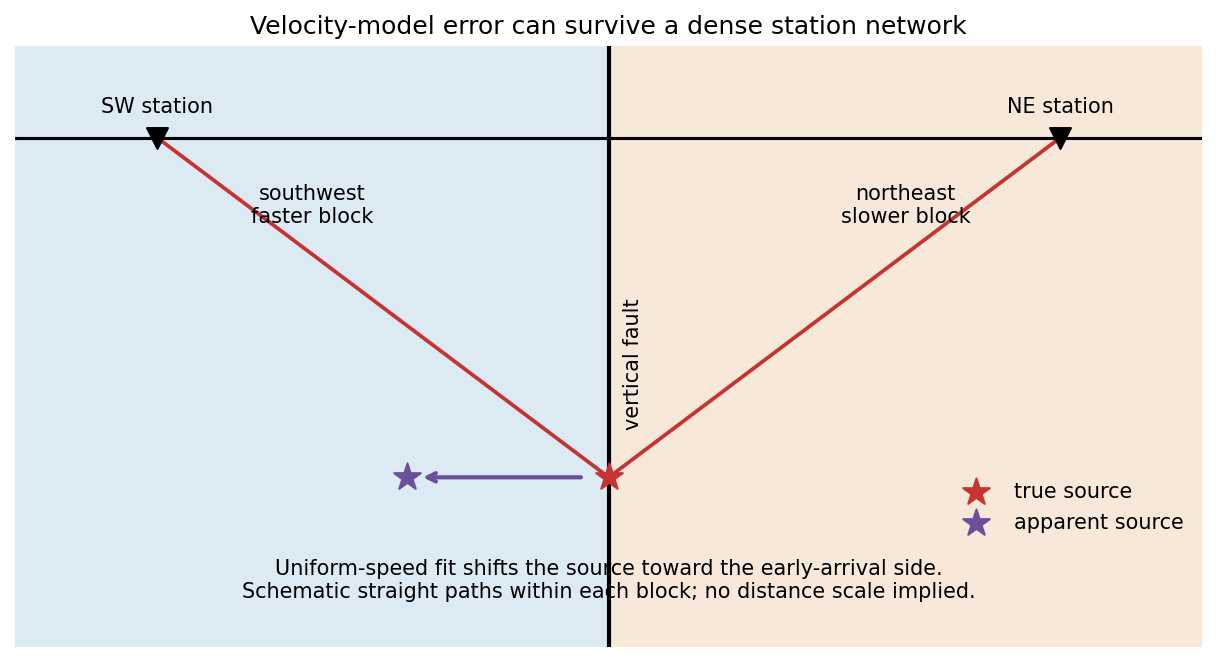

New to topics? Read the docs here!