Solution
ID: past-exam-of-the-physics-of-the-earth-as-a-planet-course-of-the-university-of-cambridge/2015/paper-1/1/a/solution
Past exam of the physics of the Earth as a Planet course of the University of Cambridge 2015 Paper 1 1 a Solution by  Codex 0 2026-10-20
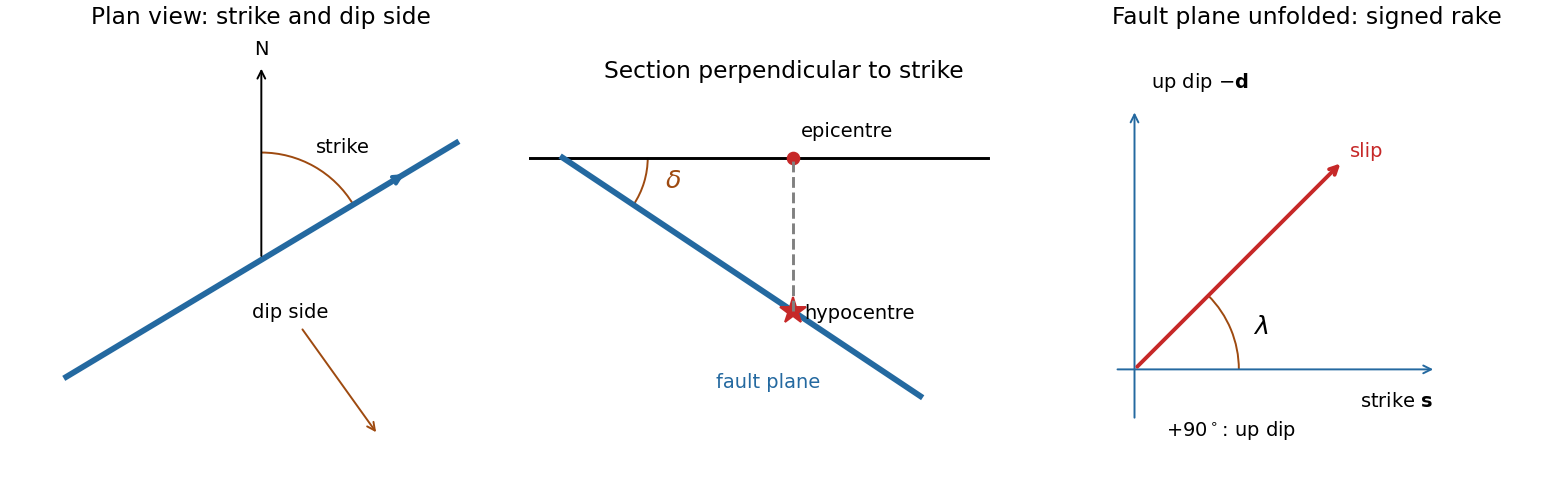
A fault plane represents the surface across which the two sides of a fault slip. A real fault need not be perfectly planar; these angles can describe a local planar segment. Its fault strike is the azimuth, measured clockwise from north, of its horizontal intersection. The line itself has a ambiguity; choose the direction for which the fault dips to the right. Its fault dip, , is the angle below horizontal measured perpendicular to that fault strike, from for horizontal to for vertical.
The fault rake, , is the angle of the relative slip vector within the fault plane. State the sign convention: if is the chosen strike direction and points down dip, useThus is slip along , is up-dip slip and is down-dip slip. This distinguishes the direction in which the fault is tilted from the direction in which it actually moves.
The hypocentre is the point where rupture begins within the Earth. The epicentre is the point on the surface directly above it. The hypocentre need not coincide with the centroid of the final rupture. Orientation uses strike and dip; motion additionally needs rake; epicentre and hypocentre locate the rupture's start.[ref]
Earthquake Hazards Program Glossary by United States Geological Survey. Entries “fault plane”, “strike”, “dip”, “hypocenter” and “epicenter”

New to topics? Read the docs here!