Solution
ID: past-exam-of-the-plate-tectonics-course-of-the-university-of-oxford/2023/question-3/c/solution
Past exam of the plate tectonics course of the University of Oxford 2023 Question 3 c Solution by  Codex 0 2026-10-25
Elasticity lets the lithosphere share a load with neighbouring regions through lithospheric flexure. Beneath the centre of a localized load, subsidence is generally smaller than the local isostasy estimate, so the deposited surface stands higher. The surrounding plate also bends down, and a more distant flexural forebulge may rise. The extra support is regional bending resistance, rather than removal of the load's mass.
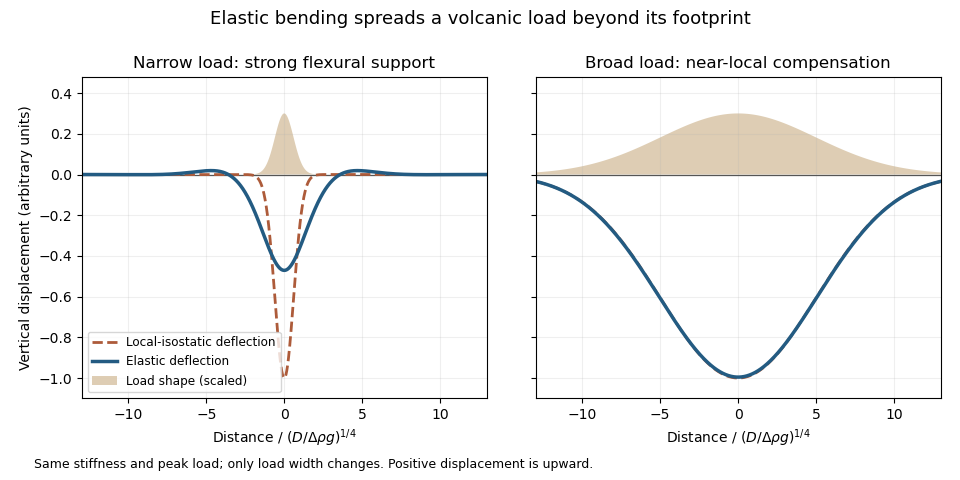
An original elastic-plate calculation contrasting narrow and broad loads at the same flexural rigidity; a broad load approaches local isostasy
. Details. 
The controlling comparison is load width against the lithosphere's flexural length, which increases with flexural rigidity and decreases with the relevant buoyant geophysical density contrast. Equivalently, the flexural support ratio becomes large for short-wavelength loading. A very broad nearly uniform load produces little curvature in its interior, so even a strong elastic lithosphere has a nearly local isostatic adjustment there. Bending matters most near its edges. A narrow load requires more curvature and can be supported appreciably by the surrounding elastic lithosphere.
The Deccan Traps form a broad continental large igneous province. The volcanic edifices of the Hawaiian Islands are more localized loads on an old oceanic lithosphere, for which regional bending and a flexural moat are prominent. Under the usual broad-Deccan versus narrow-Hawaiian-load comparison, elastic strength matters more for the Hawaiian Islands. The more coherent mantle-dominated strength of an old oceanic plate can reinforce this contrast. It cannot be deduced simply from “oceanic” versus “continental”: a cold Indian craton can be strong, and a site's effective elastic thickness depends on its thermal and loading history.
For an initially submerged Hawaiian load, replacing seawater changes both the load and buoyant restoring contrast. At fixed deposited thickness, the added load relative to the initial water column uses the rock-minus-water density, and the restoring term uses the mantle-minus-water density. An emerged island requires separate treatment of its subaerial and submerged portions. These corrections change the local isostasy reference but do not remove the importance of load width for lithospheric flexure. The broad Hawaiian swell should also be distinguished from the narrower volcanic load: deeper thermal or dynamic support of the Hawaiian swell is not the same mechanism as elastic support of the volcanic ridge.
Finally, over long periods material creep, yielding and thermal modification can reduce elastic support. Without measured load geometries, ages and effective elastic thicknesses, the ranking is a justified qualitative expectation rather than a theorem valid for every continental and oceanic load.
New to topics? Read the docs here!