Solution
ID: past-exam-of-the-quantum-atomic-and-molecular-physics-course-of-the-university-of-oxford/2016/2/b/solution
Past exam of the quantum, atomic and molecular physics course of the University of Oxford 2016 2 b Solution by  Codex 0 2026-10-25
For two valence electrons, the central-field shell structure should be the largest scale, residual electrostatic interactions should establish a reasonably definite configuration and atomic term, and spin-orbit coupling should be weaker than the separations between the relevant terms. Then and remain approximately good quantum numbers. Within a well-isolated term the leading fine structure interaction can be represented as . Its coefficient must be effectively constant for all levels in that term. Mixing of neighboring terms, spin-spin interactions, higher-order corrections or strong applied fields can spoil the simple interval rule; hyperfine structure must be negligible or separately resolved.
A suitable approximate example is the magnesium term, with , and . The interval-rule prediction isAn arbitrary common term energy may be added. For the levels ascend in the order , with gap ratio one to two. Each level still contains degenerate magnetic sublevels in zero external field. The superscript three labels the spin multiplicity , while the different subscripts identify fine structure components of that same term. This is an approximate example of LS coupling, not a claim that every real two-electron atom has exact one-to-two fine splitting.
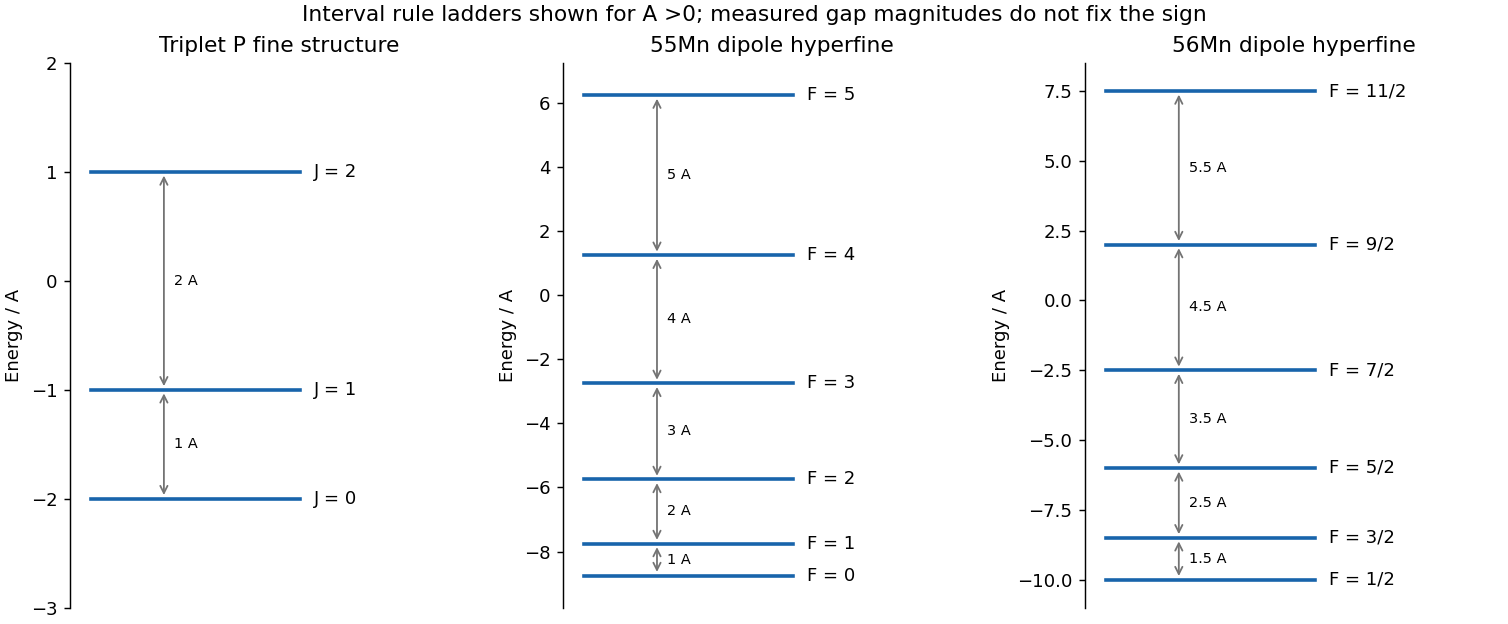
Fine-structure and magnetic-dipole hyperfine interval ladders
. Original angular-momentum eigenvalues for positive coupling coefficients. The fine-structure gaps are A and2A; the two hyperfine examples have different lowest total angular momenta. Measured positive gaps alone do not fix the coupling signs. Details.
New to topics? Read the docs here!