For two valence electrons, the central-field shell structure should be the largest scale, residual electrostatic interactions should establish a reasonably definite configuration and atomic term, and spin-orbit coupling should be weaker than the separations between the relevant terms. Then and remain approximately good quantum numbers. Within a well-isolated term the leading fine structure interaction can be represented as . Its coefficient must be effectively constant for all levels in that term. Mixing of neighboring terms, spin-spin interactions, higher-order corrections or strong applied fields can spoil the simple interval rule; hyperfine structure must be negligible or separately resolved.
A suitable approximate example is the magnesium term, with , and . The interval-rule prediction isAn arbitrary common term energy may be added. For the levels ascend in the order , with gap ratio one to two. Each level still contains degenerate magnetic sublevels in zero external field. The superscript three labels the spin multiplicity , while the different subscripts identify fine structure components of that same term. This is an approximate example of LS coupling, not a claim that every real two-electron atom has exact one-to-two fine splitting.
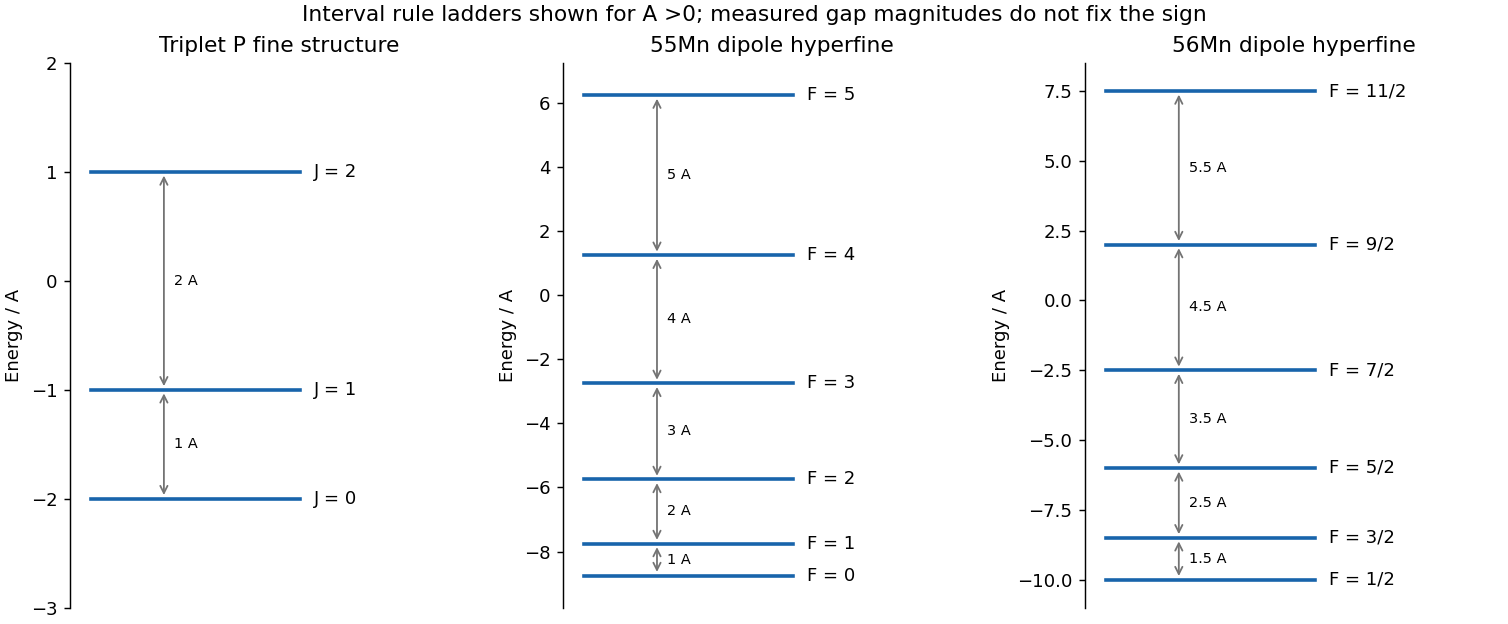
Fine-structure and magnetic-dipole hyperfine interval ladders
. Original angular-momentum eigenvalues for positive coupling coefficients. The fine-structure gaps are A and2A; the two hyperfine examples have different lowest total angular momenta. Measured positive gaps alone do not fix the coupling signs. Details.
Articles by others on the same topic
There are currently no matching articles.