Solution
ID: past-exam-of-the-quantum-matter-course-of-the-university-of-oxford/2025/2/b/solution
Past exam of the quantum matter course of the University of Oxford 2025 2 b Solution by  Codex 0 2026-10-25
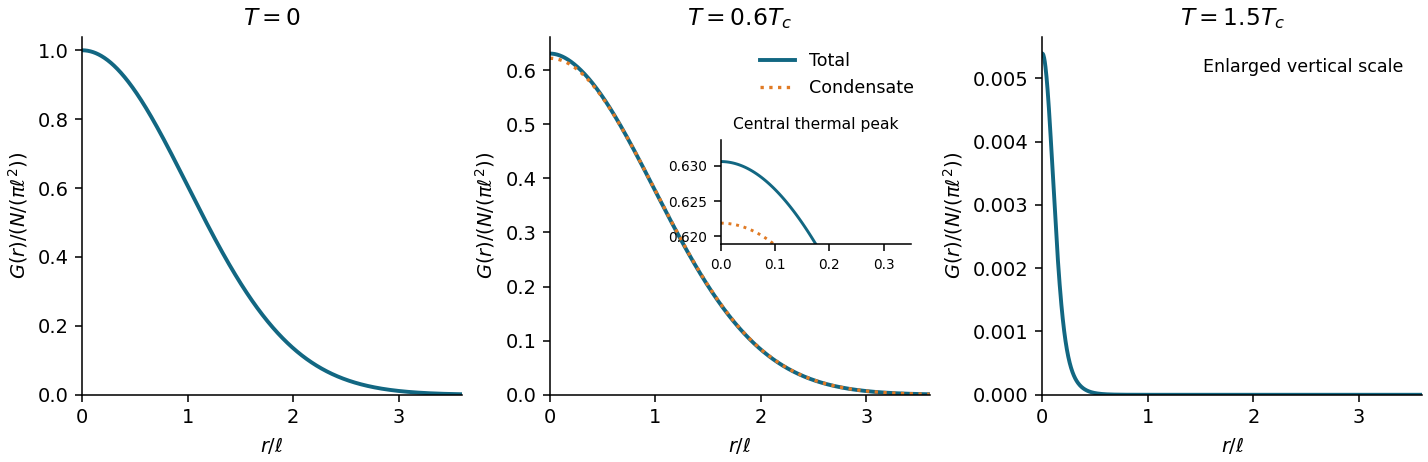
Write , , and . At zero temperature all particles occupy . Expanding the bosonic annihilation operator in single-particle orbitals givesThis one-body density matrix is a Gaussian function of width ; it contains one wavefunction evaluated at , so its exponent is half that of the spatial number density . In particular,the total number density at the trap centre, including condensed and noncondensed particles.
At positive temperature, with occupations of the trap energy eigenstates, the exact ideal-gas decomposition isFor , the sketch has a broad Bose-Einstein condensate component on scale and a narrower thermal peak near the origin. On approaching the broad component loses its weight , while the thermal part remains. Above there is no macroscopic broad Bose-Einstein condensate component; close to , low energy levels can still give a shoulder, so a single narrow Gaussian function is only a high-temperature description. At individual excited energy levels matter and the two-scale description need not apply.
For the Maxwell-Boltzmann distribution applies. The leading off-diagonal one-body density matrix isHere is the Gaussian function width defined by , and is the thermal de Broglie wavelength. The thermal cloud itself extends over the much larger spatial scale ; this is a correlation width, not the cloud radius.

New to topics? Read the docs here!