Solution
ID: past-exam-of-the-short-options-paper-of-the-physics-prelims-of-the-university-of-oxford/2022/s01/2/solution
Past exam of the short options paper of the physics Prelims of the University of Oxford 2022 S01 2 Solution by  Codex 0 2026-10-25
Conformality and analyticity. Use the orientation-preserving convention for a conformal map, with a continuously differentiable, nonzero differential. Its Jacobian matrix must be a positive scale times a rotation,Thus , , the Cauchy-Riemann equations; continuous partial derivatives then imply that is a holomorphic function. If angle preservation is allowed to reverse orientation, the statement needs this qualification: preserves unsigned angles but is an anticonformal map and is not a holomorphic function.
The mapping. Put . The displayed components combine to giveIts derivative does not vanish in the open half-strip , , so it is a conformal map there. Also . The lower edge maps to , the upper edge to , and the vertical edge to . The open half-strip maps bijectively onto the upper half-plane. Indeed, implies ; the half-strip allows only equality. Surjectivity follows by solving and choosing the root with and . The two corners are boundary critical points, not interior failures of conformality.
Transformed boundary values. A conformal map preserves Laplace's equation up to a positive scale. Thus the transformed Dirichlet problem is to find a real harmonic function on withThe conflicting values at the original corners are interpreted as one-sided edge limits.
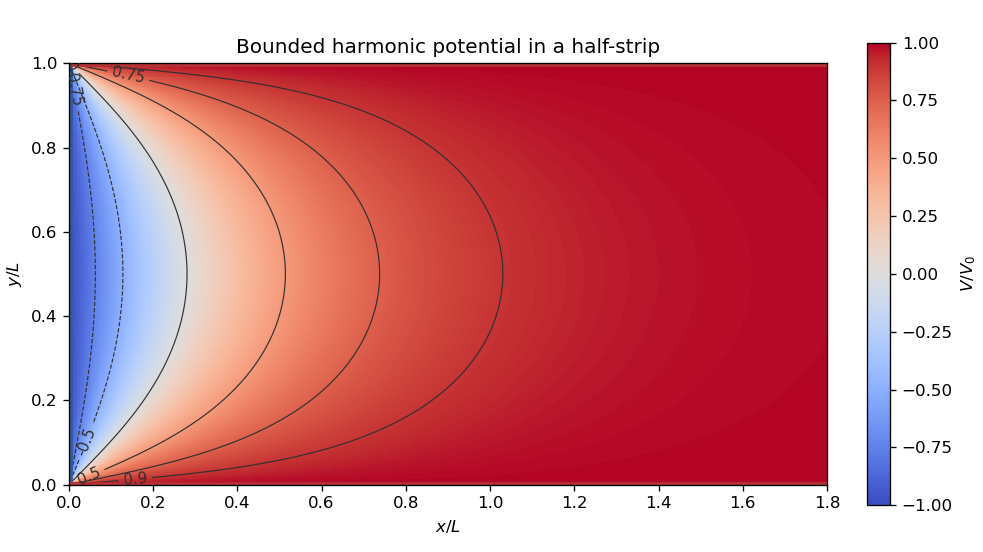
Logarithmic solution. Choose the complex logarithms of with arguments between zero and in the upper half-plane. A linear combination is a complex-valued harmonic function, since it is a holomorphic function; the real physical potential must be a real or imaginary part. In particular, setThenOn the three real boundary intervals, the argument difference is respectively , which gives the required values. This is the bounded harmonic solution, with at infinity; uniqueness holds in this bounded class by the maximum principle. Without a boundedness or far-field condition, the edge data alone do not give uniqueness: one may add .
Back substitution. Sincethe required continuous argument difference is in the open half-strip. ConsequentlyAs with , the arctangent tends to zero; as with , it tends to . These limits verify every open edge of the Dirichlet problem.

New to topics? Read the docs here!