Solution

ID: past-exam-of-the-short-options-paper-shared-by-parts-a-and-b-of-the-physics-course-of-the-university-of-oxford/2019/s2/1/b/solution

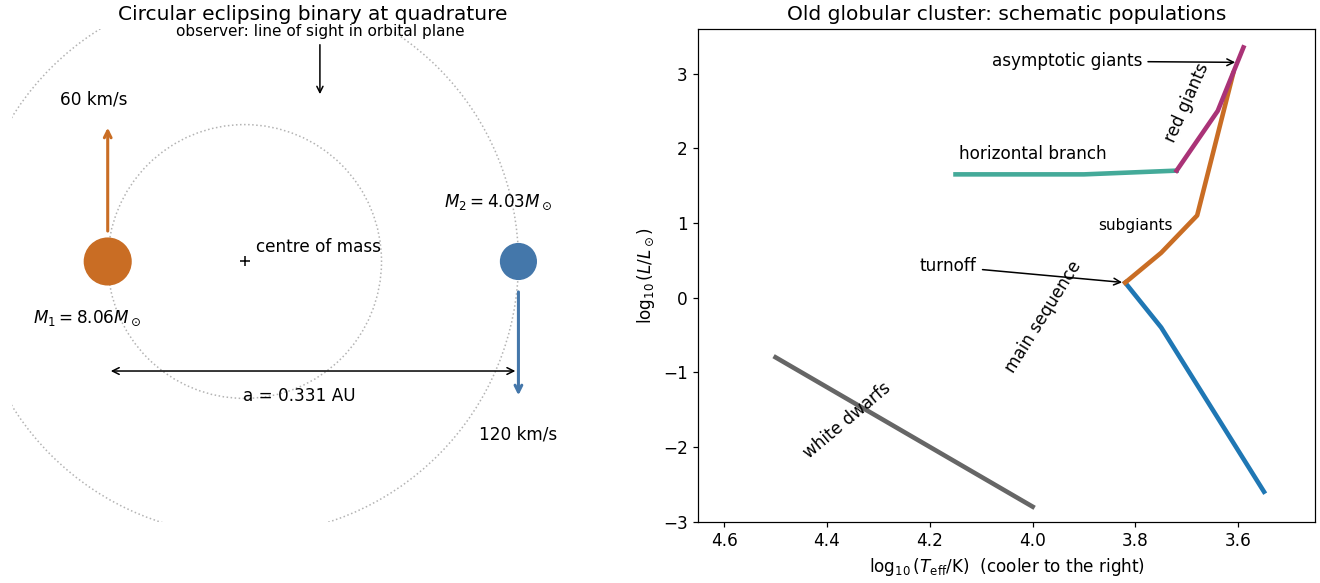
Assume a circular orbit and an orbital inclination , as appropriate for a simple eclipsing binary estimate. At quadrature the two radial velocities are opposite and equal to the orbital speeds. The more massive component has the smaller amplitude. With the centre of mass as origin,
Thus , and Kepler's third law gives
The orbital plane contains the observer's line of sight; at quadrature the two velocities point towards and away from that observer, as labelled in the original schematic below. For an elliptic orbit, the measured amplitudes instead give ; the numerical answer requires the circular assumption.

Figure 1.
Binary geometry and an old globular-cluster Hertzsprung-Russell diagram; both panels are schematic
. Details.

New to topics? Read the docs here!