For an isolated two-body problem in Newtonian gravity, the relative elliptic orbit's orbital period obeysHere is the relative semi-major axis, and is the sum of the two masses. The separation varies during an elliptic orbit, so replacing by works only for a circular orbit, where . Likewise, either body's individual semi-major axis about the centre of mass must first be converted to the relative one. When is negligible compared with , the denominator can be approximated by .
For fixed gravitational parameter, the orbital period depends on the semi-major axis and is independent of orbital eccentricity. Our , example gives both for and for a circular orbit with . The eccentric body's rapidly changing speed compensates for its different path. A compact way to see the cancellation uses Kepler's second law: divide the ellipse's area by its areal velocity . With and specific angular momentum , the result is .
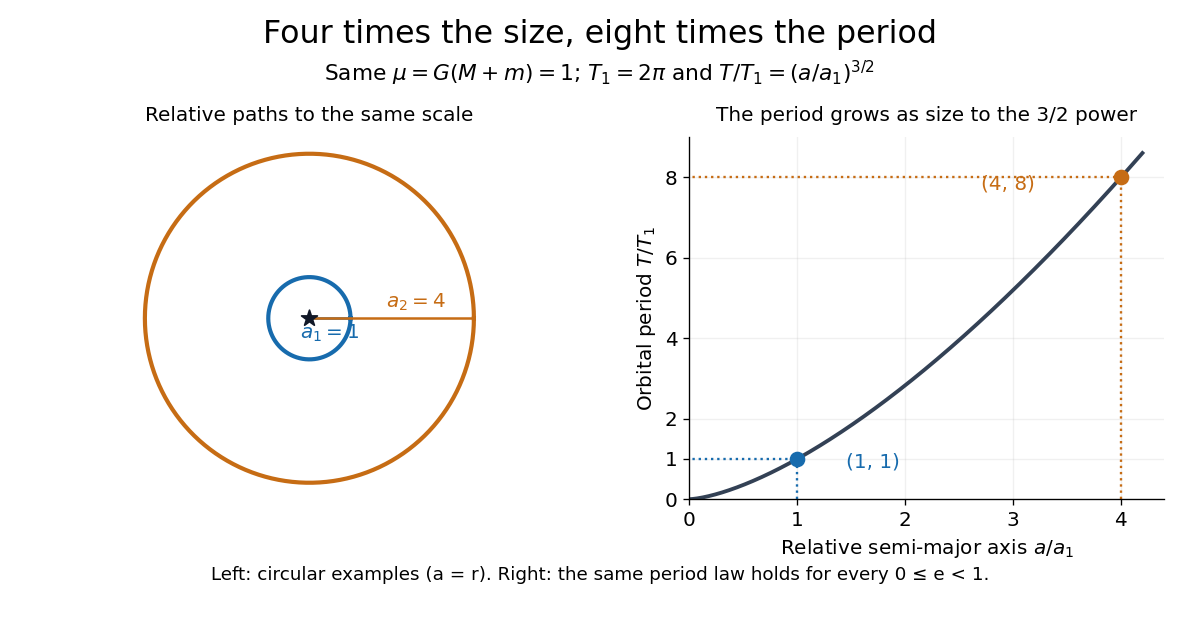
Compare two separate Kepler orbits with the same gravitational parameter, and :With , their orbital periods are and ; measured in units of , these are and . Quadrupling the size therefore takes eight times as long to complete a circuit. This power law makes comparisons possible without first choosing physical units.

The same relation can be inverted to weigh a system: . An observed relative semi-major axis and orbital period determine the total mass, while additional information is needed to separate the two masses. This is useful for binary stars, as discussed in NASA, Orbits and Kepler's Laws: measuring masses. Geometry and a clock together become a weighing instrument.
Articles by others on the same topic
There are currently no matching articles.