Solution

ID: past-exam-of-the-short-options-paper-shared-by-prelims-and-parts-a-and-b-of-the-physics-course-of-the-university-of-oxford/2015/s16/1/2/solution

Let be the conserved number density of hydrogen nuclei, whether ionized or bound, and the ionization fraction. The ideal gas pressure counts neutral atoms, free protons and free electrons:
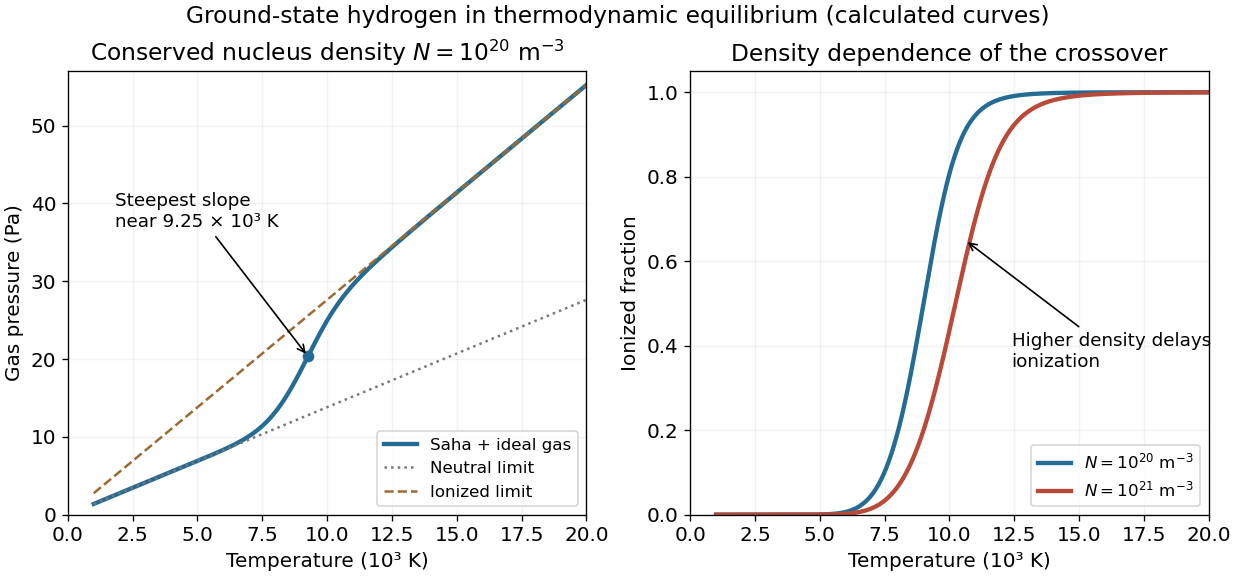
At low temperature and . Heating through the ionization region increases the particle count as well as their thermal energy, giving a steeper rise. At high temperature , so and the asymptotic slope is twice the low-temperature slope. There is a smooth ionization crossover, not a pressure discontinuity.
The held graph is legible. Representative readings are and , with readout uncertainties of roughly – and about . They give on the neutral branch and on the ionized branch, respectively. Both are consistent with
The error is a conservative graph-reading estimate, not a fitted experimental confidence interval.
For that density, the Saha equation gives at , at , and at . Differentiating the ionization relation gives
The calculated maximum slope occurs near , consistent with the source's visibly steepest region at roughly . This checks the actual slope rather than identifying it without justification with exactly half ionization.

Taking the neutral ground-state gas as the zero of internal binding energy, the matter energy density is translational kinetic energy plus ionization energy:
At , with , these terms are about and , giving
Rest energies are excluded. A separate equilibrium radiation field, if the gas were in a blackbody cavity, would add its own radiation energy density; it is not part of this gas-only estimate.
Figure 1.
Calculated hydrogen pressure and ionization crossover at two conserved nucleus densities
. Details.

New to topics? Read the docs here!