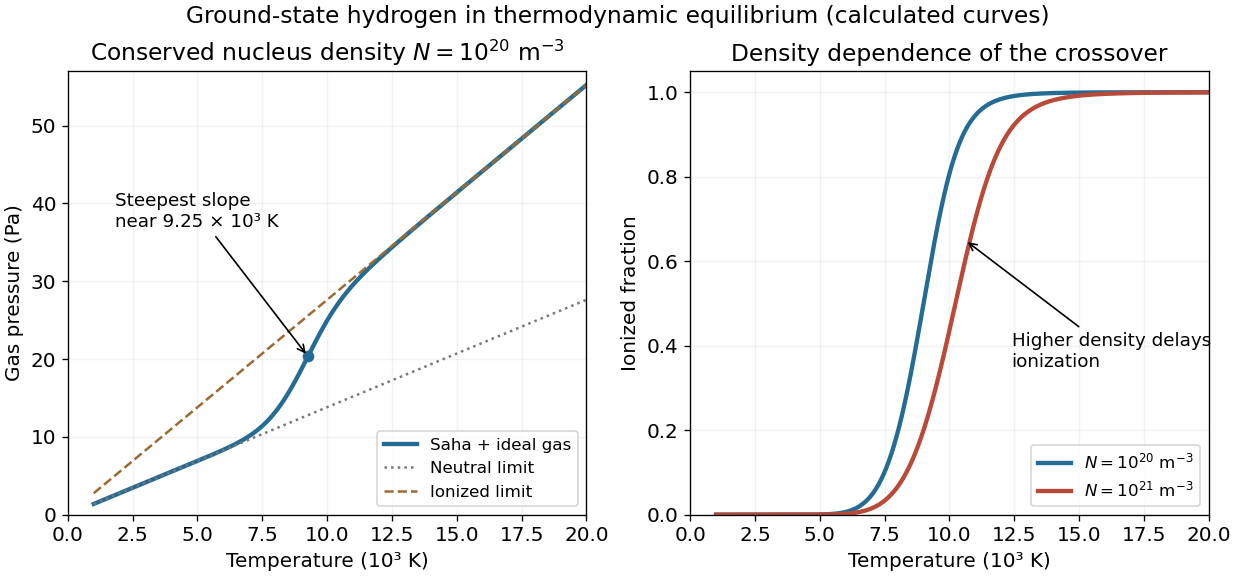
Let N=nH+np be the conserved number density of hydrogen nuclei, whether ionized or bound, and x=np/N=ne/N the ionization fraction. The ideal gas pressure counts neutral atoms, free protons and free electrons:At low temperature x≃0 and P≃NkBT. Heating through the ionization region increases the particle count as well as their thermal energy, giving a steeper rise. At high temperature x≃1, so P≃2NkBT and the asymptotic slope is twice the low-temperature slope. There is a smooth ionization crossover, not a pressure discontinuity.
P=NkBT(1+x),1−xx2=NS(T),S(T)=h3(2πmekBT)3/2e−R/(kBT).
The held graph is legible. Representative readings are P(5000K)≃6.8Pa and P(15000K)≃41.4Pa, with readout uncertainties of roughly 0.3–0.5Pa and about 100K. They give N≃P/(kBT) on the neutral branch and N≃P/(2kBT) on the ionized branch, respectively. Both are consistent withThe error is a conservative graph-reading estimate, not a fitted experimental confidence interval.
N≃(1.0±0.05)×1020m−3.
For that density, the Saha equation gives x≃0.50 at 9000K, x≃0.81 at 10000K, and x≃0.9992 at 15000K. Differentiating the ionization relation givesThe calculated maximum slope occurs near 9.25×10³K, consistent with the source's visibly steepest region at roughly (9.3±0.4)×103K. This checks the actual slope rather than identifying it without justification with exactly half ionization.
x′=2−xx(1−x)(2T3+kBT2R),P′=NkB(1+x+Tx′).
Taking the neutral ground-state gas as the zero of internal binding energy, the matter energy density is translational kinetic energy plus ionization energy:At 15000K, with R=13.6eV, these terms are about 62 and 218Jm−3, givingRest energies are excluded. A separate equilibrium radiation field, if the gas were in a blackbody cavity, would add its own radiation energy density; it is not part of this gas-only estimate.
u=23NkBT(1+x)+NxR.
u≃2.8×10²Jm−3.

Ancestors (12)
- 2
- 1
- S16
- 2015
- Past exam of the short options paper shared by Prelims and Parts A and B of the physics course of the University of Oxford
- Short options paper shared by Prelims and Parts A and B of the physics course of the University of Oxford
- Physics course of the University of Oxford
- Undergraduate course of the University of Oxford
- Course of the University of Oxford
- University of Oxford
- List of universities
- Home
Discussion (0)
New discussionThere are no discussions about this article yet.
Articles by others on the same topic (0)
There are currently no matching articles.