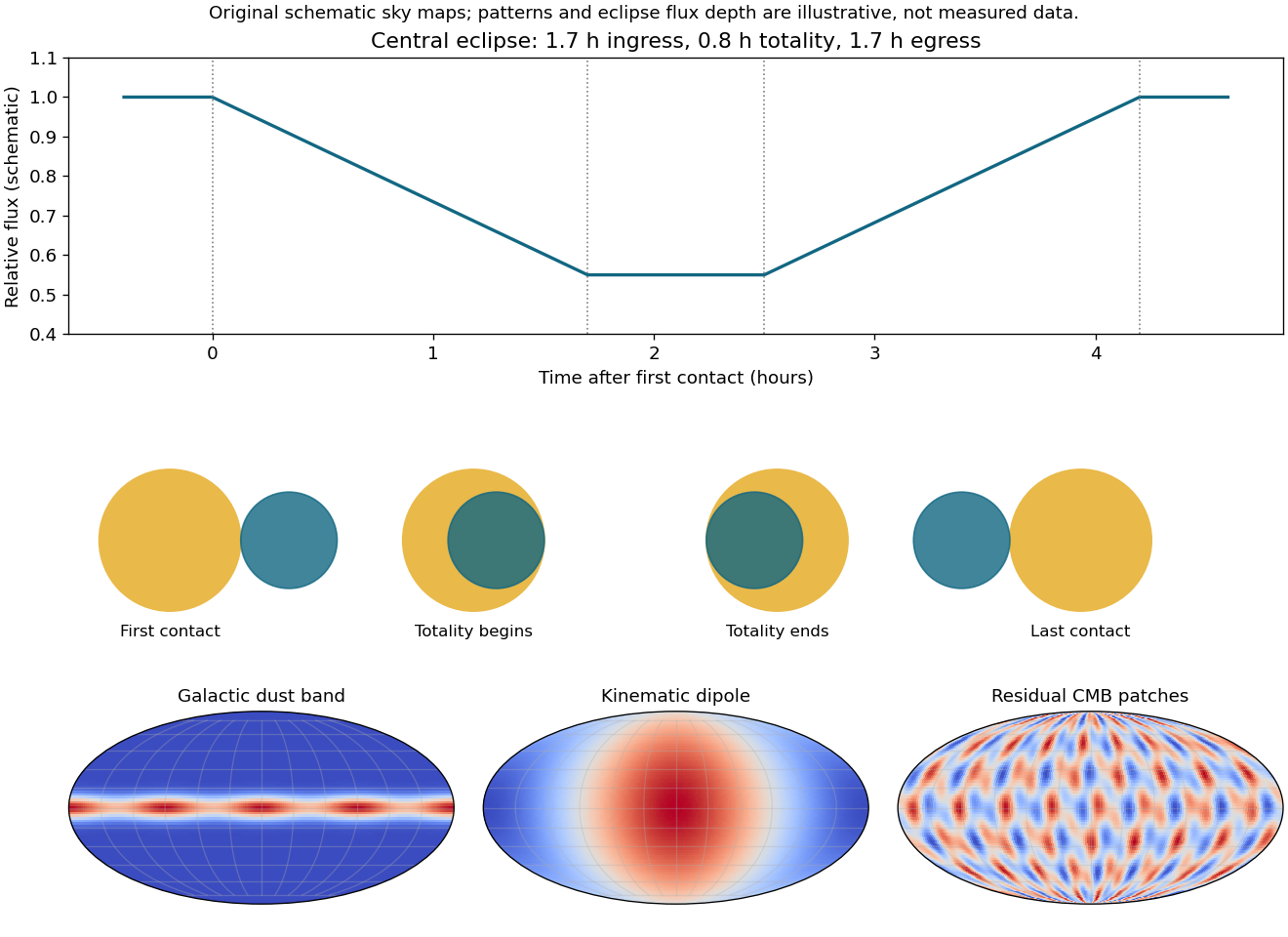
Assume
a central
eclipse and nearly uniform projected
speed during it. Let
r be the smaller
radius and
R the larger.
First-to-
second contact requires
travel 2r, whereas the totality interval requires
2(R−r). With relative
speed 200 km
s−1,
r=2v(1.7 h)≃6.12×10⁵ km,R=r+2v(0.8 h)≃9.00×10⁵ km.
The
light curve has ingress, flat minimum and egress lasting
1.
7,
0.
8 and
1.
7 hours. At the four
contacts the projected center separations are
R+r,R−r,R−r,R+r.
A noncentral chord would require an
impact parameter and changes the inferred
radii; the
data alone do not fix that
geometry exactly. For comparable
masses in an ordinary coeval system,
a component larger than its
main sequence companion suggests expansion away from the
main sequence, conventionally toward
a subgiant/early giant track. That is
a conditional evolutionary interpretation: neither
effective temperature nor
a bolometric
flux is supplied, so
a unique
position on the
Hertzsprung-Russell diagram cannot be inferred from these
radii alone. Binary interactions and the assumed central chord also
matter; these
numbers do not establish an ordinary single-
star evolutionary
model.