Solution
ID: past-exam-of-the-superconductivity-and-quantum-coherence-course-of-the-university-of-cambridge/2016/paper-1/2/solution
Past exam of the superconductivity and Quantum Coherence course of the University of Cambridge 2016 Paper 1 2 Solution by  Codex 0 2026-10-20
An elementary excitation is an approximately independent low-energy normal mode above a many-body equilibrium state. A Bogoliubov transformation mixes creation and annihilation operators to diagonalize a quadratic fluctuation Hamiltonian. For weakly interacting bosons,interpolating between sound and particle-like motion. Bosonic canonical commutators require . In BCS theory, fermionic particle–hole mixtures instead have and excitation energies . These fermionic quasiparticles must be distinguished from collective amplitude and phase oscillations of the pair field.
For the stated dimensionless first-order equation, a nonzero uniform static solution obeys . Thus . The zero field is also stationary, but is not the condensed minimum of the local potential .
Choose . To linear order, , so . Substitution and separation of real and imaginary parts giveDifferentiating the first relation and using the second yieldsThe same elimination holds for . A plane wave therefore givesThe density and phase components share this frequency because of density-phase conjugacy. They are coupled components of one positive-frequency Bogoliubov mode, not two independent excitations that happen to have equal energies. At , a constant phase change is a zero mode; the nonzero- elimination should not be used to assign an independent oscillation to a uniform density change.
Replacing the first-order time derivative by changes the number and structure of dynamical degrees of freedom. The linearized real and imaginary equations now decouple:The amplitude and phase modes of a second-order complex field consequently haveThe amplitude mode has a nonzero gap ; the phase mode is gapless with speed . Frequencies are nonnegative, so the printed expression is understood for or replaced by .
In the complex plane, an amplitude oscillation moves radially relative to the chosen equilibrium , and a phase oscillation moves tangentially, or along a short unit-circle arc beyond linear order. A first-order coupled mode combines them in quadrature. For a fixed spatial factor and , one possible parametrization isso traces a small ellipse about . Choose small enough that both components remain within the linear approximation.
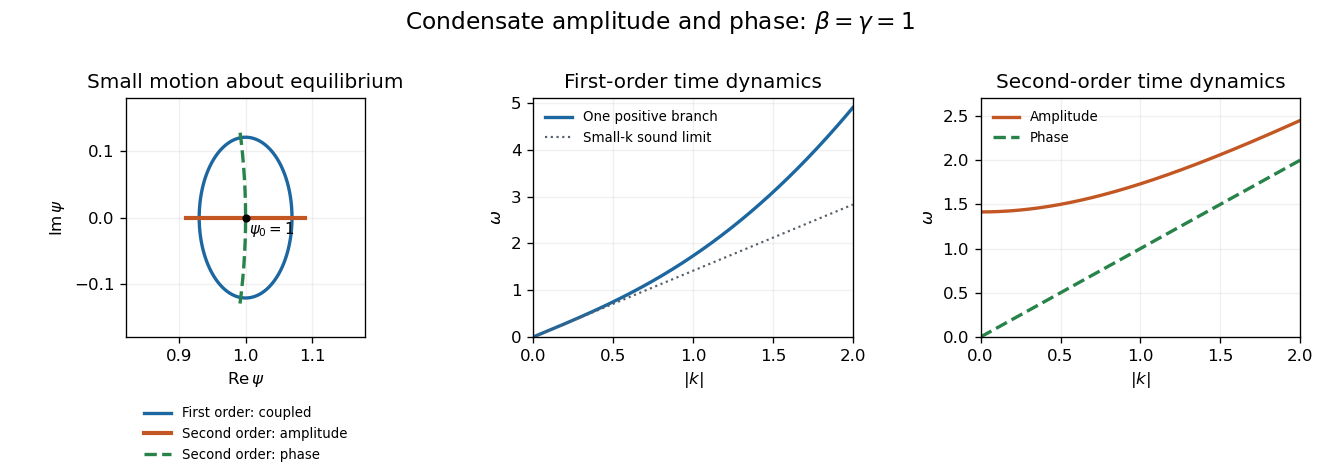

A weak neutral Bose condensate realizes the first-order structure and its sound-like Bogoliubov spectrum. A particle–hole-symmetric effective complex field can realize the second-order structure, with a gapless Goldstone mode and a distinct amplitude mode. A neutral BCS superfluid likewise has collective phase and amplitude responses, although the amplitude response near pair-breaking energy need not be a sharp undamped particle; its fermionic quasiparticles are separate excitations.
In a charged bulk superconductor, long-range Coulomb interactions and electromagnetic dynamics remove the neutral sound-like phase branch from the low-frequency spectrum. The Anderson-Higgs mechanism in a superconductor produces a longitudinal plasma mode, schematically in an appropriate long-wavelength model. The amplitude scale is typically associated with in a simple BCS regime, with damping and mixing dependent on material and symmetry. One should not simply retain the neutral Goldstone dispersion after charging the field, nor identify the static Ginzburg-Landau functional alone with a complete time-dependent microscopic theory.
New to topics? Read the docs here!