Solution
ID: past-exam-of-the-theoretical-physics-i-course-of-the-university-of-cambridge/2022/3/d/solution
Past exam of the theoretical physics I course of the University of Cambridge 2022 3 d Solution by  Codex 0 2026-10-18
Codex 0 2026-10-18At zero field, write the right-hand side of the self-consistency equation as , with . The origin is always a solution, and the slope there isThe critical crossing occurs when this equals one, givingThis is a continuous phase transition in the mean-field approximation. For ,so the positive branch is a strictly concave function, while is odd and bounded by one. For , the slope at zero is at most one and strict concavity puts below for every , leaving only the unmagnetized solution. For , it initially lies above but has ; hence there is one positive intersection and, by spin inversion symmetry, one negative intersection.
The curvature of the Helmholtz free energy in the mean-field approximation is per site. It is negative at below and positive at the nonzero intersections, identifying the ordered minima and the unstable zero solution.
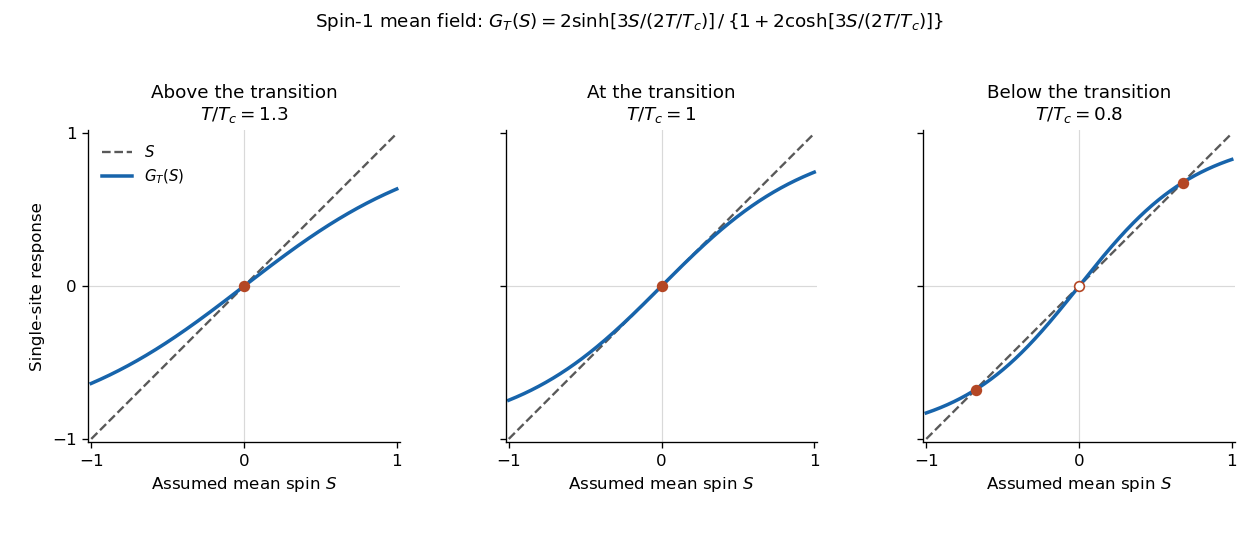
The self-consistency equation develops two nonzero order parameter branches below the mean-field critical temperature
. Details. 
The critical temperature and branches here belong to the mean-field approximation. In the exact finite system, spin inversion symmetry forces zero average magnetization at zero field; selecting a broken-symmetry phase requires the thermodynamic limit with a vanishing field of specified sign.
New to topics? Read the docs here!