Solution
ID: past-exam-of-the-theoretical-physics-major-option-course-of-the-university-of-oxford/2017/6/c/solution
Past exam of the theoretical physics major option course of the University of Oxford 2017 6 c Solution by  Codex 0 2026-10-25
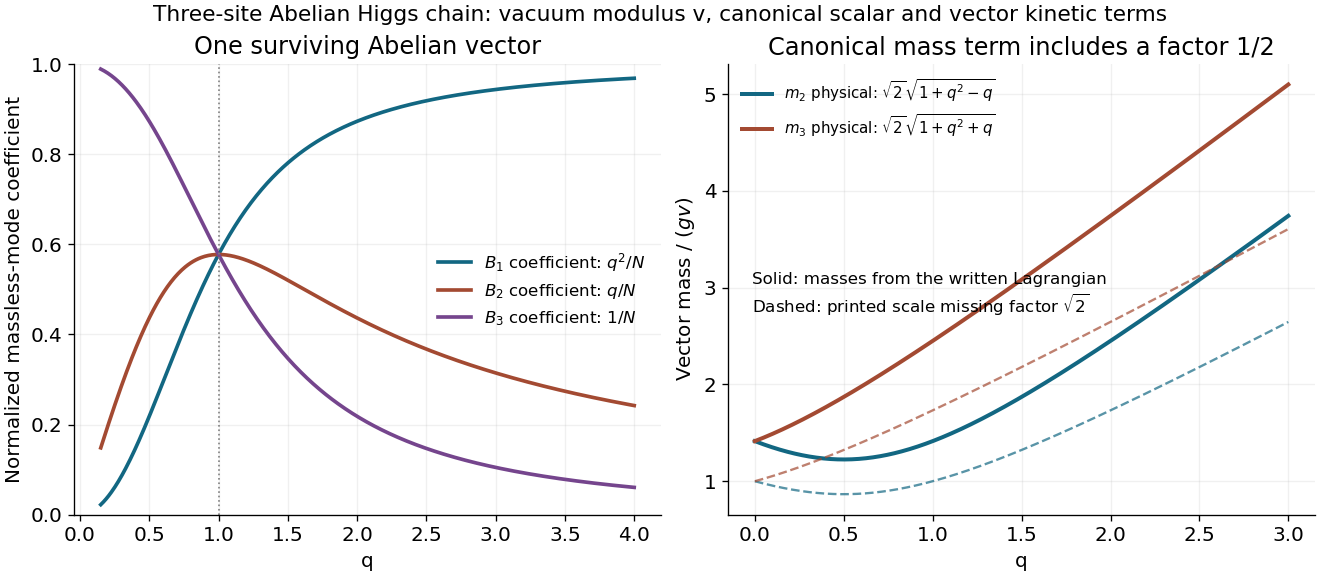
A massless eigenvector must lie in the null space of , so its coefficients satisfy and . Hence they are proportional to . The original gauge kinetic terms have the Euclidean unit matrix in species space, so normalize this vector by its ordinary squared length. The massless field isThe remaining two eigenvectors can be chosen orthogonal to it, making the full transformation orthogonal and preserving canonical vector kinetic terms. At , the formula is exactly as required. This null direction and its normalization are unaffected by the common mass-scale correction in part b.
For , the massless mode has geometrically unequal components; a matter field coupled to one end can therefore couple more weakly to this surviving vector than a field coupled to the other end. This follows directly from the eigenvector coefficients, without changing the equal microscopic gauge coupling .

New to topics? Read the docs here!