A nonzero vector v is an eigenvector of a linear operator A when Av=λv for some eigenvalue λ. For a real vector space and λ=0, the line through v is preserved: the image can point forward or backward, but cannot turn away from that line. When λ=0, the image is zero and has no direction. The zero vector is excluded because it satisfies the equation for every scalar and identifies no special direction.
Every nonzero scalar multiple of an eigenvector is an eigenvector for the same eigenvalue, since A(cv)=cAv=λ(cv). Thus there is usually no preferred length or sign; choosing a unit vector is a convenient normalization. Eigenvectors for a fixed eigenvalue, together with zero, form its eigenspace.
For a fully computed example, consider the real symmetric matrixIts characteristic polynomial isFor λ=3, (A−3I)v=0 gives −x+y=0, so v3=(1,1)T is an eigenvector. For λ=1, (A−I)v=0 gives x+y=0, so v1=(1,−1)T is an eigenvector. Direct multiplication checks both:The map stretches the line y=x threefold and fixes the line y=−x pointwise. These eigenvectors are orthogonal because v3Tv1=0; dividing each by 2 gives an orthonormal basis. A general vector turns because its components along these two lines receive different scalings. For example, (1,0)T maps to (2,1)T and is not an eigenvector.
A=(2112),A(xy)=(2x+yx+2y).
pA(λ)=det(λ−2−1−1λ−2)=(λ−2)2−1=(λ−3)(λ−1).
Av3=(33)=3v3,Av1=(1−1)=v1.
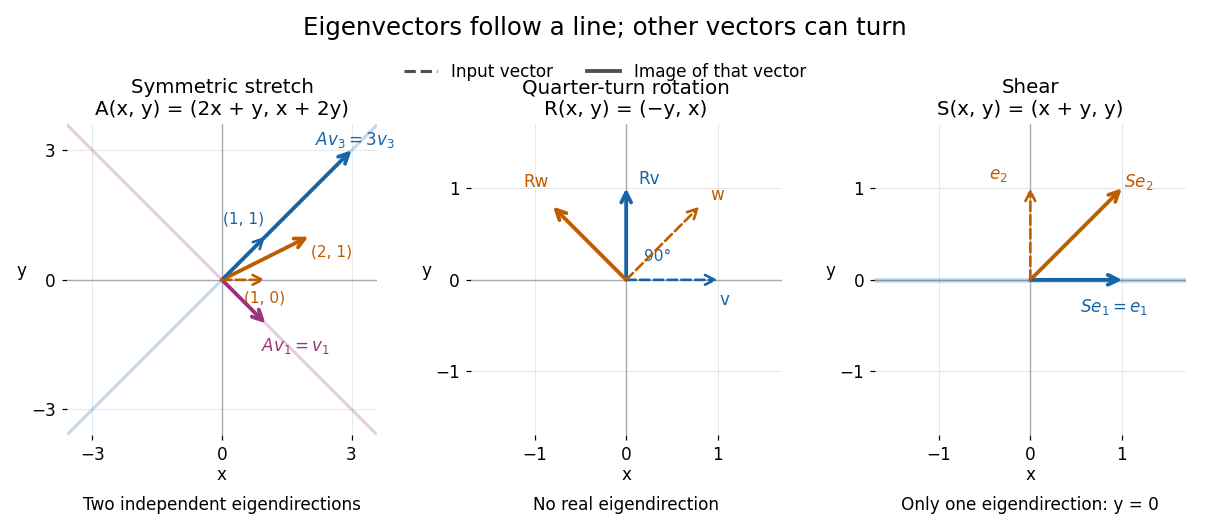
A contrasting example is the planar rotation through 90 degrees:Every nonzero real vector turns to a perpendicular direction, so there are no real eigenvectors. Its characteristic polynomial is λ2+1, which has no real roots. Over the complex numbers, however, R(1,−i)T=i(1,−i)T and R(1,i)T=−i(1,i)T. The same matrix therefore has an eigenbasis in C2 even though it has none in R2: the choice of field matters.
R=(01−10),R(xy)=(−yx).
A zero mode is a nonzero eigenvector of an operator with eigenvalue zero. For a differential fluctuation operator it must also satisfy the specified boundary conditions. A zero mode prevents ordinary inversion of the operator and makes its unmodified functional determinant vanish. Gauge directions can produce zero modes of a kinetic operator, while stationary-path focusing can produce them in a semiclassical boundary-value problem. Removing, separately integrating or otherwise treating these directions is necessary before using a Gaussian determinant formula.
Applying the product of the other eigenvalue factors to a linear relation isolates each coefficient. Distinct eigenvalues therefore give linearly independent eigenvectors. A complete eigenvector basis diagonalizes the associated linear system of ordinary differential equations.
Ancestors (7)
Incoming links (448)
- Acoustic tensor
- Alfvén characteristic eigenvector
- Approximate eigenvector
- Brouwer fixed-point theorem
- Canonical discriminant directions
- Cauchy-Euler differential system
- Characteristic map of a subdivision surface
- Characteristic speed
- CHSH optimum from the correlation tensor
- Circulant matrix
- Classical multidimensional scaling
- Commuting maps preserve eigenspaces
- Commuting with a ground projector does not imply frustration freeness
- Covariance ellipse
- Covariance matrix
- Degeneracy of principal moments of inertia
- Density matrix
- Diagonalizable matrix
- Diagonal monomial action of a second-order Euler operator
- Diffusion on a graph
- Disconnected spectrum gives a reducing subspace
- DORT method
- Effective Hamiltonian for neutral-meson mixing
- Eigenbasis
- Eigenfunction of an absolutely one-homogeneous functional
- Eigenline
- Eigenphase
- Eigenspace
- Eigenstate
- Eigenvalue
- Eigenvalue equation
- Eigenvalue problem
- Eigenvector
- Eigenvectors under similarity
- Ellipsoid level sets of a positive-definite quadratic form
- Energy eigenstate
- Exact two-dimensional power iteration
- Exponential map of a Lie group
- Failure of Lie theorem in positive characteristic
- Finite-dimensional spectral theorem
- Floquet multiplier
- Fourier diagonalization of a circulant matrix
- Gershgorin circle theorem
- Hecke eigenform
- Hermitian effect variational principle
- Hermitian operator
- Hermitian quadratic form
- Hermitian Rayleigh quotient range
- Hessian matrix
- HHL controlled reciprocal rotation
- Hyperbolicity
- Identity operator
- Independence of eigenvectors for distinct eigenvalues
- Irreducible nonnegative matrix
- Irreducible representation
- Joint spectrum
- Kaon mixing square-root branch convention
- Kernel of a graph Laplacian
- Kronecker sum
- Ky Fan maximum principle
- Laplacian matrix
- Largest-eigenvalue interlacing for a principal submatrix
- Linearly degenerate characteristic field
- Operator theory
- Mass eigenstate
- Matrix trace
- Monodromy eigenfunction Laurent representation
- Multigrid method
- Neutral-kaon mass matrix diagonalization
- Nonorthogonal vectors
- Normal mode
- Operator commutator
- Optimal energy amplification of a linear system
- Orthonormal eigenbasis
- Past exam of the mathematics course of the University of Cambridge / 2001 / ia / Paper 2 / 7B / Solution
- Past exam of the mathematics course of the University of Cambridge / 2001 / ib / Paper 1 / 14C / b / Solution
- Past exam of the mathematics course of the University of Cambridge / 2001 / ib / Paper 1 / 17B / Solution
- Past exam of the mathematics course of the University of Cambridge / 2001 / iii / Paper 30 / 3 / a / Solution
- Past exam of the mathematics course of the University of Cambridge / 2001 / iii / Paper 47 / 2 / Solution
- Past exam of the mathematics course of the University of Cambridge / 2001 / iii / Paper 51 / 1 / c / Solution
- Past exam of the mathematics course of the University of Cambridge / 2001 / iii / Paper 57 / 2 / b / Solution
- Past exam of the mathematics course of the University of Cambridge / 2001 / iii / Paper 63 / 1 / Solution
- Past exam of the mathematics course of the University of Cambridge / 2002 / ia / Paper 1 / 2D / Solution
- Past exam of the mathematics course of the University of Cambridge / 2002 / ia / Paper 2 / 8D / Solution
- Past exam of the mathematics course of the University of Cambridge / 2002 / ib / Paper 1 / 14G / b / Solution
- Past exam of the mathematics course of the University of Cambridge / 2002 / ib / Paper 1 / 5G / Solution
- Past exam of the mathematics course of the University of Cambridge / 2002 / ib / Paper 2 / 11C / Solution
- Past exam of the mathematics course of the University of Cambridge / 2002 / ib / Paper 2 / 15G / a / Solution
- Past exam of the mathematics course of the University of Cambridge / 2002 / ib / Paper 2 / 17F / ii / Solution
- Past exam of the mathematics course of the University of Cambridge / 2002 / ib / Paper 2 / 17F / iv / Solution
- Past exam of the mathematics course of the University of Cambridge / 2002 / iii / Paper 11 / 2 / Solution
- Past exam of the mathematics course of the University of Cambridge / 2002 / iii / Paper 39 / 2 / Solution
- Past exam of the mathematics course of the University of Cambridge / 2002 / iii / Paper 51 / 2 / Solution
- Past exam of the mathematics course of the University of Cambridge / 2002 / iii / Paper 58 / 4 / Solution
- Past exam of the mathematics course of the University of Cambridge / 2002 / iii / Paper 60 / 1 / a / Solution
- Past exam of the mathematics course of the University of Cambridge / 2002 / iii / Paper 60 / 4 / b / Solution
- Past exam of the mathematics course of the University of Cambridge / 2002 / iii / Paper 60 / 5 / b / Solution
- Past exam of the mathematics course of the University of Cambridge / 2002 / iii / Paper 60 / 7 / Solution
- Past exam of the mathematics course of the University of Cambridge / 2002 / iii / Paper 64 / 2 / Solution
- Past exam of the mathematics course of the University of Cambridge / 2002 / iii / Paper 64 / 3 / Solution
- Past exam of the mathematics course of the University of Cambridge / 2003 / ia / Paper 1 / 2D / Solution
- Past exam of the mathematics course of the University of Cambridge / 2003 / ia / Paper 1 / 5B / b / i / Solution
- Past exam of the mathematics course of the University of Cambridge / 2003 / ia / Paper 2 / 7D / i / Solution
- Past exam of the mathematics course of the University of Cambridge / 2003 / ia / Paper 2 / 7D / Solution
- Past exam of the mathematics course of the University of Cambridge / 2003 / ia / Paper 3 / 8B / a / Solution
- Past exam of the mathematics course of the University of Cambridge / 2003 / ia / Paper 3 / 8B / b / Solution
- Past exam of the mathematics course of the University of Cambridge / 2003 / ib / Paper 2 / 2C / Solution
- Past exam of the mathematics course of the University of Cambridge / 2003 / ib / Paper 3 / 7G / Solution
- Past exam of the mathematics course of the University of Cambridge / 2003 / ib / Paper 4 / 6G / Solution
- Past exam of the mathematics course of the University of Cambridge / 2003 / iii / Paper 35 / 1 / Solution
- Past exam of the mathematics course of the University of Cambridge / 2003 / iii / Paper 35 / 4 / i / Solution
- Past exam of the mathematics course of the University of Cambridge / 2003 / iii / Paper 42 / 3 / ii / Solution
- Past exam of the mathematics course of the University of Cambridge / 2003 / iii / Paper 46 / 2 / Solution
- Past exam of the mathematics course of the University of Cambridge / 2003 / iii / Paper 59 / 1 / b / Solution
- Past exam of the mathematics course of the University of Cambridge / 2003 / iii / Paper 59 / 2 / b / Solution
- Past exam of the mathematics course of the University of Cambridge / 2004 / ia / Paper 2 / 8B / Solution
- Past exam of the mathematics course of the University of Cambridge / 2004 / ia / Paper 3 / 7D / Solution
- Past exam of the mathematics course of the University of Cambridge / 2004 / ia / Paper 3 / 8D / Solution
- Past exam of the mathematics course of the University of Cambridge / 2004 / ib / Paper 2 / 17B / Solution
- Past exam of the mathematics course of the University of Cambridge / 2004 / ib / Paper 3 / 13E / i / Solution
- Past exam of the mathematics course of the University of Cambridge / 2004 / iii / Paper 50 / 5 / Solution
- Past exam of the mathematics course of the University of Cambridge / 2004 / iii / Paper 53 / 1 / 2 / Solution
- Past exam of the mathematics course of the University of Cambridge / 2004 / iii / Paper 53 / 1 / 3 / Solution
- Past exam of the mathematics course of the University of Cambridge / 2004 / iii / Paper 53 / 1 / Solution
- Past exam of the mathematics course of the University of Cambridge / 2004 / iii / Paper 60 / 3 / c / Solution
- Past exam of the mathematics course of the University of Cambridge / 2004 / iii / Paper 69 / 7 / Solution
- Past exam of the mathematics course of the University of Cambridge / 2004 / iii / Paper 72 / 3 / a / Solution
- Past exam of the mathematics course of the University of Cambridge / 2004 / iii / Paper 75 / 3 / b / Solution
- Past exam of the mathematics course of the University of Cambridge / 2005 / ia / Paper 1 / 2B / Solution
- Past exam of the mathematics course of the University of Cambridge / 2005 / ia / Paper 3 / 11A / Solution
- Past exam of the mathematics course of the University of Cambridge / 2005 / ib / Paper 2 / 10C / ii / Solution
- Past exam of the mathematics course of the University of Cambridge / 2005 / ib / Paper 4 / 1B / Solution
- Past exam of the mathematics course of the University of Cambridge / 2005 / iii / Paper 16 / 3 / c / Solution
- Past exam of the mathematics course of the University of Cambridge / 2005 / iii / Paper 46 / 2 / ii / Solution
- Past exam of the mathematics course of the University of Cambridge / 2005 / iii / Paper 46 / 2 / i / Solution
- Past exam of the mathematics course of the University of Cambridge / 2005 / iii / Paper 46 / 2 / Solution
- Past exam of the mathematics course of the University of Cambridge / 2005 / iii / Paper 49 / 2 / Solution
- Past exam of the mathematics course of the University of Cambridge / 2005 / iii / Paper 59 / 2 / Solution
- Past exam of the mathematics course of the University of Cambridge / 2005 / iii / Paper 65 / 2 / d / Solution
- Past exam of the mathematics course of the University of Cambridge / 2005 / iii / Paper 79 / 5 / b / Solution
- Past exam of the mathematics course of the University of Cambridge / 2005 / iii / Paper 83 / 4 / iii / Solution
- Past exam of the mathematics course of the University of Cambridge / 2005 / ii / Paper 2 / 38A / Solution
- Past exam of the mathematics course of the University of Cambridge / 2005 / ii / Paper 4 / 6E / b / iii / Solution
- Past exam of the mathematics course of the University of Cambridge / 2005 / ii / Paper 4 / 6E / c / Solution
- Past exam of the mathematics course of the University of Cambridge / 2006 / ia / Paper 2 / 5B / Solution
- Past exam of the mathematics course of the University of Cambridge / 2006 / ia / Paper 3 / 1D / ii / Solution
- Past exam of the mathematics course of the University of Cambridge / 2006 / ia / Paper 3 / 1D / i / Solution
- Past exam of the mathematics course of the University of Cambridge / 2006 / ib / Paper 1 / 14A / Solution
- Past exam of the mathematics course of the University of Cambridge / 2006 / iii / Paper 46 / 3 / a / Solution
- Past exam of the mathematics course of the University of Cambridge / 2006 / iii / Paper 46 / 3 / b / ii / Solution
- Past exam of the mathematics course of the University of Cambridge / 2006 / iii / Paper 46 / 3 / b / i / Solution
- Past exam of the mathematics course of the University of Cambridge / 2006 / iii / Paper 46 / 3 / b / iv / Solution
- Past exam of the mathematics course of the University of Cambridge / 2006 / iii / Paper 66 / 5 / f / Solution
- Past exam of the mathematics course of the University of Cambridge / 2006 / iii / Paper 68 / 2 / b / Solution
- Past exam of the mathematics course of the University of Cambridge / 2006 / iii / Paper 72 / 3 / iv / e / Solution
- Past exam of the mathematics course of the University of Cambridge / 2006 / iii / Paper 8 / 2 / Solution
- Past exam of the mathematics course of the University of Cambridge / 2006 / iii / Paper 85 / 1 / c / Solution
- Past exam of the mathematics course of the University of Cambridge / 2006 / ii / Paper 2 / 38C / Solution
- Past exam of the mathematics course of the University of Cambridge / 2006 / ii / Paper 4 / 19F / a / i / Solution
- Past exam of the mathematics course of the University of Cambridge / 2006 / ii / Paper 4 / 22G / Solution
- Past exam of the mathematics course of the University of Cambridge / 2007 / ia / Paper 3 / 7D / iii / Solution
- Past exam of the mathematics course of the University of Cambridge / 2007 / ia / Paper 3 / 7D / ii / Solution
- Past exam of the mathematics course of the University of Cambridge / 2007 / ia / Paper 3 / 7D / Solution
- Past exam of the mathematics course of the University of Cambridge / 2007 / ib / Paper 1 / 1G / Solution
- Past exam of the mathematics course of the University of Cambridge / 2007 / ib / Paper 2 / 18F / Solution
- Past exam of the mathematics course of the University of Cambridge / 2007 / ib / Paper 2 / 1G / Solution
- Past exam of the mathematics course of the University of Cambridge / 2007 / ib / Paper 3 / 16B / Solution
- Past exam of the mathematics course of the University of Cambridge / 2007 / iii / Paper 10 / 4 / b / Solution
- Past exam of the mathematics course of the University of Cambridge / 2007 / iii / Paper 10 / 7 / Solution
- Past exam of the mathematics course of the University of Cambridge / 2007 / iii / Paper 2 / 2 / a / Solution
- Past exam of the mathematics course of the University of Cambridge / 2007 / iii / Paper 2 / 4 / c / Solution
- Past exam of the mathematics course of the University of Cambridge / 2007 / iii / Paper 4 / 1 / ii / Solution
- Past exam of the mathematics course of the University of Cambridge / 2007 / iii / Paper 47 / 3 / b / Solution
- Past exam of the mathematics course of the University of Cambridge / 2007 / iii / Paper 53 / 1 / Solution
- Past exam of the mathematics course of the University of Cambridge / 2007 / iii / Paper 68 / 3 / ii / Solution
- Past exam of the mathematics course of the University of Cambridge / 2007 / iii / Paper 73 / 3 / c / Solution
- Past exam of the mathematics course of the University of Cambridge / 2007 / iii / Paper 73 / 4 / b / Solution
- Past exam of the mathematics course of the University of Cambridge / 2007 / iii / Paper 73 / 4 / d / Solution
- Past exam of the mathematics course of the University of Cambridge / 2007 / iii / Paper 74 / 3 / d / Solution
- Past exam of the mathematics course of the University of Cambridge / 2007 / iii / Paper 76 / 6 / Solution
- Past exam of the mathematics course of the University of Cambridge / 2007 / iii / Paper 83 / 4 / b / Solution
- Past exam of the mathematics course of the University of Cambridge / 2007 / ii / Paper 1 / 8B / Solution
- Past exam of the mathematics course of the University of Cambridge / 2007 / ii / Paper 2 / 7E / Solution
- Past exam of the mathematics course of the University of Cambridge / 2007 / ii / Paper 3 / 14E / ii / Solution
- Past exam of the mathematics course of the University of Cambridge / 2007 / ii / Paper 3 / 25J / b / Solution
- Past exam of the mathematics course of the University of Cambridge / 2007 / ii / Paper 3 / 32D / Solution
- Past exam of the mathematics course of the University of Cambridge / 2007 / ii / Paper 3 / 38C / a / Solution
- Past exam of the mathematics course of the University of Cambridge / 2007 / ii / Paper 4 / 2F / Solution
- Past exam of the mathematics course of the University of Cambridge / 2008 / ia / Paper 1 / 7C / Solution
- Past exam of the mathematics course of the University of Cambridge / 2008 / ia / Paper 1 / 8C / Solution
- Past exam of the mathematics course of the University of Cambridge / 2008 / ia / Paper 3 / 2E / Solution
- Past exam of the mathematics course of the University of Cambridge / 2008 / ib / Paper 3 / 7A / Solution
- Past exam of the mathematics course of the University of Cambridge / 2008 / ib / Paper 4 / 10E / Solution
- Past exam of the mathematics course of the University of Cambridge / 2008 / ib / Paper 4 / 1E / Solution
- Past exam of the mathematics course of the University of Cambridge / 2008 / iii / Paper 1 / 1 / a / Solution
- Past exam of the mathematics course of the University of Cambridge / 2008 / iii / Paper 58 / 3 / i / Solution
- Past exam of the mathematics course of the University of Cambridge / 2008 / iii / Paper 61 / 2 / e / i / Solution
- Past exam of the mathematics course of the University of Cambridge / 2008 / iii / Paper 69 / 3 / Solution
- Past exam of the mathematics course of the University of Cambridge / 2008 / iii / Paper 78 / 1 / d / Solution
- Past exam of the mathematics course of the University of Cambridge / 2008 / iii / Paper 80 / 6 / a / Solution
- Past exam of the mathematics course of the University of Cambridge / 2008 / iii / Paper 90 / 2 / c / Solution
- Past exam of the mathematics course of the University of Cambridge / 2008 / ii / Paper 3 / 25I / b / Solution
- Past exam of the mathematics course of the University of Cambridge / 2008 / ii / Paper 4 / 39C / a / Solution
- Past exam of the mathematics course of the University of Cambridge / 2008 / ii / Paper 4 / 39C / b / Solution
- Past exam of the mathematics course of the University of Cambridge / 2009 / ia / Paper 1 / 2B / c / Solution
- Past exam of the mathematics course of the University of Cambridge / 2009 / ia / Paper 1 / 7A / a / Solution
- Past exam of the mathematics course of the University of Cambridge / 2009 / ia / Paper 1 / 7A / b / Solution
- Past exam of the mathematics course of the University of Cambridge / 2009 / ia / Paper 1 / 7A / c / Solution
- Past exam of the mathematics course of the University of Cambridge / 2009 / ia / Paper 1 / 7A / Solution
- Past exam of the mathematics course of the University of Cambridge / 2009 / ib / Paper 1 / 6C / Solution
- Past exam of the mathematics course of the University of Cambridge / 2009 / ib / Paper 3 / 10G / Solution
- Past exam of the mathematics course of the University of Cambridge / 2009 / iii / Paper 27 / 1 / a / Solution
- Past exam of the mathematics course of the University of Cambridge / 2009 / iii / Paper 27 / 4 / c / Solution
- Past exam of the mathematics course of the University of Cambridge / 2009 / iii / Paper 6 / 1 / ii / Solution
- Past exam of the mathematics course of the University of Cambridge / 2009 / iii / Paper 6 / 1 / i / Solution
- Past exam of the mathematics course of the University of Cambridge / 2009 / iii / Paper 70 / 2 / Solution
- Past exam of the mathematics course of the University of Cambridge / 2009 / iii / Paper 72 / 6 / Solution
- Past exam of the mathematics course of the University of Cambridge / 2009 / iii / Paper 78 / 5 / a / Solution
- Past exam of the mathematics course of the University of Cambridge / 2009 / iii / Paper 8 / 2 / a / Solution
- Past exam of the mathematics course of the University of Cambridge / 2009 / iii / Paper 8 / 2 / b / Solution
- Past exam of the mathematics course of the University of Cambridge / 2009 / ii / Paper 1 / 39B / ii / Solution
- Past exam of the mathematics course of the University of Cambridge / 2009 / ii / Paper 4 / 12F / ii / Solution
- Past exam of the mathematics course of the University of Cambridge / 2009 / ii / Paper 4 / 22H / c / Solution
- Past exam of the mathematics course of the University of Cambridge / 2010 / ia / Paper 1 / 7B / ii / Solution
- Past exam of the mathematics course of the University of Cambridge / 2010 / ia / Paper 1 / 7B / i / Solution
- Past exam of the mathematics course of the University of Cambridge / 2010 / ia / Paper 1 / 7B / iv / Solution
- Past exam of the mathematics course of the University of Cambridge / 2010 / ia / Paper 1 / 8B / i / Solution
- Past exam of the mathematics course of the University of Cambridge / 2010 / ia / Paper 2 / 7A / a / Solution
- Past exam of the mathematics course of the University of Cambridge / 2010 / ia / Paper 2 / 7A / b / Solution
- Past exam of the mathematics course of the University of Cambridge / 2010 / ia / Paper 2 / 8A / a / Solution
- Past exam of the mathematics course of the University of Cambridge / 2010 / iii / Paper 63 / 7 / Solution
- Past exam of the mathematics course of the University of Cambridge / 2010 / ii / Paper 1 / 7D / Solution
- Past exam of the mathematics course of the University of Cambridge / 2010 / ii / Paper 2 / 3F / Solution
- Past exam of the mathematics course of the University of Cambridge / 2010 / ii / Paper 3 / 24H / ii / Solution
- Past exam of the mathematics course of the University of Cambridge / 2010 / ii / Paper 3 / 39A / Solution
- Past exam of the mathematics course of the University of Cambridge / 2011 / ia / Paper 1 / 7B / a / Solution
- Past exam of the mathematics course of the University of Cambridge / 2011 / ia / Paper 1 / 7B / c / Solution
- Past exam of the mathematics course of the University of Cambridge / 2011 / ia / Paper 1 / 8B / a / iii / Solution
- Past exam of the mathematics course of the University of Cambridge / 2011 / ia / Paper 1 / 8B / a / ii / Solution
- Past exam of the mathematics course of the University of Cambridge / 2011 / ia / Paper 1 / 8B / a / i / Solution
- Past exam of the mathematics course of the University of Cambridge / 2011 / ia / Paper 1 / 8B / b / Solution
- Past exam of the mathematics course of the University of Cambridge / 2011 / ii / Paper 1 / 17F / Solution
- Past exam of the mathematics course of the University of Cambridge / 2011 / ii / Paper 1 / 7C / Solution
- Past exam of the mathematics course of the University of Cambridge / 2011 / ii / Paper 3 / 21G / Solution
- Past exam of the mathematics course of the University of Cambridge / 2012 / ia / Paper 1 / 7B / a / Solution
- Past exam of the mathematics course of the University of Cambridge / 2012 / ia / Paper 1 / 7B / c / Solution
- Past exam of the mathematics course of the University of Cambridge / 2012 / ia / Paper 1 / 8B / a / ii / Solution
- Past exam of the mathematics course of the University of Cambridge / 2012 / ia / Paper 1 / 8B / a / i / Solution
- Past exam of the mathematics course of the University of Cambridge / 2012 / ia / Paper 1 / 8B / b / ii / Solution
- Past exam of the mathematics course of the University of Cambridge / 2012 / ia / Paper 2 / 7A / Solution
- Past exam of the mathematics course of the University of Cambridge / 2012 / iii / Paper 1 / 2 / Solution
- Past exam of the mathematics course of the University of Cambridge / 2012 / iii / Paper 1 / 3 / Solution
- Past exam of the mathematics course of the University of Cambridge / 2012 / iii / Paper 62 / 1 / Solution
- Past exam of the mathematics course of the University of Cambridge / 2012 / iii / Paper 67 / 4 / c / Solution
- Past exam of the mathematics course of the University of Cambridge / 2012 / iii / Paper 73 / 1 / iv / Solution
- Past exam of the mathematics course of the University of Cambridge / 2013 / ia / Paper 1 / 7B / a / Solution
- Past exam of the mathematics course of the University of Cambridge / 2013 / ia / Paper 1 / 7B / b / Solution
- Past exam of the mathematics course of the University of Cambridge / 2013 / ia / Paper 1 / 8B / b / Solution
- Past exam of the mathematics course of the University of Cambridge / 2013 / ib / Paper 2 / 1E / Solution
- Past exam of the mathematics course of the University of Cambridge / 2013 / iii / Paper 1 / 1 / Solution
- Past exam of the mathematics course of the University of Cambridge / 2013 / iii / Paper 1 / 5 / Solution
- Past exam of the mathematics course of the University of Cambridge / 2013 / iii / Paper 36 / 2 / a / Solution
- Past exam of the mathematics course of the University of Cambridge / 2013 / iii / Paper 58 / 1 / b / Solution
- Past exam of the mathematics course of the University of Cambridge / 2013 / iii / Paper 63 / 1 / 2 / Solution
- Past exam of the mathematics course of the University of Cambridge / 2013 / iii / Paper 63 / 5 / Solution
- Past exam of the mathematics course of the University of Cambridge / 2014 / ia / Paper 1 / 2A / a / Solution
- Past exam of the mathematics course of the University of Cambridge / 2014 / ia / Paper 1 / 2A / b / Solution
- Past exam of the mathematics course of the University of Cambridge / 2014 / ia / Paper 1 / 6A / ii / Solution
- Past exam of the mathematics course of the University of Cambridge / 2014 / ia / Paper 1 / 6A / i / Solution
- Past exam of the mathematics course of the University of Cambridge / 2014 / iii / Paper 2 / 1 / Solution
- Past exam of the mathematics course of the University of Cambridge / 2014 / iii / Paper 44 / 1 / a / Solution
- Past exam of the mathematics course of the University of Cambridge / 2014 / iii / Paper 59 / 4 / Solution
- Past exam of the mathematics course of the University of Cambridge / 2014 / iii / Paper 63 / 4 / a / ii / Solution
- Past exam of the mathematics course of the University of Cambridge / 2014 / iii / Paper 72 / 3 / b / Solution
- Past exam of the mathematics course of the University of Cambridge / 2015 / ia / Paper 1 / 2C / Solution
- Past exam of the mathematics course of the University of Cambridge / 2015 / ia / Paper 1 / 7A / iii / Solution
- Past exam of the mathematics course of the University of Cambridge / 2015 / ia / Paper 1 / 7A / i / Solution
- Past exam of the mathematics course of the University of Cambridge / 2015 / ia / Paper 1 / 8A / a / iii / Solution
- Past exam of the mathematics course of the University of Cambridge / 2015 / ia / Paper 1 / 8A / a / iv / Solution
- Past exam of the mathematics course of the University of Cambridge / 2015 / ia / Paper 1 / 8A / a / v / Solution
- Past exam of the mathematics course of the University of Cambridge / 2015 / ia / Paper 1 / 8A / c / Solution
- Past exam of the mathematics course of the University of Cambridge / 2015 / ia / Paper 2 / 8B / iii / Solution
- Past exam of the mathematics course of the University of Cambridge / 2015 / ia / Paper 2 / 8B / ii / Solution
- Past exam of the mathematics course of the University of Cambridge / 2015 / ia / Paper 2 / 8B / i / Solution
- Past exam of the mathematics course of the University of Cambridge / 2015 / iii / Paper 18 / 1 / 2 / Solution
- Past exam of the mathematics course of the University of Cambridge / 2015 / iii / Paper 2 / 1 / Solution
- Past exam of the mathematics course of the University of Cambridge / 2015 / iii / Paper 32 / 2 / Solution
- Past exam of the mathematics course of the University of Cambridge / 2015 / iii / Paper 36 / 4 / Solution
- Past exam of the mathematics course of the University of Cambridge / 2015 / iii / Paper 67 / 2 / b / ii / Solution
- Past exam of the mathematics course of the University of Cambridge / 2015 / iii / Paper 67 / 4 / d / Solution
- Past exam of the mathematics course of the University of Cambridge / 2015 / iii / Paper 68 / 2 / b / Solution
- Past exam of the mathematics course of the University of Cambridge / 2015 / iii / Paper 68 / 6 / Solution
- Past exam of the mathematics course of the University of Cambridge / 2015 / iii / Paper 7 / 1 / Solution
- Past exam of the mathematics course of the University of Cambridge / 2015 / iii / Paper 76 / 3 / c / Solution
- Past exam of the mathematics course of the University of Cambridge / 2015 / ii / Paper 1 / 14I / b / Solution
- Past exam of the mathematics course of the University of Cambridge / 2015 / ii / Paper 2 / 37E / a / Solution
- Past exam of the mathematics course of the University of Cambridge / 2015 / ii / Paper 4 / 37E / a / ii / Solution
- Past exam of the mathematics course of the University of Cambridge / 2015 / ii / Paper 4 / 7D / b / Solution
- Past exam of the mathematics course of the University of Cambridge / 2016 / ia / Paper 1 / 6B / Solution
- Past exam of the mathematics course of the University of Cambridge / 2016 / ia / Paper 1 / 7B / Solution
- Past exam of the mathematics course of the University of Cambridge / 2016 / ia / Paper 2 / 8A / a / Solution
- Past exam of the mathematics course of the University of Cambridge / 2016 / ib / Paper 1 / 1F / a / Solution
- Past exam of the mathematics course of the University of Cambridge / 2016 / ib / Paper 3 / 10F / ii / Solution
- Past exam of the mathematics course of the University of Cambridge / 2016 / iii / Paper 102 / 1 / Solution
- Past exam of the mathematics course of the University of Cambridge / 2016 / iii / Paper 106 / 4 / Solution
- Past exam of the mathematics course of the University of Cambridge / 2016 / iii / Paper 126 / 3 / Solution
- Past exam of the mathematics course of the University of Cambridge / 2016 / iii / Paper 210 / 4 / b / Solution
- Past exam of the mathematics course of the University of Cambridge / 2016 / iii / Paper 210 / 4 / c / Solution
- Past exam of the mathematics course of the University of Cambridge / 2016 / iii / Paper 303 / 2 / Solution
- Past exam of the mathematics course of the University of Cambridge / 2016 / iii / Paper 314 / 1 / Solution
- Past exam of the mathematics course of the University of Cambridge / 2016 / iii / Paper 316 / 3 / Solution
- Past exam of the mathematics course of the University of Cambridge / 2016 / iii / Paper 318 / 2 / Solution
- Past exam of the mathematics course of the University of Cambridge / 2016 / iii / Paper 323 / 2 / i / Solution
- Past exam of the mathematics course of the University of Cambridge / 2016 / iii / Paper 330 / 2 / d / Solution
- Past exam of the mathematics course of the University of Cambridge / 2016 / iii / Paper 331 / 4 / b / iv / Solution
- Past exam of the mathematics course of the University of Cambridge / 2017 / ia / Paper 2 / 2C / Solution
- Past exam of the mathematics course of the University of Cambridge / 2017 / iii / Paper 103 / 2 / b / ii / Solution
- Past exam of the mathematics course of the University of Cambridge / 2017 / iii / Paper 103 / 2 / b / i / Solution
- Past exam of the mathematics course of the University of Cambridge / 2017 / iii / Paper 216 / 5 / a / Solution
- Past exam of the mathematics course of the University of Cambridge / 2017 / iii / Paper 303 / 2 / a / Solution
- Past exam of the mathematics course of the University of Cambridge / 2017 / iii / Paper 303 / 2 / b / Solution
- Past exam of the mathematics course of the University of Cambridge / 2017 / iii / Paper 305 / 2 / a / Solution
- Past exam of the mathematics course of the University of Cambridge / 2017 / iii / Paper 324 / 3 / a / Solution
- Past exam of the mathematics course of the University of Cambridge / 2017 / iii / Paper 324 / 3 / b / i / Solution
- Past exam of the mathematics course of the University of Cambridge / 2017 / iii / Paper 339 / 1 / a / Solution
- Past exam of the mathematics course of the University of Cambridge / 2017 / iii / Paper 341 / 6 / Solution
- Past exam of the mathematics course of the University of Cambridge / 2017 / iii / Paper 341 / 7 / Solution
- Past exam of the mathematics course of the University of Cambridge / 2017 / ii / Paper 4 / 16H / i / Solution
- Past exam of the mathematics course of the University of Cambridge / 2017 / ii / Paper 4 / 16H / iv / Solution
- Past exam of the mathematics course of the University of Cambridge / 2017 / ii / Paper 4 / 16H / Solution
- Past exam of the mathematics course of the University of Cambridge / 2017 / ii / Paper 4 / 21F / iii / Solution
- Past exam of the mathematics course of the University of Cambridge / 2017 / ii / Paper 4 / 39A / a / Solution
- Past exam of the mathematics course of the University of Cambridge / 2018 / ib / Paper 2 / 14G / a / Solution
- Past exam of the mathematics course of the University of Cambridge / 2018 / iii / Paper 331 / 4 / b / v / Solution
- Past exam of the mathematics course of the University of Cambridge / 2018 / iii / Paper 335 / 2 / iii / Solution
- Past exam of the mathematics course of the University of Cambridge / 2018 / iii / Paper 341 / 3 / b / Solution
- Past exam of the mathematics course of the University of Cambridge / 2018 / iii / Paper 344 / 3 / c / Solution
- Past exam of the mathematics course of the University of Cambridge / 2018 / iii / Paper 345 / 2 / b / Solution
- Past exam of the mathematics course of the University of Cambridge / 2018 / ii / Paper 2 / 40E / b / Solution
- Past exam of the mathematics course of the University of Cambridge / 2018 / ii / Paper 3 / 8B / Solution
- Past exam of the mathematics course of the University of Cambridge / 2019 / ib / Paper 4 / 1F / Solution
- Past exam of the mathematics course of the University of Cambridge / 2019 / iii / Paper 102 / 1 / b / Solution
- Past exam of the mathematics course of the University of Cambridge / 2019 / iii / Paper 302 / 2 / Solution
- Past exam of the mathematics course of the University of Cambridge / 2019 / iii / Paper 316 / 4 / ii / Solution
- Past exam of the mathematics course of the University of Cambridge / 2019 / iii / Paper 316 / 4 / i / Solution
- Past exam of the mathematics course of the University of Cambridge / 2019 / iii / Paper 331 / 3 / c / Solution
- Past exam of the mathematics course of the University of Cambridge / 2019 / iii / Paper 331 / 3 / e / Solution
- Past exam of the mathematics course of the University of Cambridge / 2019 / iii / Paper 339 / 1 / e / Solution
- Past exam of the mathematics course of the University of Cambridge / 2019 / iii / Paper 341 / 4 / b / Solution
- Past exam of the mathematics course of the University of Cambridge / 2019 / iii / Paper 345 / 2 / b / Solution
- Past exam of the mathematics course of the University of Cambridge / 2019 / iii / Paper 350 / 1 / b / Solution
- Past exam of the mathematics course of the University of Cambridge / 2019 / ii / Paper 1 / 40C / b / Solution
- Past exam of the mathematics course of the University of Cambridge / 2019 / ii / Paper 4 / 32B / Solution
- Past exam of the mathematics course of the University of Cambridge / 2021 / ib / Paper 1 / 8E / b / i / Solution
- Past exam of the mathematics course of the University of Cambridge / 2021 / ib / Paper 2 / 8E / b / i / Solution
- Past exam of the mathematics course of the University of Cambridge / 2021 / ib / Paper 4 / 8E / c / Solution
- Past exam of the mathematics course of the University of Cambridge / 2022 / ib / Paper 1 / 8F / a / i / Solution
- Past exam of the mathematics course of the University of Cambridge / 2022 / ii / Paper 3 / 15D / b / Solution
- Past exam of the mathematics course of the University of Cambridge / 2022 / ii / Paper 4 / 40C / a / Solution
- Past exam of the mathematics course of the University of Cambridge / 2023 / ia / Paper 1 / 2C / c / Solution
- Past exam of the mathematics course of the University of Cambridge / 2023 / ia / Paper 1 / 8B / Solution
- Past exam of the mathematics course of the University of Cambridge / 2023 / ib / Paper 3 / 9F / Solution
- Past exam of the mathematics course of the University of Cambridge / 2023 / ib / Paper 4 / 12B / c / Solution
- Past exam of the mathematics course of the University of Cambridge / 2023 / iii / Paper 216 / 1 / c / Solution
- Past exam of the mathematics course of the University of Cambridge / 2023 / iii / Paper 218 / 6 / c / i / Solution
- Past exam of the mathematics course of the University of Cambridge / 2023 / iii / Paper 225 / 1 / a / Solution
- Past exam of the mathematics course of the University of Cambridge / 2023 / iii / Paper 335 / 3 / i / Solution
- Past exam of the mathematics course of the University of Cambridge / 2023 / ii / Paper 1 / 19H / Solution
- Past exam of the mathematics course of the University of Cambridge / 2024 / ia / Paper 1 / 7B / b / Solution
- Past exam of the mathematics course of the University of Cambridge / 2024 / ia / Paper 1 / 8B / a / Solution
- Past exam of the mathematics course of the University of Cambridge / 2024 / ia / Paper 1 / 8B / c / Solution
- Past exam of the mathematics course of the University of Cambridge / 2024 / ia / Paper 1 / 8B / d / i / Solution
- Past exam of the mathematics course of the University of Cambridge / 2024 / ib / Paper 2 / 8G / a / Solution
- Past exam of the mathematics course of the University of Cambridge / 2024 / ib / Paper 3 / 9G / d / Solution
- Past exam of the mathematics course of the University of Cambridge / 2024 / iii / Paper 324 / 1 / b / Solution
- Past exam of the mathematics course of the University of Cambridge / 2024 / iii / Paper 324 / 1 / c / ii / Solution
- Past exam of the mathematics course of the University of Cambridge / 2024 / iii / Paper 325 / 1 / Solution
- Past exam of the mathematics course of the University of Cambridge / 2024 / ii / Paper 1 / 34B / a / Solution
- Past exam of the mathematics course of the University of Cambridge / 2024 / ii / Paper 4 / 22G / b / ii / Solution
- Past exam of the mathematics course of the University of Cambridge / 2024 / ii / Paper 4 / 40A / a / Solution
- Past exam of the mathematics course of the University of Cambridge / 2025 / iii / Paper 316 / 3 / ii / Solution
- Past exam of the mathematics course of the University of Cambridge / 2025 / iii / Paper 324 / 1 / b / ii / Solution
- Past exam of the mathematics course of the University of Cambridge / 2025 / iii / Paper 324 / 3 / b / Solution
- Past exam of the mathematics course of the University of Cambridge / 2025 / ii / Paper 1 / 19J / a / Solution
- Past exam of the mathematics course of the University of Cambridge / 2025 / ii / Paper 1 / 26I / c / i / Solution
- Past exam of the mathematics course of the University of Cambridge / 2025 / ii / Paper 1 / 34C / b / i / Solution
- Past exam of the mathematics course of the University of Cambridge / 2026 / ib / Paper 4 / 8G / Solution
- Past exam of the mathematics course of the University of Cambridge / 2026 / iii / Paper 102 / 1 / ii / Solution
- Past exam of the mathematics course of the University of Cambridge / 2026 / ii / Paper 1 / 41B / b / Solution
- Perpendicular fast magnetosonic simple wave
- Perron–Frobenius theorem
- Point spectrum
- Positive definiteness
- Positive-definiteness threshold in a two-by-two family
- Positive matrix eigenvector from simplex normalization
- Power boundedness of a two-level Fourier scheme
- Power iteration
- Power iteration convergence for a diagonalizable matrix
- Power iteration direction error
- Power iteration failure cases
- Power method
- Principal axis
- Principal component
- Principal component loading
- Principal direction
- Principal moment of inertia
- Principal strain rates
- Projective measurement
- Purity of a density operator
- Quantum phase estimation with a maximally mixed target
- Quantum spectral filtering
- Rank-one eigenprojector perturbation bound
- Rayleigh quotient
- Real spectral theorem
- Real symmetric spectral orthogonality
- Relevant direction of a fixed point
- Representation theory
- Richardson iteration
- Right Cauchy-Green deformation tensor
- Right singular vector
- Same eigenvalues do not imply similarity
- Second-derivative test
- Sign and phase in power iteration
- Sign rounding bound for a unit eigenvector
- Similarity transformation
- Simple spectrum gives simultaneous diagonalization
- Simple wave in magnetohydrodynamics
- Simultaneous triangularization of a Lie algebra representation
- Skew-symmetric exponential as an axial rotation
- Spectral graph theory
- Spectrum of a bounded operator
- Spectrum of a three-dimensional matrix with zero row sums
- Stationary directions of the Rayleigh quotient
- Structure tensor
- Subdivision matrix
- Success probability of positive quantum spectral filtering
- Support of a positive operator
- Three-dimensional improper orthogonal transformation
- Transfer matrix for a classical spin chain
- Tree-level electroweak gauge-boson masses
- Two-by-two positive-definiteness test
- Two-dimensional subalgebra criterion for Lie algebra nilpotence
- Two-dimensional triangular model of transient growth
- Unbounded directional risk of fixed ridge shrinkage
- Unique minimizer of a positive-definite quadratic function
- Unstable manifold
- Vanishing-penalty ridge limit
- Vector space
Discussion (0)
New discussionThere are no discussions about this article yet.

