Solution
ID: past-exam-of-the-thermal-and-statistical-physics-course-of-the-university-of-cambridge/2014/paper-1/3/solution
Past exam of the thermal and statistical physics course of the University of Cambridge 2014 Paper 1 3 Solution by  Codex 0 2026-10-20
For one three-dimensional quadratic branch, the density of states per unit volume isWith , changing integration variable to givesA degeneracy factor multiplies both densities if additional equivalent branches are present. The first expression is the noncondensed density: a macroscopically occupied ground state must be counted separately.
Bose-Einstein condensation occurs when the excited states can no longer hold all particles and the ground-state occupation becomes macroscopic. At fixed total density,For field-induced triplon condensation, write , so . At fixed reference , the three requested dispersions have gaps , and zero respectively. Their curvature is unchanged. Because the actual thermodynamic chemical potential is zero, the Bose distribution requires . At , the minimum reaches zero and the noncondensed population saturates, permitting macroscopic occupation.
For the triplon condensation field scaling, the critical density at onset is . ThereforeThe low-temperature phase boundary rises from ; the condensed phase lies on the higher-field side.
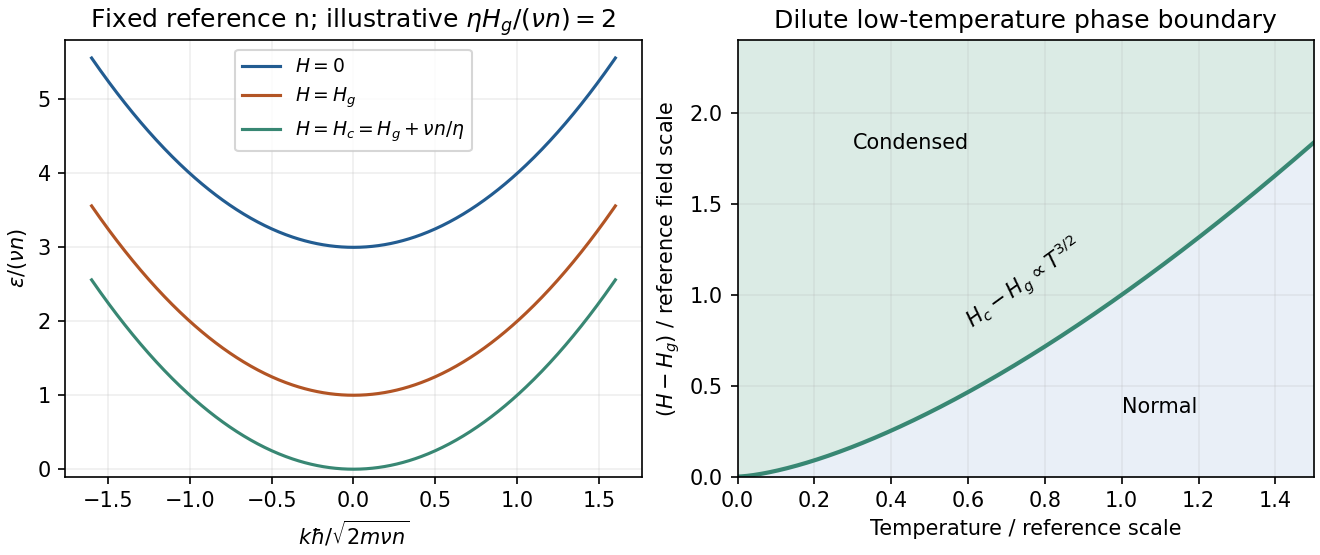
Original shifted-parabola triplon dispersions and low-temperature field–temperature phase diagram; model choices are dimensionless and illustrative
. Details. 
For , simply continuing the gap below zero would give unphysical Bose occupations. For the condensate density in a shifted-parabola triplon model, added condensate density keeps the minimum at zero: . At fixed temperature this giveswith below onset. At zero temperature it becomes within that model.
This prefactor is conditional on continuing the stated single-density mean-field shift into the condensed phase. A microscopic interacting Bose condensate has collective Bogoliubov excitations , with , which are linear at small . The normal-state shift alone does not fix the condensed interaction closure or identify with . The gap closes and the condensate density grows linearly with excess field in the simple mean-field description; the detailed collective dispersion needs that additional interaction model. A dilute-boson treatment of field-induced magnetic ordering makes this normal/condensed distinction explicitly.[ref]
New to topics? Read the docs here!