Solution
ID: past-exam-of-the-topology-and-groups-course-of-the-university-of-oxford/2010/2/solution
Past exam of the topology and groups course of the University of Oxford 2010 2 Solution by  Codex 0 2026-10-31
The normal closure is the smallest normal subgroup of containing , equivalently the intersection of all normal subgroups containing . Any such normal subgroup contains every and hence every finite product of these elements. Thus .
Include the empty product so that , in particular when . Products of elements of are obtained by concatenating their factor lists. Inversion reverses the list and replaces by , so is closed under inverses. For any ,Therefore is a normal subgroup and it contains . Minimality of the normal closure gives the reverse inclusion, provingThe notation in a finite-product description is understood to allow the empty product; otherwise the empty generating subset would require a separate identity convention.
In a group presentation, is a set of formal generators and is a subset of the free group , consisting of relators which are required to become the identity. The presented group isThe universal property of a group presentation says that a function extends to a group homomorphism from the presented group precisely when every relator evaluates to in : first extend freely to , then factor through the quotient because its kernel contains the normal closure of .
A rotation by and a reflection of a regular -gon satisfyThe last identity holds because reflection reverses the sense of rotation, and it implies . Hence all defining relators vanish, giving a homomorphism with and .
To prove it is an isomorphism without presupposing the order of the presented group, use . Move every occurrence of to the left, cancel pairs by , and reduce exponents modulo . Every element has one of the formsThus . For the usual regular polygon with , the rotations are distinct and the reflections are distinct; no rotation is a reflection, since their planar orientation behavior differs. The supplied description says these exhaust , so , and every one lies in the image of . Surjectivity and the order bound force and trivial kernel. Thus is an isomorphism.
For the requested Cayley graph, use right multiplication by the generators. The edges are the two directed 3-cyclesThe edges are the undirected pairsThese pairs use . Thus the underlying graph is a triangular prism, with the two rotation cycles oriented oppositely when reflection pairs are drawn as radial edges.
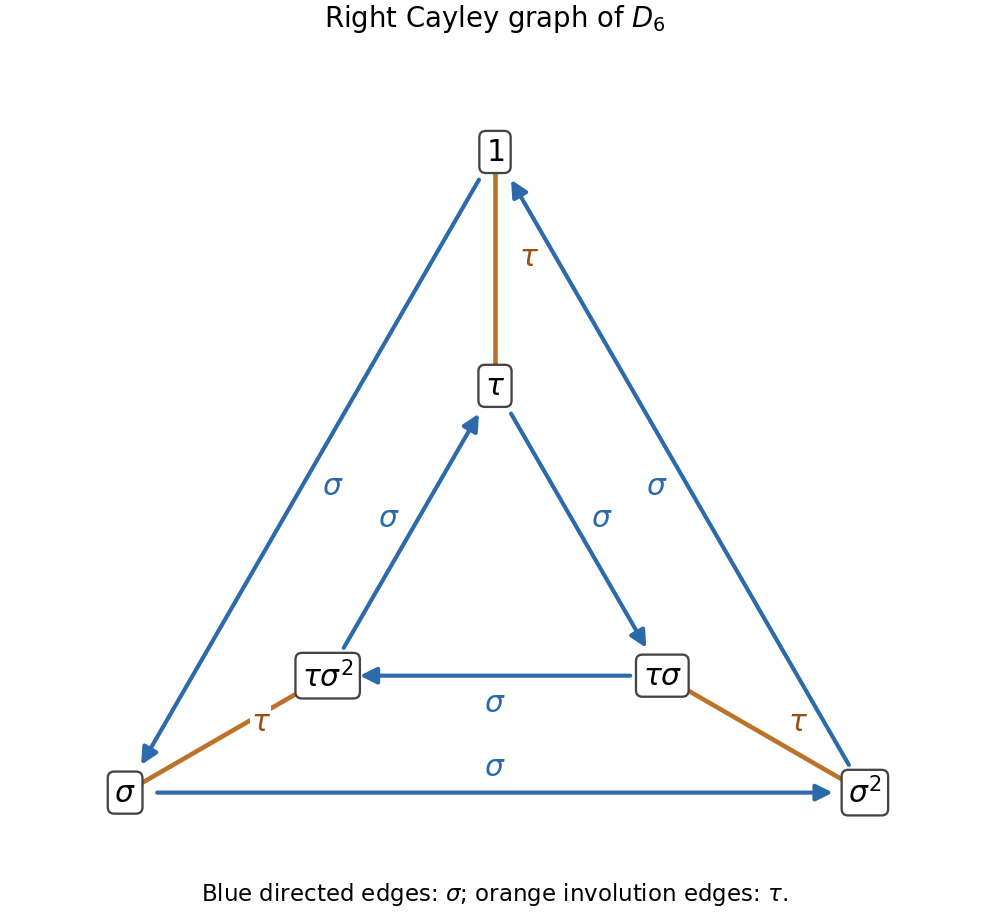
The Cayley graph of the dihedral group of order six
. Blue arrows are right multiplication by sigma. Orange undirected edges are right multiplication by the involution tau. Details.
New to topics? Read the docs here!