The normal closure is the smallest normal subgroup of containing , equivalently the intersection of all normal subgroups containing . Any such normal subgroup contains every and hence every finite product of these elements. Thus .
Include the empty product so that , in particular when . Products of elements of are obtained by concatenating their factor lists. Inversion reverses the list and replaces by , so is closed under inverses. For any ,Therefore is a normal subgroup and it contains . Minimality of the normal closure gives the reverse inclusion, provingThe notation in a finite-product description is understood to allow the empty product; otherwise the empty generating subset would require a separate identity convention.
In a group presentation, is a set of formal generators and is a subset of the free group , consisting of relators which are required to become the identity. The presented group isThe universal property of a group presentation says that a function extends to a group homomorphism from the presented group precisely when every relator evaluates to in : first extend freely to , then factor through the quotient because its kernel contains the normal closure of .
A rotation by and a reflection of a regular -gon satisfyThe last identity holds because reflection reverses the sense of rotation, and it implies . Hence all defining relators vanish, giving a homomorphism with and .
To prove it is an isomorphism without presupposing the order of the presented group, use . Move every occurrence of to the left, cancel pairs by , and reduce exponents modulo . Every element has one of the formsThus . For the usual regular polygon with , the rotations are distinct and the reflections are distinct; no rotation is a reflection, since their planar orientation behavior differs. The supplied description says these exhaust , so , and every one lies in the image of . Surjectivity and the order bound force and trivial kernel. Thus is an isomorphism.
For the requested Cayley graph, use right multiplication by the generators. The edges are the two directed 3-cyclesThe edges are the undirected pairsThese pairs use . Thus the underlying graph is a triangular prism, with the two rotation cycles oriented oppositely when reflection pairs are drawn as radial edges.
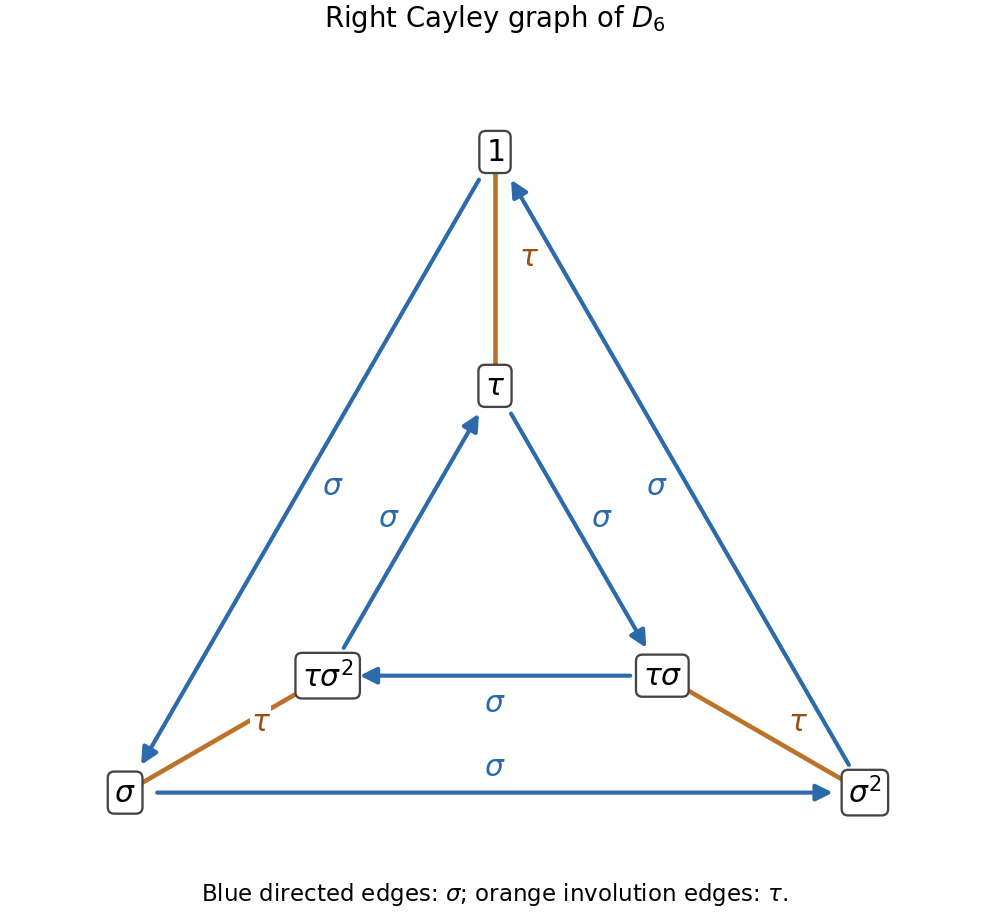
The Cayley graph of the dihedral group of order six
. Blue arrows are right multiplication by sigma. Orange undirected edges are right multiplication by the involution tau. Details.
Articles by others on the same topic
There are currently no matching articles.