A subgroup is a normal subgroup when for every . In other words, conjugation by any group element preserves the subgroup as a set, although it may exchange its individual elements. Equivalently, for every : the left and right cosets of agree. Write .
Every subgroup of an abelian group is a normal subgroup, because conjugation fixes each element. Normality can also hold in a nonabelian group: in , the three even permutations form the alternating group , a normal subgroup as the group kernel of the sign of a permutation. Its two cosets separate the even and odd permutations.
In contrast, is a subgroup of but is not a normal subgroup. With function composition of permutations acting rightmost first, choose . Thenwhich are different cosets. Also , directly contradicting invariance under conjugation. Thus a subgroup alone does not suffice for quotient group multiplication.
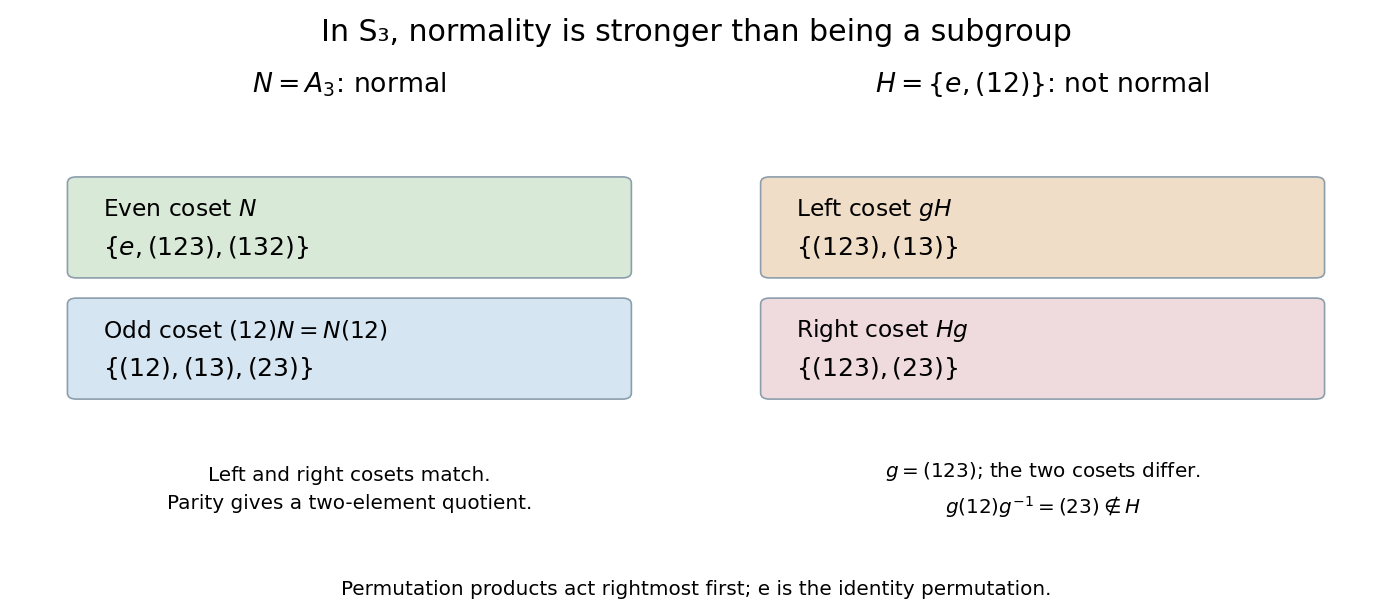
A normal subgroup gives matching left and right cosets, while a nonnormal subgroup can give different ones
. Details. The practical value of normality is coset multiplication is well-defined exactly for normal subgroups. Each coset can act as one element of a quotient group, with results independent of representatives. Conversely every normal subgroup is the group kernel of its quotient map of groups, so normality also identifies which distinctions a group homomorphism can consistently forget.
If is a subgroup and a normal subgroup of a group , their product set is a subgroup. Normality gives and . Together with the identity element this proves the subgroup test. For finite subgroups, : the pairs representing one product differ exactly by multiplying the first factor by an element of and its second factor by its inverse.
The p-residual is the smallest normal subgroup with p-group quotient, equivalently the subgroup generated by all elements of order prime to . It is characteristic and satisfies : an extension of two finite p-groups is a p-group. A finite group has a normal p-complement exactly when its p-residual has order prime to .
A group complement to a normal subgroup is a subgroup with and . Projection identifies with , and conjugation gives . This is a subgroup notion, not the set-theoretic complement of .
If finite normal subgroups of a group have coprime orders, their intersection is trivial by Lagrange's theorem. For and , the commutator belongs to both subgroups: write it as to use normality of , and as to use normality of . Hence it is the identity and . The product subgroup is therefore isomorphic to the direct product of groups .
For a finite group with Sylow -subgroup , a normal -complement is a normal subgroup of order . It consists exactly of the elements of order prime to : every such element has trivial image in the -group quotient, and every element of the complement has prime-to- order. Thus a normal -complement, if it exists, is unique and a characteristic subgroup.
A finite group is p-nilpotent when it has a normal p-complement. This terminology is distinct from having a normal Sylow p-subgroup. A finite group is nilpotent exactly when it is p-nilpotent for every prime dividing its order.
If a prime divides the degree of every nonlinear irreducible character of a finite group, the group has a normal p-complement. Indeed, the p-prime-degree characters are exactly the linear characters. Their squared-degree sum is , whose p-part is ; Isaacs' character-degree criterion for p-nilpotency applies.
The integer divides . The group is p-nilpotent exactly when . To see this, let . Invariant p-prime-degree characters of extend, and each has exactly extensions of p-prime degree. Conjugation by the p-group then gives . Thus the quotient is prime to precisely when is a normal p-complement.
A proper normal subgroup maximal among proper normal subgroups. Its quotient is a nontrivial simple group. Maximality among normal subgroups does not imply maximality among all subgroups.
// Target: algebra.bigb
Above any proper normal subgroup of a finitely generated group, a chain of proper normal subgroups has proper union. Otherwise that union would contain the finite generating set, all of which would already lie in one member of the chain. The Zorn lemma therefore provides a maximal proper normal subgroup containing the given one.
// Target: algebra.bigb
A subnormal series is a finite chain of subgroups in which each is a normal subgroup of the next. A member need not be normal in the whole group. Requiring the factors to be cyclic groups defines a polycyclic group; allowing finite factors as well defines a poly-(cyclic or finite) group.
Any two finite subnormal series have refinements with the same successive factors up to ordering and group isomorphism. For descending chains and , insert between and and insert in the other chain. The Zassenhaus butterfly lemma identifies the factor indexed by in the first refinement with the factor indexed by in the second. If both chains are composition series, their simple factors admit no nontrivial refinement, giving the Jordan–Hölder theorem.
Let and be subgroups of one group. Put and . Then and the first isomorphism theorem identifies bothwith . Indeed maps onto either displayed quotient group, and its kernel in either case is . This gives the matching factors used in the Schreier refinement theorem.
A normal series is a chain whose terms are all normal subgroups of the ambient group. A subnormal series only requires each term normal in the next. Confusing these conditions would incorrectly require every term of a composition series to be normal in the full group.
A chief series is a strict normal series of a group with no proper normal-series refinement. Its factors are minimal normal subgroups of the appropriate quotient groups. A chief factor of a finite soluble group is elementary abelian, whereas a composition factor of a finite soluble group is cyclic of prime order. A chief factor can therefore have order larger than a prime.
A hypothetical finite chief series in has a first nonzero term . The subgroup is normal in and strictly between zero and that term. This contradicts the defining maximality condition for the first chief factor. Finite groups always admit chief series, by choosing a maximal chain of their normal subgroups; this example shows why finiteness matters.
A chief factor of is a quotient with normal in and no -normal subgroup strictly between them. Equivalently, is a minimal normal subgroup of . Such factors are the successive factors of a chief series, and are direct products of isomorphic simple groups when is finite.
A minimal normal subgroup is a nontrivial normal subgroup containing no smaller nontrivial normal subgroup of the ambient group. It need not be a minimal nontrivial subgroup. In a finite soluble group, it is elementary abelian: its derived subgroup must be trivial, a characteristic Sylow subgroup selects one prime, and the characteristic subgroup of elements killed by that prime gives exponent .
A nontrivial minimal normal subgroup of a finite solvable group is abelian: its commutator subgroup is characteristic, and minimality plus solvability excludes . A nontrivial Sylow subgroup of this abelian group is characteristic, so minimality makes a p-group. The characteristic subgroup of pth powers is proper, hence trivial by minimality. Therefore is an elementary abelian group.
Choose a minimal nontrivial normal subgroup of . Its conjugates under the ambient group are minimal normal subgroups of ; distinct ones intersect trivially and commute. Choose a maximal family whose product is direct. Any omitted conjugate either lies in that product or meets it trivially and could be adjoined, so all conjugates lie in it. Their product is ambient-normal and therefore is . A normal subgroup of one factor is then normal in , since the other factors commute with it; minimality makes each factor simple. All factors are isomorphic because they are conjugates of . In the abelian case they are cyclic of one common prime order.
The socle is generated by all minimal nontrivial normal subgroups. Distinct minimal normal subgroups commute and meet trivially, although in the abelian case not every collection of them is an independent direct-product decomposition. It is a direct product of simple groups. In a faithful primitive permutation group each nontrivial normal subgroup is transitive; its minimal normal subgroups are either elementary abelian and regular, or direct powers of a nonabelian simple group. This is the starting point of the O'Nan–Scott theorem.
If is a normal subgroup of a group , conjugation by any element of preserves and fixes . It must therefore fix as well. Thus lies in the center of a group. This fact can turn a small normal subgroup into a commuting factor without assuming the whole group is abelian.
The core of a subgroup isIt is the largest normal subgroup of contained in . If has finite index , the action on gives .
The normal closure of a subset is the smallest normal subgroup containing , equivalently the subgroup generated by all conjugates with and .
Articles by others on the same topic

A **normal subgroup** is a special type of subgroup in the context of group theory, which is a branch of abstract algebra. Let's define it more precisely. Given a group \( G \) and a subgroup \( N \) of \( G \): 1. **Subgroup**: A subgroup \( N \) must itself be a group under the operation defined on \( G \).


Ultimate explanation: math.stackexchange.com/questions/776039/intuition-behind-normal-subgroups/3732426#3732426
Only normal subgroups can be used to form quotient groups: their key definition is that they plus their cosets form a group.
One key intuition is that "a normal subgroup is the kernel" of a group homomorphism, and the normal subgroup plus cosets are isomorphic to the image of the isomorphism, which is what the fundamental theorem on homomorphisms says.
Therefore "there aren't that many group homomorphism", and a normal subgroup it is a concrete and natural way to uniquely represent that homomorphism.
The best way to think about the, is to always think first: what is the homomorphism? And then work out everything else from there.