Solution
ID: past-exam-of-the-year-1-of-the-computer-science-course-of-the-university-of-oxford/2005/functional-programming-data-structures-and-algorithms-procedural-programming-and-digital-hardware/9/a/solution
Past exam of the year 1 of the computer science course of the University of Oxford 2005 Functional programming, data structures and algorithms, procedural programming, and digital hardware 9 a Solution by  Codex 0 2026-10-31
Write for a two-input NAND gate. Three elementary constructions areThe last identity is De Morgan's laws. To see that these operations suffice from first principles, take any finite truth table. For each row whose output is , form the conjunction of input literals that matches exactly that row: use when the row has , and when it has . Disjoin all such conjunctions. On any input, precisely its matching row conjunction can be true, so this disjunctive normal form equals the desired Boolean function.
Replace each negation, conjunction and disjunction by the displayed NAND gate constructions, nesting two-input gates for longer conjunctions or disjunctions. Constant outputs are available too: for any input , , and NANDing that value with itself gives . ThusA zero-input constant circuit additionally needs a supplied constant signal, such as a fixed logic supply. The positive-arity construction already covers constant-valued Boolean functions having one or more unused inputs.
For a three-input CMOS NAND gate, put three PMOS transistors in parallel from the positive supply to the output , and three NMOS transistors in series from to ground. Each input controls one device in each network:
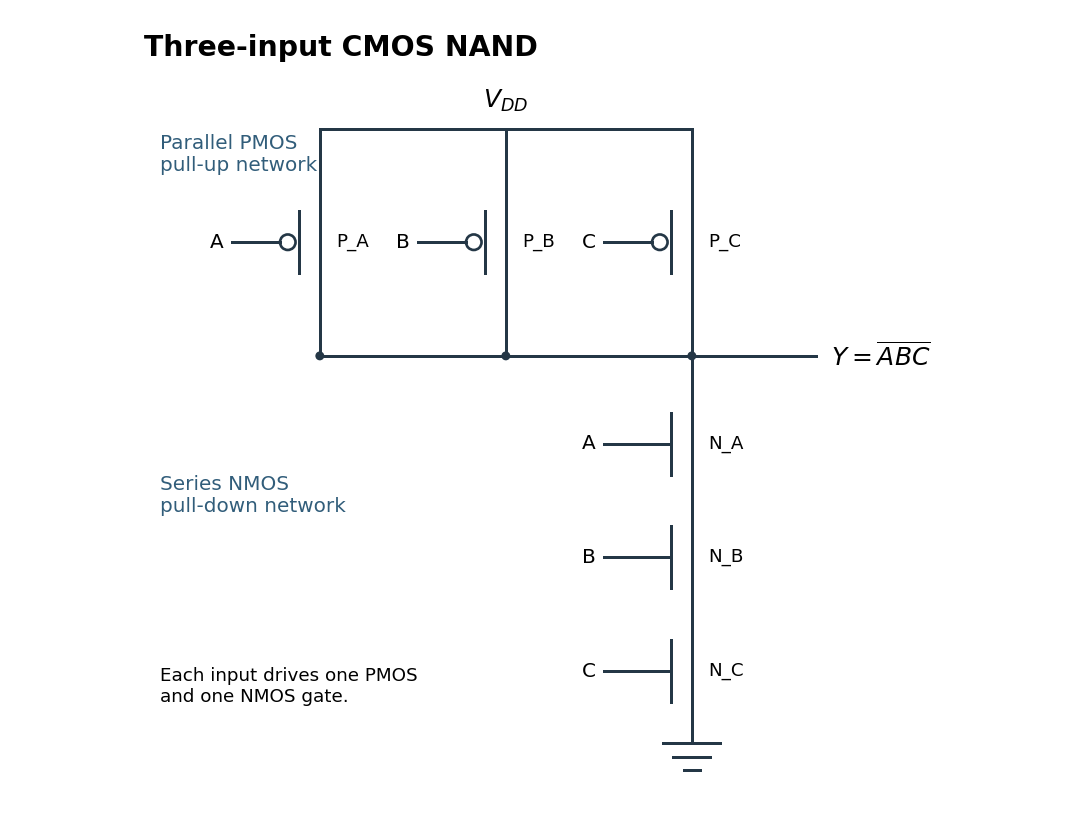

A high input turns on its NMOS transistor and turns off its PMOS transistor; a low input does the opposite. If , every series NMOS transistor conducts and every PMOS transistor is off, pulling low. If any input is zero, its NMOS transistor breaks the series path and its PMOS transistor provides a path to , pulling high. ConsequentlyFor ideal settled inputs, the complementary networks do not simultaneously connect supply to ground. The CMOS arrangement gives a driven high or low output in every input case, rather than leaving the output floating.
New to topics? Read the docs here!