Solution
ID: past-exam-of-the-year-1-of-the-computer-science-course-of-the-university-of-oxford/2014/digital-systems-linear-algebra-introduction-to-formal-proof/3/b/solution
Past exam of the year 1 of the computer science course of the University of Oxford 2014 Digital systems, linear algebra, introduction to formal proof 3 b Solution by  Codex 0 2026-10-31
Let the stored bits be , with most significant. The required Gray code transitions giveConnect directly to the first D flip-flop's data input and feed through one NOT gate to the second input. Drive both enable inputs with and both clock inputs with the same clock. Thus holds both stored bits; takes the next Gray-code counter state at the active clock edge. Reset initializes .
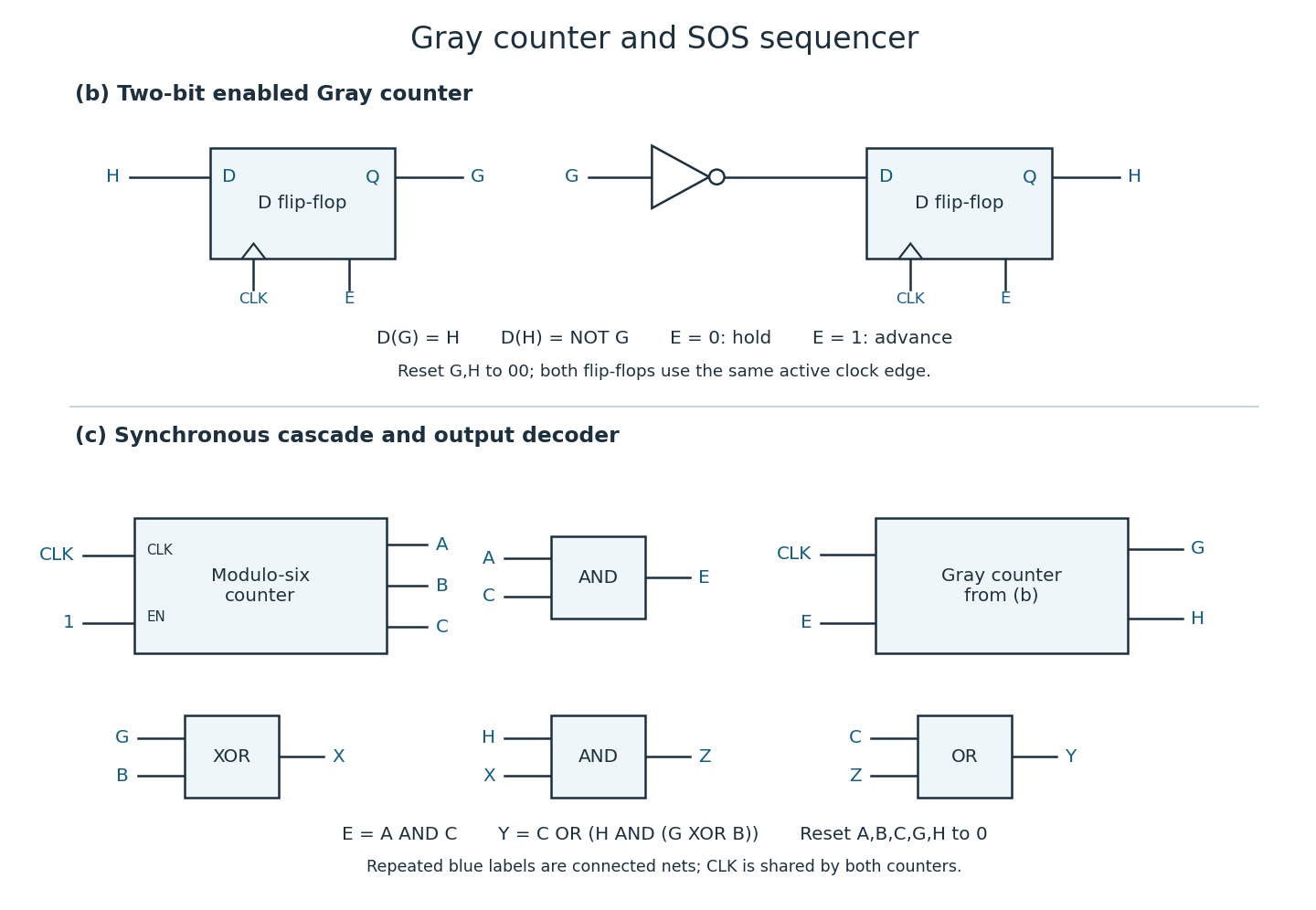

With ordinary uncomplemented outputs, one NOT gate is minimal: wiring alone cannot produce . If a D flip-flop already provides a complementary output, that output supplies the inversion without an external logic gate. This is a Moore machine because its output depends only on stored state; controls transitions.
New to topics? Read the docs here!