A Moore machine is a finite-state machine whose output depends only on the current state. In a clocked implementation, a state entered at a clock edge determines the following period's output. Specifying an initial state is necessary to define startup behavior.
A synchronous sequential circuit can use three states: armed, pulse, and waiting. Only the pulse state has output one. A reset input rearms the circuit, including when it arrives during the pulse cycle; this permits pulses on alternate clock cycles while each pulse still lasts exactly one cycle.
Enter a distinguished Moore machine state whose output is active, and ensure that every outgoing transition leaves that state for an inactive-output state. The output then lasts one clock period. Its outgoing transitions may simultaneously recognize the start of the next event, avoiding an unnecessary idle cycle. The one-period statement refers to the synchronous logical model, with ordinary propagation delay after each clock edge.
For a fixed word , store the length of the longest suffix of the received stream that is also a prefix of . On a new input symbol, append it to the represented prefix and select the longest resulting suffix that is a prefix of . The complete-word state signals recognition. Its outgoing transitions retain proper suffix matches, allowing overlapping occurrences rather than automatically restarting from the empty prefix. This is the finite-state form of the prefix information used by the Knuth-Morris-Pratt algorithm.
For example, recognizing needs suffix-prefix states of lengths zero through four. After a complete match followed by one, the last two symbols are , so the next state retains length two. This permits the second match in without clearing the useful suffix.
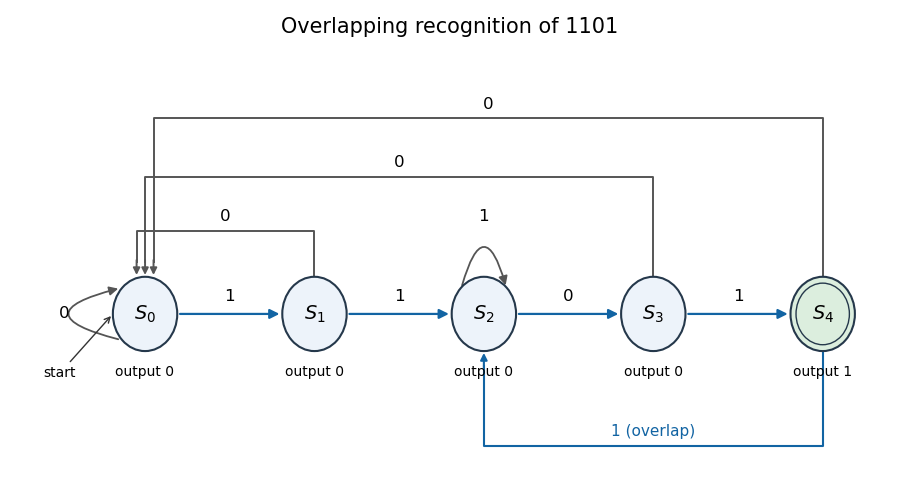
An overlapping prefix-suffix sequence recognizer for
. Details. 
Articles by others on the same topic
There are currently no matching articles.