Solution
ID: past-exam-of-the-year-1-of-the-computer-science-course-of-the-university-of-oxford/2019/discrete-mathematics-continuous-mathematics-and-probability/4/d/solution
Past exam of the year 1 of the computer science course of the University of Oxford 2019 Discrete mathematics, continuous mathematics, and probability 4 d Solution by  Codex 0 2026-10-25
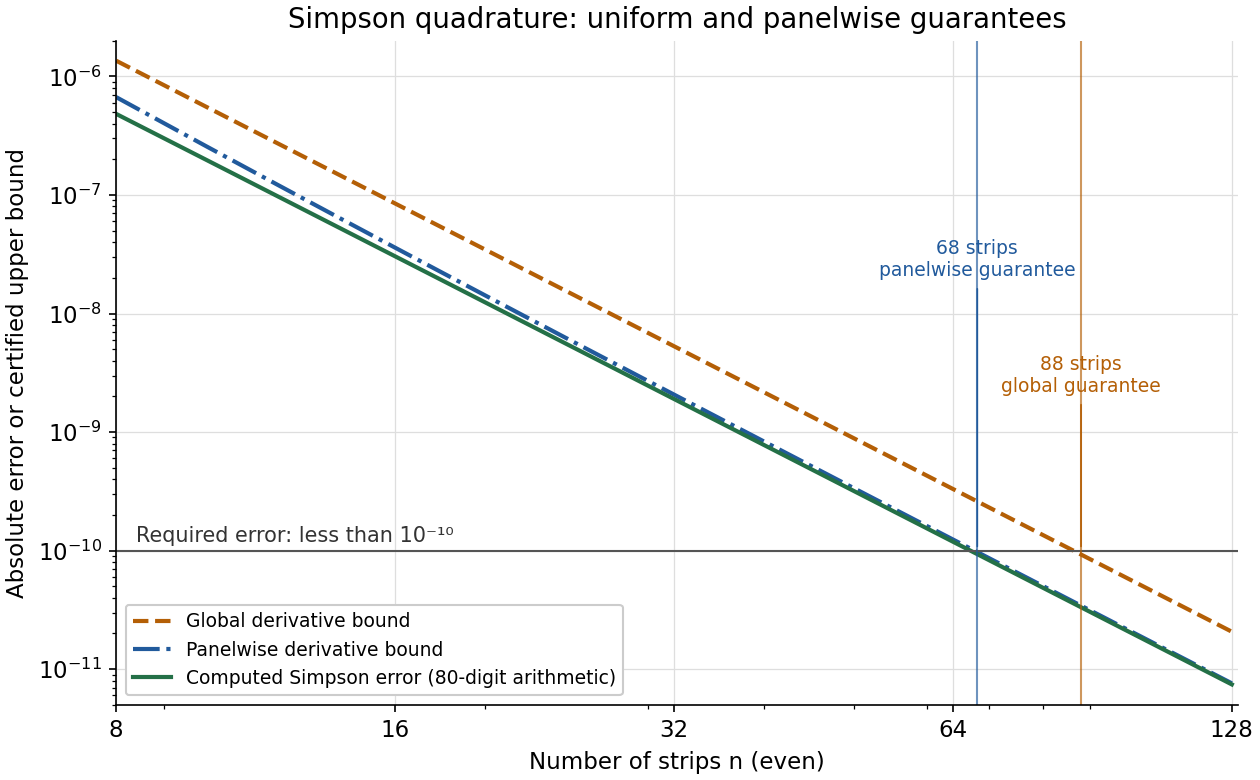
The global bound requiresSince the strip count must be even, the smallest count certified by this bound is .
For the tighter bound, use the bisection method on the continuous extension for . The initial root bracket is valid: , while is below the global bound and hence below . To identify the smallest admissible even count, the monotonicity of can also be justified.
Put andFor , differentiation showsThe numerator is nonnegative because : its difference from starts at zero and has nonnegative derivative , by the arithmetic-geometric mean inequality. Thus , and . Therefore increases with , so is strictly decreasing with . Bisection locates its unique threshold crossing; then check the neighboring even integers, retaining the strict error inequality.
For example, and , so the tighter bound certifies strips. These are evaluations of the bound, not an assumption that it equals the actual quadrature error.

New to topics? Read the docs here!