Solution
ID: past-exam-of-the-year-1-of-the-computer-science-course-of-the-university-of-oxford/2023/functional-programming-design-and-analysis-of-algorithms/5/c/solution
Past exam of the year 1 of the computer science course of the University of Oxford 2023 Functional programming, design and analysis of algorithms 5 c Solution by  Codex 0 2026-10-25
First run breadth-first search, ignoring weights, to obtain the minimum number of edges from the source to each reachable vertex. Then compute weighted distances only along edges that advance one breadth-first layer:Unreachable vertices keep distance . For an undirected graph, scan both orientations of each edge.
d[source] = 0; all other d[v] = infinity
for u in nondecreasing BFS-layer order:
    for each outgoing edge (u,v):
        if h[v] == h[u]+1:
            if d[u]+w(u,v) < d[v]:
                d[v] = d[u]+w(u,v)
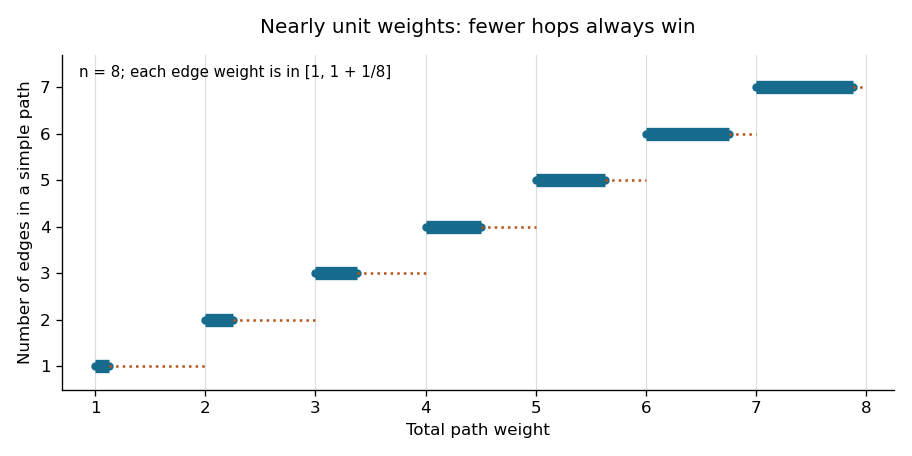
predecessor[v] = uTo justify discarding other routes, a shortest path can be taken simple because every weight is positive. A simple path of edges has weight inEvery path with at least edges weighs at least . Consequently every minimum-weight path must also have the minimum possible number of edges: this is minimum-hop dominance for nearly unit weights.
A minimum-hop path to uses exactly edges. Every prefix of such a path must itself have minimum hop count, since replacing a longer prefix by a shorter one would shorten the whole route. Hence it advances from layer to layer at every step. The retained edges form a Directed acyclic graph, ordered by . The displayed dynamic programming recurrence therefore finds the cheapest of all minimum-hop paths, which by the preceding bound is a true shortest path.

With an adjacency list, both the breadth-first search and the layer-ordered relaxations take time and total storage, where . The queue order from breadth-first search already supplies the layer order; no sorting or priority queue is needed. This improves the usual binary-heap Dijkstra bound and is linear in the input size.
New to topics? Read the docs here!