Period and small-angle limit of a conical pendulum
ID: period-and-small-angle-limit-of-a-conical-pendulum

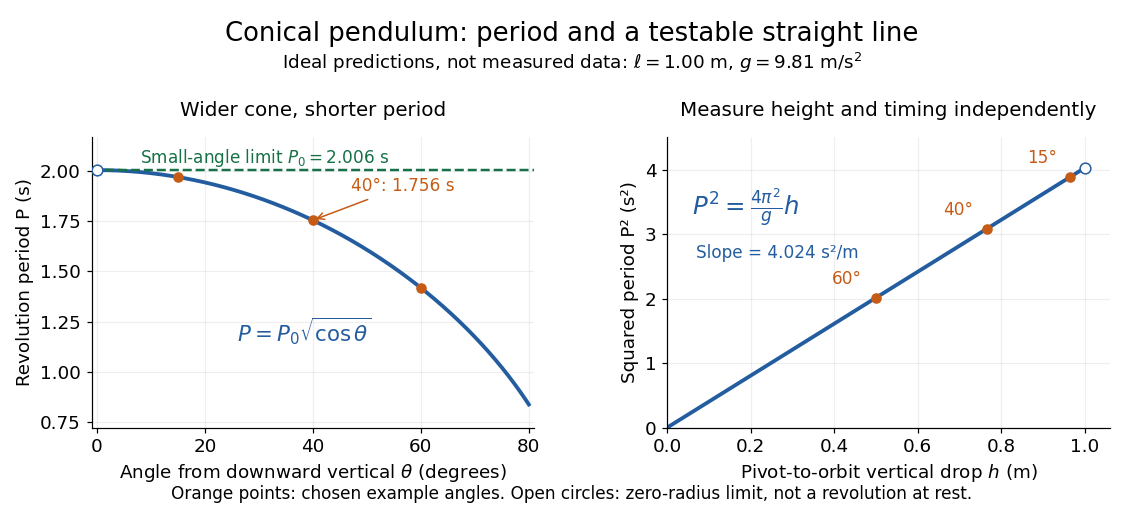
Ideal conical pendulum period decreases with cone angle and its square is proportional to the vertical drop
. Details. 
For fixed and , the exact conical pendulum oscillation period satisfies . In the small-angle approximation, with in radians,Thus the limiting revolution period equals the small-amplitude oscillation period of a planar simple pendulum. This equality has a geometric explanation: to first order, and are perpendicular simple harmonic motions of equal amplitude, a quarter period apart, with . At finite angle, however, the conical pendulum's oscillation period decreases with , whereas a planar simple pendulum's oscillation period increases with its angular amplitude.
The endpoint itself is a stationary bob with and no observable revolution; is a limit of nonzero circular motions, not a measured revolution period at rest. For fixed , nonzero conical pendulum motion also requires , because . At the other endpoint, gives , , and unbounded tension and speed. These mathematical limits explain why the ideal string cannot sustain a horizontal orbit at finite tension; a real experiment ceases to satisfy the ideal assumptions before that limit.
New to topics? Read the docs here!