Perpetual American call option
ID: perpetual-american-call-option

An American call option with no expiry. For geometric Brownian motion with drift under a risk-neutral measure, positive dividend yield , , and volatility , let solve . Its value is below and above. The power solves the stationary Black-Scholes equation with continuous stock dividends; value matching and smooth fit determine the threshold.
The candidate dominates the positive part because its continuation branch is convex and tangent to at . In the exercise region its discounted-generator residual is : the root equation gives . Applying Itô's formula to the discounted value, localized if necessary, gives an upper bound on every exercise policy. Stopping at the first hit of attains it; on paths not yet hitting, the bounded discounted continuation value tends to zero. This supplies the optimal stopping verification. As , , the threshold diverges and the value tends to .
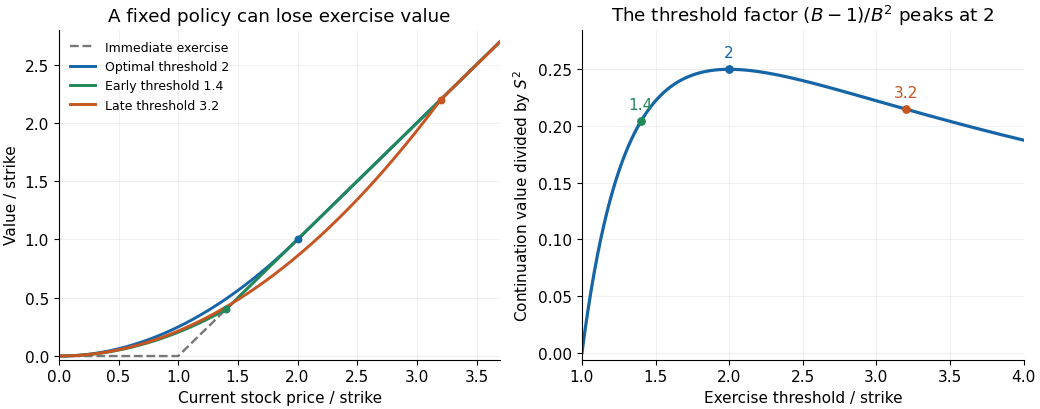
Early and late exercise thresholds both lose value relative to the optimal perpetual-call threshold
. An ideal Black-Scholes example with strike one, interest rate 0.05, volatility 0.2 and dividend yield 0.045 gives exponent two and optimal threshold two. A late fixed-policy value may lie below the immediate exercise payoff; it cannot be the price of an unrestricted American option. Details.
New to topics? Read the docs here!