
Consider a deliberately simplified model: fatal defects form a spatially uniform Poisson point process with intensity per unit area. A semiconductor die of area works exactly when it contains no fatal defect. Its defect count has a Poisson distribution with expected value , hence its probability of working, called its yield, isThe product is dimensionless. The formula concerns fatal defects, not every visible imperfection. Spatial uniformity, independent defect counts in disjoint areas, and failure from even one fatal defect are model assumptions. Clustering, shared processing failures, repairable regions and defects that affect only some functions can invalidate them. This is a chosen probability model, not historical yield data.
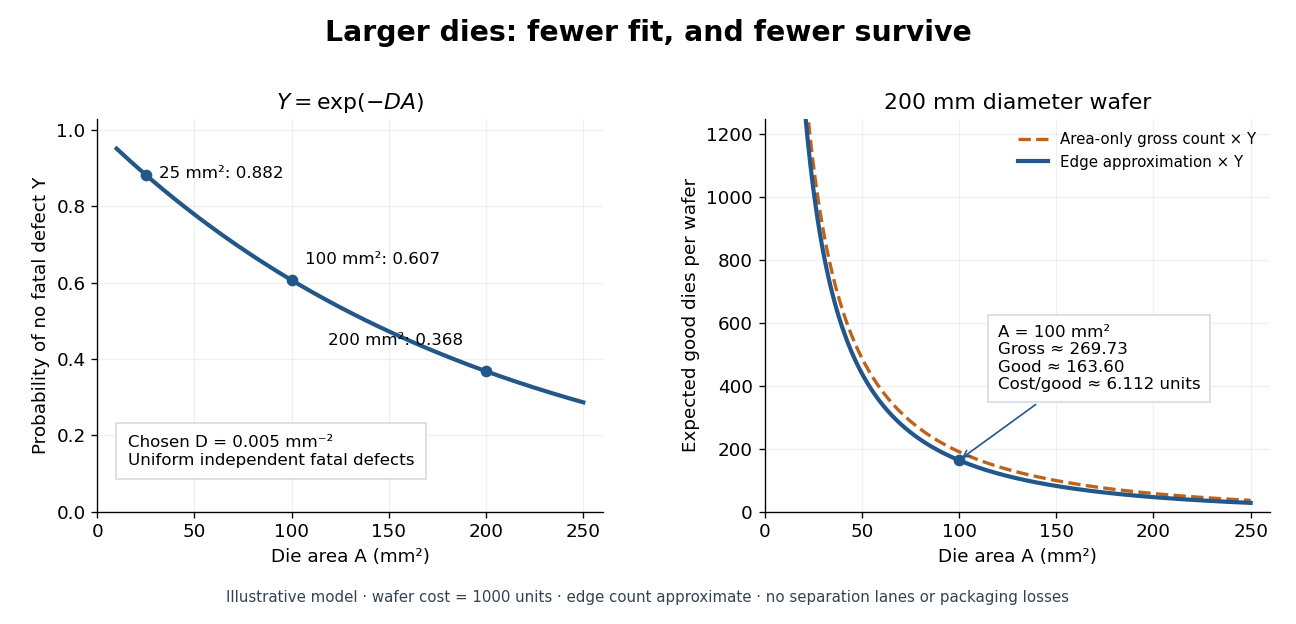
Choose . For semiconductor die areas , and , the model gives , and . Doubling the area squares the yield: . This follows either from the exponential function or by splitting the larger area into two disjoint parts and using independence. More functions on one semiconductor die can save assembly while making the no-defect requirement harder to satisfy.

New to topics? Read the docs here!