Primitive cubic Bragg peak positions
ID: primitive-cubic-bragg-peak-positions

Consider a chosen primitive cubic lattice with and one identical point scatterer per primitive unit cell. Retain the incident wavelength . This is an ideal point model. Its reciprocal lattice vectors are for integer triples other than . Write . The associated interplanar spacing and first-order Bragg angle satisfyThe reflection labels use the Miller index convention, keeping unreduced triples to encode diffraction order. With that convention, set in Bragg's law for each label. The reflection is equivalently the second diffraction order of : does not imply extra scatterers halfway between the occupied planes. Counting both descriptions as distinct reflections would count the same direction twice.
For , , and , respectively, and the calculated interplanar spacings are , , and . Their calculated deflections are , , and . Equal steps in give equal steps in , not equal steps in . This regularity makes an angular pattern a test of a proposed crystal structure.
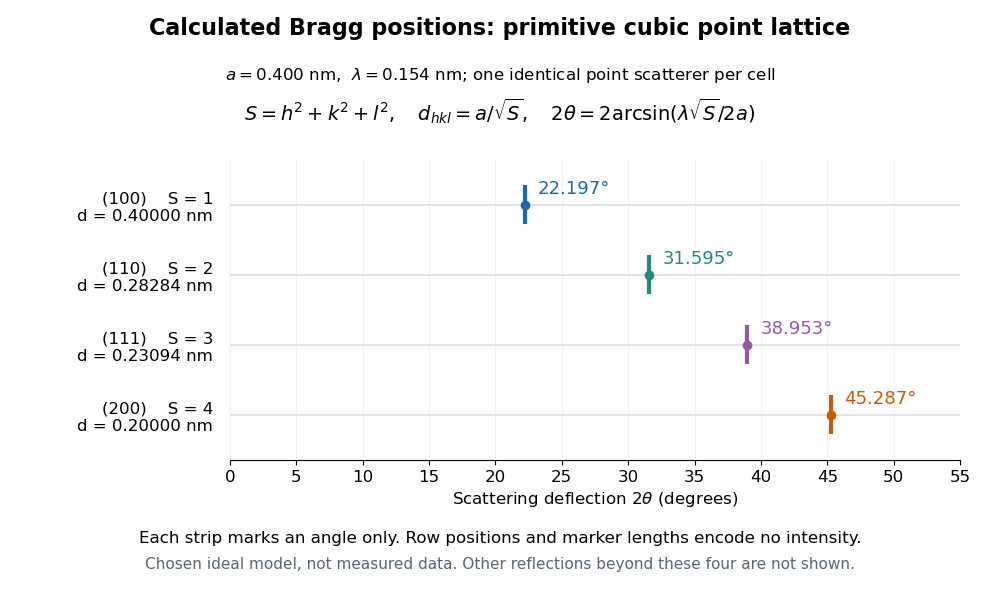

A real crystal structure has a Bravais lattice together with an atomic basis of a crystal. The crystal lattice structure factor selects the periodic directions; the crystal basis structure factor combines the scattering amplitudes of atoms within a unit cell and can cancel a reflection. Consequently Bragg's law alone predicts neither allowed reflections nor their wave intensities. [ref]
Structure factor. Online Dictionary of Crystallography by International Union of Crystallography; Definition, sum over atoms in the unit cell; Derivation, addition of companion atoms
Systematic absences further restrict observed families; for example, face-centered cubic lattice centering permits only indices all even or all odd in conventional cubic indexing. The four strips above apply to the stated primitive cubic lattice, not to sodium chloride or a face-centered cubic lattice. [ref]Reflection conditions. Online Dictionary of Crystallography by International Union of Crystallography; Definition and Table 1: primitive versus all-face-centered integral reflection conditions
New to topics? Read the docs here!