
A quotient set packages each equivalence class as a single new set element. It remembers which class an original set element belongs to and forgets which member of that class it was. For an equivalence relation on a set ,Each set element of the quotient set is itself a nonempty subset of . The canonical projection of a quotient set sends an original set element to this entire equivalence class. [ref]
https://www.math.umd.edu/~pbrosnan/notes/ugalg/sect0018.html. Patrick Brosnan, Undergraduate Algebra, §2.10, Definitions 2.78 and 2.80
For integer congruence modulo three restricted to , the quotient set isIt has cardinality three. The set is a choice of equivalence class representatives, not literally this quotient set: is an integer, while is a set. The function sending each chosen equivalence class representative to its equivalence class is a bijection between these two different sets.
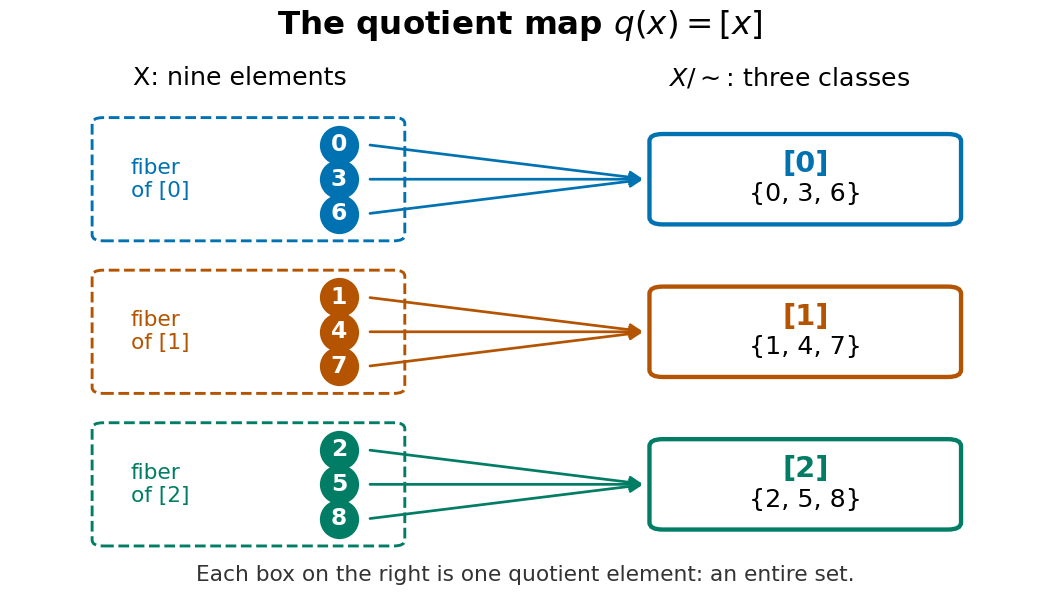
The quotient projection sends nine elements to three classes, with each class appearing as one fiber
. Details. 
A quotient set alone specifies no arithmetic. To obtain the familiar modular arithmetic example with addition, use integer congruence on the whole set of integers. Its quotient set is , where is an infinite residue class. Define addition byThe answer must be independent of the equivalence class representatives. If and , then , so both sums have the same residue class. This is what it means for the group operation to be well-defined. With this addition, the quotient set is a cyclic group, with identity and inverse for . [ref]
https://math-cs.gordon.edu/ntic/ntic2017/section-cong-props.html. Karl-Dieter Crisman, Number Theory: In Context and Interactive, §4.3, Proposition 4.3.2: congruence arithmetic is well-defined
For example, . Choosing and as different representatives of an equivalence class for gives the same sum; choosing and gives again. These calculations use residue classes of all integers. Raw addition on the finite does not stay in : . The formula for addition on therefore cannot be applied as a raw inherited operation on that finite example.
New to topics? Read the docs here!